
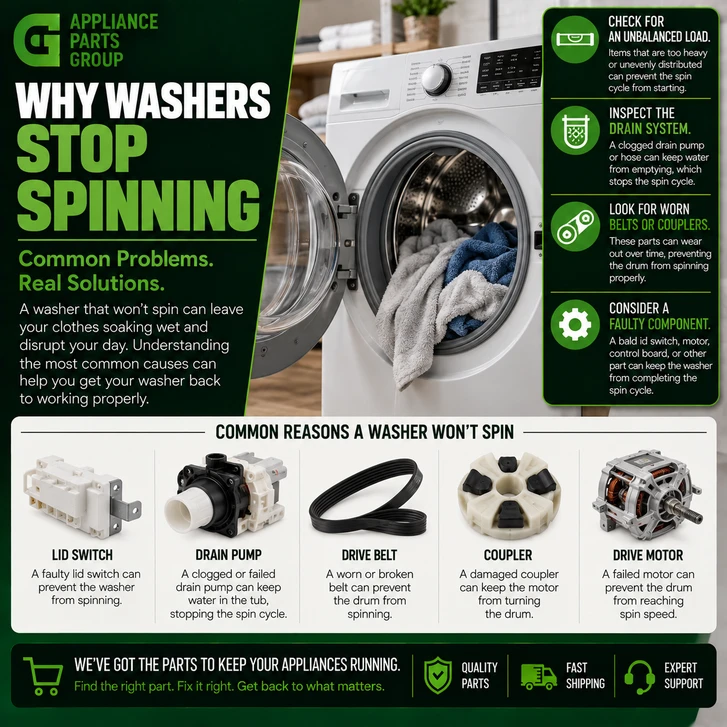
A washing machine that fills and washes normally but suddenly refuses to spin can leave you with a tub full of heavy, soaking-wet clothes. Sometimes the cause is surprisingly simple, such as an unbalanced load or a drainage problem. In other cases, a failed door lock, drive belt, motor component, or control may prevent the washer from reaching its final spin speed.
Because modern washing machines monitor several conditions before allowing a high-speed spin, a washer that will not spin does not necessarily have a problem with the part that physically turns the basket. Understanding what happens before and during the spin cycle can help narrow down the possible causes.
Key Takeaways
- A washer may refuse to spin if it cannot drain the water from the tub first.
- Unbalanced or overloaded wash loads can prevent high-speed spinning even when nothing is mechanically wrong.
- Door locks and lid switches are important safety components that must operate correctly before many washers will spin.
- Drive belts, motor couplings, clutches, shift actuators, motors, and control boards can all contribute to spin problems depending on the washer design.
- The correct replacement part should always be identified using the washer's complete model number because components can vary significantly between otherwise similar machines.
Why Does a Washing Machine Need the Spin Cycle?
The spin cycle removes water from clothing after washing and rinsing. The washer rotates the basket at high speed, using centrifugal force to move water out of the fabric. That water passes through the basket and is pumped out through the washer's drain system.
Without a proper spin cycle, clothes can remain saturated with water. They may take considerably longer to dry, and placing excessively wet clothing into a dryer can increase drying time and energy use.
A washer therefore needs several systems to work together before it can successfully complete a high-speed spin. Depending on the design, these can include the drain pump, lid switch or door lock, motor, drive system, suspension components, speed sensors, and electronic controls.
1. The Washer Has an Unbalanced Load
One of the first things to check is also one of the easiest to correct: the laundry itself.
When heavy items collect on one side of the basket, the washer can become unbalanced. Modern washers often detect excessive movement and reduce the spin speed, stop spinning, or repeatedly attempt to redistribute the load.
This is especially common when washing bulky items such as:
- Blankets
- Comforters
- Bath mats
- Heavy towels
- Jeans
- Large bedding items
Pause the washer and redistribute the clothing evenly around the basket. If the washer is overloaded, remove some items and try the spin cycle again.
2. The Washer Is Not Draining Properly
A washer that will not spin may actually have a drainage problem rather than a spin problem.
Many washing machines are designed to prevent or limit high-speed spinning when a significant amount of water remains in the tub. If the washer cannot drain, the control may never allow the machine to proceed normally into the final spin.
Possible drainage problems include:
- A clogged drain pump filter
- A blocked drain pump
- A damaged drain pump
- A kinked drain hose
- A clogged drain hose
- An obstruction between the tub and pump
If you can still see water inside the washer when it should be spinning, investigate the drainage system before assuming that the washer's drive system has failed.
3. The Lid Switch May Have Failed
Top-load washers commonly use a lid switch or lid lock to confirm that the lid is safely closed. Because a rapidly spinning washer basket can present a safety hazard, the washer may not enter the spin cycle unless it receives the proper signal from this component.
A failed lid switch can sometimes produce a washer that fills and agitates but will not spin. Other designs may stop earlier in the cycle or display an error code.
Look for obvious damage around the lid switch, lid strike, or locking mechanism. A broken plastic strike can sometimes prevent an otherwise functional switch from being activated correctly.
4. A Front-Load Washer's Door Lock May Be Defective
Front-load washers generally use an electrically operated door-lock assembly. Before high-speed spinning begins, the control must confirm that the door is securely locked.
A malfunctioning door-lock assembly can cause several symptoms, including:
- The washer will not start.
- The cycle stops before spinning.
- The door repeatedly attempts to lock.
- An error code appears.
- The washer drains but does not enter high-speed spin.
Door-lock assemblies may contain multiple switches and electrical components, so a lock that appears mechanically functional can still have an electrical failure.
5. The Drive Belt Is Worn, Loose, or Broken
Many washing machines use a drive belt to transfer power from the motor to the washer's drive system. A broken belt can prevent the basket from spinning entirely.
A stretched or slipping belt can produce less obvious symptoms. The washer may rotate during slower portions of the cycle but struggle when attempting to reach high spin speeds, particularly with a heavy load.
Depending on the washer design, signs of a belt problem can include:
- A basket that does not turn during spin
- Squealing or slipping noises
- Black belt residue
- A visibly cracked or damaged belt
- A burning-rubber odor
Not every washer uses a traditional belt-drive system, so always verify the design before ordering replacement parts.
6. A Motor Coupling or Drive Component Has Failed
Some washer designs use a motor coupling rather than a conventional belt to connect the motor to the transmission or drive system. The coupling is designed to transfer motor power while also providing some protection to other components.
If the coupling breaks, the motor may run without properly turning the basket or agitator.
Other washers use different drive arrangements, so components such as pulleys, hubs, splutches, or other drive parts may perform a similar role.
7. The Washer Clutch Is Worn
Certain top-load washer designs use a clutch to help the basket reach the proper spin speed. As the clutch wears, it may begin slipping under load.
A washer with a worn clutch might still spin when empty but struggle when filled with wet clothing. The basket may turn slowly, take too long to accelerate, or fail to reach full speed.
Because clutch designs vary considerably between washer platforms, diagnosis should be based on the specific model and its service information.
8. The Shift Actuator or Mode Shifter Is Not Working
Some washers use an actuator or mode-shifting mechanism to change the drive system between agitation and spin.
If the actuator cannot move the mechanism into the proper position, the washer may wash normally but fail when it reaches the spin portion of the cycle.
Depending on the model, a failed actuator can also produce error codes, unusual clicking sounds, or problems switching between wash and spin modes.
9. The Suspension System Is Worn
The washer's suspension system helps control basket movement. Depending on the design, the machine may use suspension rods, springs, dampers, or shock absorbers.
When these components wear out, the basket can move excessively during high-speed spinning. Modern washers may detect that movement and repeatedly slow or stop the spin cycle.
Signs of suspension problems can include:
- Excessive shaking
- Repeated unbalanced-load warnings
- The washer banging against the cabinet
- The basket appearing unusually loose
- The machine repeatedly attempting to rebalance the load
10. The Motor or Motor Control System Has a Problem
The washer motor provides the mechanical power needed to turn the basket. Depending on the washer, motor operation may also rely on a separate motor control board, inverter, speed sensor, or other electronic components.
A motor-related problem may cause the basket to twitch, rotate briefly, operate inconsistently, or fail to turn at all.
Because modern washer motor systems can be electronically controlled, diagnosis may require checking stored error codes and performing electrical tests rather than simply inspecting the motor itself.
11. The Main Control Board May Be Responsible
The main electronic control coordinates the different stages of the wash cycle. It receives information from sensors and switches and then controls components such as the drain pump, motor, valves, and door-lock system.
A control-board problem can potentially prevent spinning, but the control should generally not be the first component replaced simply because the washer will not spin.
Problems with drainage, door locking, load balance, wiring, sensors, or the drive system can create similar symptoms. These possibilities should usually be investigated before replacing an electronic control.
Step-by-Step Troubleshooting: What to Check When Your Washer Won't Spin
- Check the wash load. Make sure the washer is not overloaded and redistribute any clothing that has collected on one side.
- Try a drain-and-spin cycle. This can help determine whether the problem occurs specifically during the spin portion of the cycle.
- Check for standing water. Water remaining in the tub can indicate a drainage problem.
- Inspect the drain hose. Make sure it is not kinked, crushed, or visibly obstructed.
- Check the pump filter if applicable. Some front-load washers have an accessible drain pump filter that can become clogged with debris.
- Inspect the lid or door mechanism. Look for damage to the lid strike, door strike, switch, latch, or lock assembly.
- Listen during the spin cycle. A running motor with a stationary basket may point toward a drive-system problem.
- Look for excessive basket movement. Severe bouncing can indicate worn suspension components or an unbalanced machine.
- Check for error codes. Many modern washers store diagnostic codes that can help identify the system causing the problem.
- Use the model number before ordering parts. Verify the correct OEM replacement component for your exact washer.
Safety note: Disconnect electrical power before accessing internal washer components. Water supply may also need to be shut off depending on the repair. If electrical testing, cabinet disassembly, or handling heavy components is beyond your comfort level, consider using a qualified appliance service professional.
Common Parts That May Need Replacement
The exact parts involved depend heavily on the washer's design, but several components are commonly associated with spin-cycle problems.
Drain Pump
The drain pump removes water from the washer. A failed or obstructed pump can leave water in the tub and prevent the washer from proceeding normally into high-speed spin.
Lid Switch or Lid Lock
Top-load washers use these components to verify that the lid is safely closed or locked before spinning.
Door Lock Assembly
Front-load washers generally require confirmation from the door-lock system before high-speed spinning is permitted.
Drive Belt
The belt transfers motor power on many washer designs. A broken, stretched, or slipping belt can interfere with basket movement.
Drive Hub or Related Drive Components
Depending on the washer platform, a hub, pulley, splutch, coupling, clutch, or similar component may connect portions of the drive system.
Shift Actuator
On applicable models, the actuator changes the washer between operating modes and can prevent proper spinning if it fails.
Suspension Rods, Shocks, or Springs
These components stabilize the tub and basket. Excessive movement can cause the washer to reduce or cancel high-speed spinning.
Motor or Motor Control
A failed motor, inverter, motor control board, or associated sensor can prevent the washer from reaching the commanded spin speed.
Main Control Board
The electronic control coordinates washer operation and may require replacement when testing confirms that it is not properly controlling the spin cycle.
When replacing washer components, use the complete appliance model number to identify the correct OEM part. Even washers that look nearly identical can use different components depending on the model, production revision, or serial range.
Preventative Maintenance Tips
Not every washer spin problem can be prevented, but a few habits can reduce unnecessary strain on the machine.
- Avoid routinely overloading the washer. Oversized loads place additional stress on the drive and suspension systems.
- Balance bulky loads. Avoid washing a single heavy item when the manufacturer's instructions recommend balancing it with other items.
- Check pockets before washing. Coins and other small objects can enter the drain system and potentially obstruct the pump.
- Clean the pump filter when applicable. Follow the manufacturer's recommended maintenance procedure for washers equipped with an accessible filter.
- Keep the washer level. An improperly leveled machine can experience excessive movement during high-speed spinning.
- Pay attention to new noises. Grinding, squealing, knocking, or repeated clicking can provide an early indication that something has changed mechanically.
- Address excessive vibration. Repeated severe shaking can place additional stress on suspension and drive components.
Frequently Asked Questions
Why does my washer wash normally but not spin?
A washer that washes but does not spin may have a problem with its lid switch, door lock, drain system, drive belt, clutch, actuator, motor system, or another component involved specifically in the spin portion of the cycle.
Can a clogged drain cause a washer not to spin?
Yes. Many washers will not enter high-speed spin if they cannot drain the water from the tub properly.
Why are my clothes still soaking wet after the washer finishes?
The washer may not have reached its full spin speed. Possible causes include an unbalanced load, drainage problem, slipping drive component, worn suspension system, or another spin-related failure.
Can an overloaded washer stop spinning?
Yes. An overloaded or severely unbalanced washer may reduce its spin speed or stop the spin cycle to limit excessive vibration and movement.
Will a washer spin with a bad lid switch?
Many top-load washers will not spin if the control cannot confirm that the lid is properly closed or locked. Exact operation depends on the washer design.
Can a bad drain pump cause spin problems?
Yes. If a defective drain pump leaves water in the tub, the washer may not proceed into its normal high-speed spin.
How do I know if my washer drive belt is bad?
A damaged belt may be broken, cracked, stretched, or slipping. Depending on the washer, you may hear the motor operating even though the basket does not rotate correctly.
Why does my washer start spinning and then stop?
The washer may be detecting an unbalanced load, excessive vibration, a motor-speed problem, or another condition that causes the control to interrupt high-speed spinning.
Why does my washer keep trying to rebalance the load?
The clothing may simply be distributed unevenly, but repeated balancing problems can also be associated with worn suspension components or other mechanical issues.
Should I replace the control board if my washer won't spin?
Not without additional diagnosis. Several mechanical, drainage, safety-switch, wiring, and sensor problems can produce similar symptoms. The control board is only one possible cause.
How do I find the correct replacement part for my washer?
Locate the complete model number on the washer's model and serial tag and use that number when identifying replacement parts. Part compatibility should not be determined by appearance alone.
Is a washer that won't spin worth repairing?
That depends on the cause, the age and condition of the washer, the cost of the required parts, and whether professional labor is needed. Some spin problems involve relatively straightforward components, while others require more extensive repairs.
Entities and Terms
- Washing machine
- Spin cycle
- Drain pump
- Drain hose
- Pump filter
- Lid switch
- Lid lock
- Door lock assembly
- Drive belt
- Drive hub
- Motor coupling
- Clutch
- Shift actuator
- Suspension rods
- Shock absorbers
- Washer motor
- Motor control board
- Main control board
- OEM washer parts
Finding the Right Washer Parts
If troubleshooting points to a failed component, identifying the correct replacement part starts with your washer's complete model number. Appliance Parts Group carries OEM appliance parts for many major washer brands and models.
Searching by model number can help you identify the correct drain pump, door lock, lid switch, belt, suspension component, control, or other replacement part designed for your specific machine.
This article was written by an AI program as part of a beta test by Appliance Parts Group to explore how artificial intelligence can help inform and educate our customers.
Our goal is to use AI tools to provide clear, reliable information so you can make confident, well-informed purchasing decisions.