
Key Takeaways
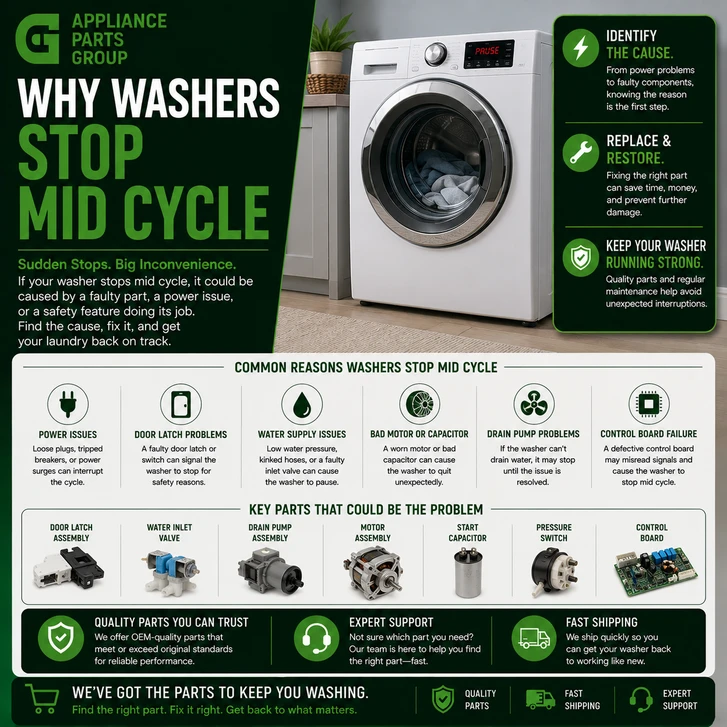
- A washer that stops mid cycle may be experiencing a drainage problem, door or lid lock issue, unbalanced load, water supply problem, or electrical fault.
- Where the washer stops—during filling, washing, draining, or spinning—can provide an important clue about the cause.
- Simple problems such as an overloaded tub, kinked drain hose, closed water valve, or temporary control error can sometimes be corrected without replacing a part.
- Drain pumps, door locks, lid switches, water inlet valves, control boards, and motor-related components are among the parts that may cause a washer to stop before completing a cycle.
- Always identify the washer's complete model number before ordering an OEM replacement part because components can vary between similar-looking models.
Introduction
You start a load of laundry, hear the washer filling and agitating normally, and walk away expecting to return to clean clothes. Instead, you discover the washing machine sitting silent with the cycle unfinished. There may still be water in the tub, the door may remain locked, or the control panel may display an error code.
A washer stopping mid cycle can be frustrating, but it does not automatically mean the appliance has suffered a major failure. Modern washing machines depend on several sensors, switches, pumps, valves, motors, and electronic controls to move through each stage of a wash program. If the control system does not receive the expected signal from one of these components, it may pause or stop the cycle.
The first step is determining exactly when the washer stops. A machine that stops immediately after filling may have a different problem from one that washes normally but stops with a tub full of water. Similarly, a washer that reaches the spin cycle and suddenly stops may be responding to an unbalanced load or a problem with its door lock, motor, or suspension system.
This guide covers some of the most common reasons washers stop mid cycle, what homeowners can safely check, and which OEM replacement parts may be involved when a component has failed.
Why Does a Washing Machine Stop Before the Cycle Is Finished?
A washer's control system progresses through a sequence of operations. Depending on the selected program, the appliance may lock the door, fill with water, tumble or agitate, drain, rinse, and spin. Sensors and switches continually report operating conditions back to the washer's electronic controls.
If the machine cannot complete one stage successfully, it may not proceed to the next. For example, a washer that cannot drain may be prevented from entering a high-speed spin. A front-load washer that cannot confirm that its door is securely locked may also stop for safety reasons.
This means the point at which the cycle stops is often one of the best troubleshooting clues.
1. The Washer Has an Unbalanced or Overloaded Load
One of the simplest explanations is an improperly distributed load. Towels, blankets, bedding, and other heavy items can collect on one side of the basket during the spin cycle.
Many modern washers monitor basket movement and may slow, pause, or attempt to redistribute an unbalanced load. If the machine cannot correct the imbalance, it may stop rather than continue into a high-speed spin.
Overloading creates a similar problem. Stuffing too many clothes into the washer can restrict movement and place additional strain on the drive and suspension systems.
If the washer stops near the spin portion of the cycle, remove some items and redistribute the remaining laundry evenly. Then attempt the appropriate drain-and-spin or rinse-and-spin program.
2. The Washer Cannot Drain
A drainage problem is one of the most important possibilities when a washer stops with water still inside the tub.
Before the appliance can move into certain portions of the cycle—especially high-speed spinning—it generally needs to remove the wash or rinse water. If the control detects that the water level is not decreasing as expected, the washer may stop, display an error, or continue attempting to drain.
Possible causes include:
- A kinked or crushed drain hose
- A clogged pump filter or coin trap on models equipped with one
- Debris inside the drain pump
- A blocked drain hose
- A damaged drain pump impeller
- A failed drain pump motor
- An installation-related drain hose problem
If the washer stops and remains full of water, listen carefully. A humming sound without water leaving the machine may indicate that the pump is receiving power but cannot move water. Silence during a stage when the washer should be draining can indicate a different pump, wiring, or control problem.
Never open a pump filter or disconnect a drain hose without preparing for the water remaining inside the washer. Depending on the machine and where it stopped, a substantial amount of water may be released.
3. The Door Lock or Lid Switch Is Not Working Correctly
Washers use safety devices to verify that the lid or door is in the correct position before certain operations occur.
Front-load washers commonly use an electrically operated door lock assembly. Top-load machines may use a lid switch, lid lock assembly, or a related sensing mechanism. The exact design varies considerably by manufacturer and model.
A failing lock or switch can create intermittent symptoms. The washer might start normally and then stop when the control needs to verify the lock again before spinning.
Possible symptoms include:
- The washer starts but stops before spinning
- The lid or door does not lock
- The lock repeatedly clicks
- The control displays a door, lid, or lock-related error
- The washer works intermittently
- The door remains locked unexpectedly after the cycle stops
Do not attempt to bypass a lid switch or door-lock safety system. If the component has failed, the correct repair is to diagnose the problem and replace the defective component with the proper part for the washer.
4. The Washer Is Not Filling Correctly
A washer can also stop because it is not receiving the expected amount of water.
Start with the simple checks. Verify that the household hot and cold water valves are open and inspect the inlet hoses for kinks. Some wash programs rely on both water supplies even when the selected temperature seems to favor one.
The water inlet valve inside the washer contains electrically operated valves that control water entering the machine. If a valve fails or an inlet screen becomes restricted, filling may become unusually slow or stop completely.
Depending on the washer, the electronic control may eventually recognize that the expected water level has not been reached and interrupt the program.
5. The Washer Is Not Detecting the Correct Water Level
Washers need to know how much water is inside the tub. Depending on the design, this may involve a pressure sensor, water-level switch, pressure hose, or electronic sensing system.
If the washer receives inaccurate water-level information, it may not know when to stop filling, begin washing, or proceed to draining and spinning.
Problems involving water-level sensing can be more difficult to diagnose because the sensor itself is not always the cause. A restricted pressure hose, loose connection, wiring problem, or control issue can sometimes produce similar symptoms.
6. A Motor or Drive-System Problem Is Interrupting the Cycle
The washer's drive system rotates or agitates the basket during the wash and spin portions of the program. The exact components vary widely between models and can include a drive motor, belt, pulley, clutch, rotor, stator, actuator, transmission, or other drive components.
If the motor cannot operate correctly, the machine may stop when it reaches the portion of the program requiring basket movement.
Warning signs can include unusual humming, grinding, burning odors, repeated attempts to start spinning, or a basket that does not move even though other washer functions operate.
If you notice a burning smell, smoke, sparking, or signs of overheated wiring, stop using the washer and disconnect it from power. Electrical and drive-system diagnosis may require a qualified appliance service technician.
7. The Washer Has a Temporary Electronic Control Problem
Modern washing machines are electronically controlled appliances. Occasionally, a temporary communication or control problem can cause the machine to become unresponsive during a program.
Check the owner's manual for the manufacturer's recommended reset procedure. Depending on the model, this may involve canceling the current program or disconnecting power for a specified period.
A reset should not be viewed as a permanent repair for a recurring problem. If the washer repeatedly stops at approximately the same point in every cycle, there is likely an underlying condition that needs diagnosis.
8. The Main Control Board or User Interface May Be Faulty
The electronic control coordinates many washer functions, including filling, draining, locking, motor operation, and cycle timing. A failed control board can therefore produce a wide variety of symptoms.
However, the control board should not automatically be blamed simply because the washer stops mid cycle. A control can intentionally stop the machine because another component failed to provide the expected feedback.
For example, a drainage fault, door-lock problem, or water-level sensing issue may appear to be a control problem from the outside.
Because electronic control boards can be relatively expensive, other likely causes should generally be investigated before replacing one.
9. The Washer Is Losing Electrical Power
Sometimes the problem is outside the washer itself.
If the entire control panel goes dark when the machine stops, inspect the electrical supply. Verify that the plug is securely seated and check whether the circuit breaker has tripped.
A loose outlet, damaged power cord, electrical circuit problem, or internal wiring fault can cause intermittent shutdowns. If a breaker repeatedly trips, do not continually reset it without determining the cause.
Electrical problems involving household wiring should be handled by an appropriately qualified electrician.
What the Stopping Point Can Tell You
Paying attention to exactly when the washer stops can narrow the troubleshooting process.
- Stops while filling: Check the water supply, inlet hoses, water inlet valve, and water-level sensing system.
- Stops after filling: Consider the door or lid safety system, motor or drive components, controls, and sensing systems.
- Stops before draining: Investigate the drain pump, pump filter, drain hose, and water-level sensing system.
- Stops with water in the tub: A drainage problem becomes an important possibility.
- Stops before spinning: Check for an unbalanced load, drainage issue, door/lid lock problem, or drive-system fault.
- Stops randomly and loses all power: Investigate the power supply, wiring, connections, and electronic controls.
Step-by-Step Troubleshooting
- Note where the cycle stopped. Determine whether the washer was filling, washing, draining, rinsing, or spinning. Write down any error code shown on the display.
- Check the load. If the washer stopped during or before spinning, redistribute the clothes. Remove some laundry if the basket appears overloaded.
- Verify the power supply. Confirm that the washer is plugged in securely and check the circuit breaker. Do not repeatedly reset a breaker that continues to trip.
- Check the water supply. Make sure the appropriate household water valves are fully open and that the inlet hoses are not kinked or crushed.
- Inspect the drain hose. Look behind the washer for obvious kinks, crushing, or installation problems that could restrict drainage.
- Check the pump filter if applicable. Some front-load washers have an accessible pump filter. Follow the manufacturer's instructions because opening the filter can release water from the machine.
- Observe the door or lid lock. Check whether the washer appears to recognize that the door or lid is closed. Repeated clicking or lock-related error codes can help identify the problem.
- Listen during operation. Humming, grinding, repeated clicking, or other unusual noises can help distinguish a pump, lock, or drive-system problem.
- Try the manufacturer's reset procedure. Consult the owner's manual for the correct method. If the problem immediately returns, continue troubleshooting rather than repeatedly resetting the washer.
- Identify the model number before ordering parts. Washer components are highly model-specific. Use the complete model information from the appliance's identification label when searching for replacement components.
Safety reminder: Disconnect the washer from electrical power before removing panels or accessing internal components. Shut off the water supply when working with water-related components. Repairs involving energized electrical testing should be left to a qualified service professional unless you have the appropriate training and equipment.
Common Parts That May Need Replacement
Drain Pump
The drain pump removes water from the washer between stages of the program. A blocked, damaged, or electrically failed pump can leave water inside the tub and prevent the cycle from advancing. Drain pumps are one of the components worth investigating when a washer consistently stops before spinning.
Door Lock Assembly
Front-load washers typically require confirmation that the door is securely locked before beginning certain operations. A defective door lock assembly may cause the washer to stop, refuse to spin, or display a lock-related error.
Lid Switch or Lid Lock Assembly
Many top-load washers monitor the lid position using a switch or locking assembly. If the control cannot confirm the expected lid condition, the cycle may stop before agitation or spinning depending on the machine's design.
Water Inlet Valve
The inlet valve controls water entering the washer. A defective valve can cause slow filling, incomplete filling, or failure to fill with hot or cold water. If the washer cannot reach the expected water level within the required time, it may interrupt the cycle.
Water-Level or Pressure Sensor
The washer uses water-level information to coordinate filling, washing, and draining. A faulty sensor or a problem within its associated pressure system can interfere with normal cycle progression.
Drive Motor and Related Components
If the washer stops when the basket should begin moving, the motor or another part of the drive system may need inspection. Because washer drive designs vary substantially, always use the model number to identify the correct components.
Main Electronic Control Board
The control board coordinates the washer's major operations. Board replacement may be necessary if diagnosis confirms an electronic failure, but other components and wiring should be considered first because many faults can cause the control to intentionally stop a cycle.
OEM Washer Replacement Parts
When a component has been properly diagnosed as defective, matching the replacement part to the washer's exact model is critical. Even washers from the same manufacturer that look nearly identical may use different pumps, locks, valves, motors, sensors, or electronic controls.
Before ordering an OEM replacement part, locate the manufacturer's model number label and use the complete model designation. Checking compatibility first can help prevent ordering a component that looks similar but is electrically or mechanically different.
When Should You Call an Appliance Repair Technician?
Many basic checks—such as redistributing clothes, inspecting hoses, checking household water valves, or cleaning a manufacturer-accessible pump filter—can be performed by homeowners.
Professional diagnosis may be appropriate when the repair requires accessing energized electrical components, testing electronic control boards, diagnosing wiring, removing major drive components, or determining why a breaker repeatedly trips.
You should also stop using the washer if you notice smoke, sparking, a strong burning smell, damaged wiring, significant leaking near electrical components, or other signs of an electrical hazard.
Preventative Maintenance Tips
- Avoid overloading the washer. Follow the manufacturer's load recommendations and give clothing enough room to move.
- Balance heavy items. Avoid washing a single heavy blanket or absorbent item when the manufacturer's instructions recommend balancing the load.
- Check pockets. Coins, screws, hair accessories, and other small objects can enter the pump or drainage system.
- Inspect hoses periodically. Look for kinks, cracking, bulges, leaks, and other damage.
- Clean accessible filters. If your washer has a user-serviceable pump filter, clean it at the interval recommended by the manufacturer.
- Use the correct detergent. High-efficiency washers generally require HE detergent. Excessive suds can interfere with normal washing and draining.
- Keep the washer level. Proper leveling helps reduce excessive vibration and load-balance problems.
- Respond to recurring error codes. Repeated faults should be investigated rather than continually cleared with resets.
- Address unusual noises early. New grinding, humming, clicking, or banging sounds may provide early warning of a developing problem.
Frequently Asked Questions
Why does my washing machine stop in the middle of a cycle?
A washer may stop mid cycle because of an unbalanced load, drainage problem, door or lid lock fault, water supply issue, motor problem, sensor malfunction, electrical interruption, or electronic control issue. The stage where the machine stops can help narrow down the cause.
Why does my washer stop mid cycle with water in it?
If water remains in the tub, check for a drainage problem. Possible causes include a kinked drain hose, clogged pump filter, obstruction in the drainage system, or faulty drain pump.
Can an unbalanced load make a washer stop?
Yes. Many modern washers monitor basket movement and may pause, slow down, or stop if they cannot safely balance the load before high-speed spinning.
Can overloading a washer cause it to stop mid cycle?
Yes. An overloaded basket can make load balancing difficult and place additional stress on the washer's drive and suspension systems. Remove some items and redistribute the remaining laundry.
Can a bad lid switch cause a washer to stop?
Yes. On washers that rely on a lid switch or lid lock for safe operation, a faulty component can prevent the machine from progressing into certain stages such as agitation or spinning.
Can a bad door lock stop a front-load washer?
Yes. If the washer cannot verify that the door is properly locked, it may interrupt or prevent portions of the cycle. Repeated clicking or a door-lock error can be a useful diagnostic clue.
Why does my washer stop before the spin cycle?
Common possibilities include water that has not drained, an unbalanced load, a faulty door or lid lock, or a drive-system problem. Start by checking whether water remains in the tub.
Why does my washer stop and then start again?
Some pauses are normal because washers may soak clothing, redistribute a load, sense water levels, or wait for other operating conditions. A pause is more concerning when the machine never resumes, displays an error, or repeatedly stops at the same stage.
Will resetting my washer fix a mid-cycle problem?
A manufacturer-recommended reset may clear a temporary electronic problem. However, if the washer repeatedly stops mid cycle, resetting it does not correct an underlying mechanical, electrical, drainage, or sensing failure.
How do I know if my washer drain pump is bad?
Possible signs include water remaining in the tub, failure to drain, unusual pump noises, or a drain-related error code. These symptoms can also be caused by blockages, hoses, wiring, or other components, so diagnosis is important before replacing the pump.
Can a control board make a washing machine stop mid cycle?
Yes, but a control board should not automatically be assumed to be faulty. The board may be stopping the cycle because another component has failed to provide the expected signal or operating condition.
Is it worth repairing a washer that keeps stopping?
Often, yes. The repair may involve a replaceable component such as a drain pump, door lock, lid switch, inlet valve, sensor, or other part. The decision depends on the washer's age, condition, diagnosis, repair cost, and availability of the correct replacement parts.
Entities and Terms
- Washing machine
- Drain pump
- Drain hose
- Pump filter
- Door lock assembly
- Lid switch
- Lid lock assembly
- Water inlet valve
- Water-level sensor
- Pressure sensor
- Drive motor
- Drive belt
- Suspension system
- Main electronic control board
- User interface
- OEM washer parts
- Spin cycle
- Drain cycle
- Unbalanced load
Find the Correct Washer Part Before You Order
A washer stopping mid cycle is a symptom rather than a diagnosis. Drainage failures, safety switches, water supply problems, load-balancing issues, sensors, motors, and electronic controls can all produce similar behavior.
Before replacing anything, identify when the cycle stops, check for error codes, inspect the simple external causes, and locate your washer's complete model number. Proper diagnosis can help you avoid replacing a working component.
Once the failed component has been identified, use the model number to locate the correct OEM replacement part designed for your specific washer.
This article was written by an AI program as part of a beta test by Appliance Parts Group to explore how artificial intelligence can help inform and educate our customers.
Our goal is to use AI tools to provide clear, reliable information so you can make confident, well-informed purchasing decisions.