
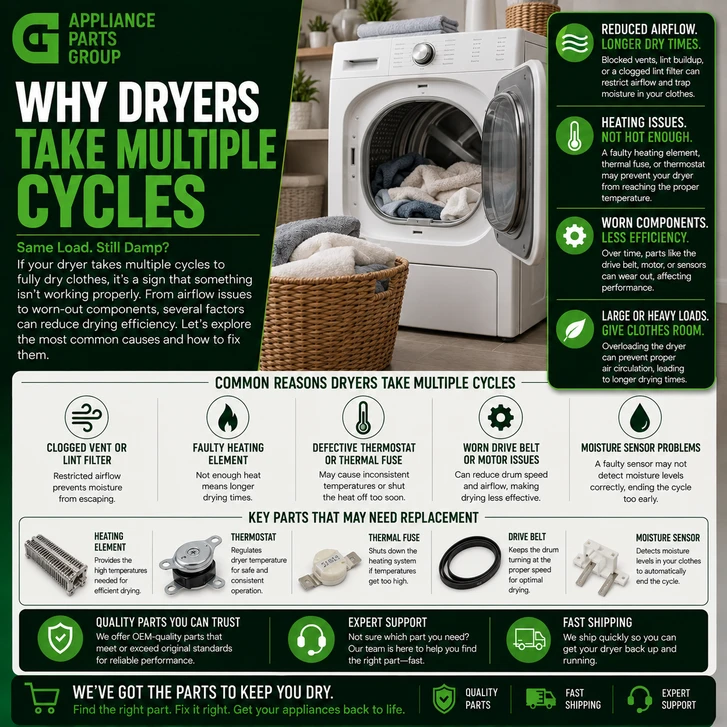
Key Takeaways
- A dryer that requires two or three cycles usually has an airflow, heating, load, or moisture-sensing problem.
- A clogged lint filter or restricted exhaust vent is one of the first things to check when drying times suddenly increase.
- Weak heat can be caused by a failing heating element, thermostat, thermistor, gas heating component, electrical supply problem, or related component.
- Dirty moisture sensors, overloaded drums, and excessively wet laundry can also make a normally functioning dryer take longer to finish a load.
- When testing confirms a failed component, using the correct OEM dryer replacement part for the appliance model helps restore proper operation and compatibility.
Introduction
You start the dryer, return when the cycle finishes, and discover that the towels are still damp. You run another cycle. Sometimes you even need a third. If this has become normal in your laundry room, your dryer may be telling you that something is wrong.
A properly operating dryer should not routinely require multiple full cycles to dry an ordinary load. Drying time varies depending on fabric type, load size, cycle selection, dryer design, and how much water remains in the clothing after washing. However, a noticeable increase in drying time is often a symptom worth investigating.
Dryers depend on three basic things to remove moisture effectively: heat, airflow, and tumbling. Automatic dryers also depend on sensors and electronic controls to determine when clothing has reached the selected dryness level. A problem with any part of that process can leave laundry damp at the end of the cycle.
The good news is that long drying times do not automatically mean you need a new dryer. The problem may be something as simple as a clogged lint filter, crushed exhaust duct, overloaded drum, or dirty moisture sensor. Other cases may require replacement of an OEM heating element, thermostat, thermistor, blower wheel, sensor, or gas dryer heating component.
Here is how to determine why your dryer takes multiple cycles and what you can do about it.
How a Dryer Actually Removes Moisture
Understanding the drying process makes troubleshooting much easier.
In a conventional vented dryer, air enters the appliance and passes through a heating system. Electric dryers generally use a resistance heating element, while gas dryers use a burner assembly. The heated air moves through the rotating drum, where it absorbs moisture from the laundry.
A blower wheel then moves the warm, moisture-filled air through the lint filtration system and into the exhaust duct. The humid air eventually exits through the exterior dryer vent.
For this process to work efficiently, the dryer must continuously generate sufficient heat and move enough air through the drum.
If airflow slows down, moisture cannot leave efficiently. If the heating system becomes weak or intermittent, the air may not become warm enough to evaporate moisture quickly. If the drum is overloaded, clothing may not tumble sufficiently for heated air to reach the entire load.
Modern dryers add another variable: electronic moisture detection. Moisture sensor bars can help the control system determine whether clothing is still wet. Temperature sensors and thermistors provide additional information used to regulate heat and cycle operation.
Why Does My Dryer Take Two or Three Cycles to Dry Clothes?
There is no single cause. Several different problems can create almost identical symptoms, so troubleshooting should start with the easiest and most common possibilities before expensive components are replaced.
1. The Lint Filter Is Clogged
The lint filter is your dryer's first line of defense against fibers entering the exhaust system. As lint accumulates on the screen, airflow decreases.
A heavily clogged lint filter can make the dryer run hotter internally while simultaneously drying clothes more slowly. That may sound contradictory, but drying depends on moving humid air out of the drum—not simply generating more heat.
Clean the lint filter before or after every load. If the screen appears clean but airflow still seems weak, inspect it for fabric-softener or dryer-sheet residue. Some screens can develop a nearly invisible coating that restricts airflow.
2. The Dryer Vent Is Restricted
A restricted exhaust system is one of the most important causes to investigate when a dryer suddenly takes much longer than normal.
Lint can accumulate inside the flexible connector, wall duct, elbows, and exterior vent hood. A flexible duct can also become crushed behind the dryer when the appliance is pushed too close to the wall.
Common signs of restricted dryer airflow include:
- Clothes require multiple cycles.
- Clothing feels unusually hot but remains damp.
- The dryer cabinet becomes excessively warm.
- Airflow at the exterior vent seems weak.
- Lint accumulates around the dryer or vent connection.
- Drying times gradually become longer.
Inspect the complete exhaust path rather than checking only the short hose behind the dryer.
3. The Washer Is Leaving Clothes Too Wet
Sometimes the dryer is blamed for a problem that actually begins in the washing machine.
A washer's final spin cycle removes a significant amount of water before laundry reaches the dryer. If the washer is not reaching its intended spin speed, clothing can enter the dryer much wetter than normal.
Pick up a few items immediately after the washer finishes. They should be damp, but they generally should not be dripping or unusually heavy with water.
If clothes suddenly seem much wetter after washing, investigate the washer's spin performance before assuming the dryer has failed.
4. The Dryer Is Overloaded
More clothes do not necessarily mean more efficient drying.
Clothing needs room to lift, fall, and separate as the drum rotates. Packing the drum too tightly reduces this tumbling action and limits how effectively heated air circulates around individual garments.
Heavy towels, blankets, jeans, comforters, and other dense fabrics are particularly susceptible to uneven drying when the drum is overloaded.
If a smaller load dries normally while a large load requires multiple cycles, load size may be a major part of the problem.
5. The Heating Element Is Weak or Damaged
Electric dryers typically use a resistance heating element to warm incoming air. The element contains coils that become hot when electrical current passes through them.
A failed heating element commonly causes a no-heat condition, but heating-system problems can also produce inconsistent or inadequate heat depending on the design and failure.
If the dryer tumbles normally and airflow appears strong but the air never becomes sufficiently warm, the heating circuit should be investigated.
Heating elements should be tested according to the service information for the specific dryer. Disconnect electrical power before accessing internal components.
6. A Thermostat or Thermistor Is Not Working Correctly
Dryers need to regulate temperature rather than simply keeping the heater on continuously.
Depending on the model, temperature regulation may involve cycling thermostats, high-limit thermostats, thermistors, electronic controls, or a combination of these components.
A thermistor changes resistance as temperature changes, allowing the electronic control to monitor operating conditions. If temperature information is incorrect, heating performance and cycle duration can be affected.
Because specifications vary considerably between models, thermostats and thermistors should be tested against manufacturer service specifications instead of being replaced based on symptoms alone.
7. The Blower Wheel Is Damaged or Obstructed
The blower wheel is one of the most important—and sometimes overlooked—parts of the drying system.
Driven by the motor on many conventional dryers, the blower pulls or pushes air through the drum and exhaust path. A cracked, loose, damaged, or obstructed blower wheel may reduce airflow even when the vent itself is clean.
Possible symptoms include long drying times, weak exhaust airflow, unusual rattling or vibration, overheating, and excessive lint accumulation inside the dryer.
If the external vent system is clear but airflow remains weak, the blower assembly deserves closer inspection.
8. Moisture Sensors Are Dirty or Malfunctioning
Many modern dryers use metal moisture sensor bars inside the drum. Damp clothing contacts the bars as it tumbles, providing information the control system uses during automatic cycles.
Residue from dryer sheets and fabric-care products may coat these bars and interfere with moisture detection. Wiring problems or a failed sensor circuit can also affect automatic cycle behavior.
A useful diagnostic clue is to compare an automatic sensor cycle with a timed dry cycle. If timed drying works reasonably well but automatic cycles behave inconsistently, the moisture-sensing system may warrant closer inspection.
Do not automatically replace the sensors, however. Load size, mixed fabrics, airflow problems, inadequate heat, and temperature-sensing faults can produce similar symptoms.
9. An Electric Dryer May Not Be Receiving Full Power
Many electric dryers in the United States require a 240-volt supply. A dryer can sometimes tumble even when there is a power-supply problem affecting the heating circuit.
If the dryer suddenly tumbles normally but produces little or no heat, check the applicable circuit breakers and power supply before replacing dryer components.
Electrical testing at dryer receptacles involves potentially dangerous voltage. If you are not trained and equipped to perform those measurements safely, use a qualified technician or electrician.
10. A Gas Dryer May Have an Ignition or Gas Valve Problem
Gas dryers generate heat differently. The heating system may include an igniter, flame sensor, burner, gas valve, and gas valve coils.
A common symptom of certain gas heating failures is heat at the beginning of a cycle followed by little or no heat later. The dryer continues tumbling, but the burner does not operate as expected.
Gas-appliance repairs require additional precautions. If troubleshooting requires opening or servicing the gas system and you are not qualified to do so, contact a professional technician.
11. The Cycle or Fabric Mix Is Working Against You
Not every long drying cycle indicates a failed appliance.
Mixed loads can create inconsistent results because lightweight shirts dry much faster than thick towels or jeans. Bulky bedding can fold over itself, trapping damp sections inside. Very small loads may also make inconsistent contact with moisture sensor bars.
Separate lightweight and heavyweight fabrics when possible and select a cycle appropriate for the load.
12. Ventless and Heat Pump Dryers Work Differently
Not every modern dryer exhausts hot air outdoors. Ventless condenser and heat pump dryers remove moisture using heat exchangers, condensers, filters, fans, pumps, and other components.
Some of these dryers intentionally operate differently from conventional vented models, and cycle times can be longer by design.
If a ventless or heat pump dryer has become noticeably slower than it used to be, inspect the filters, heat-exchange surfaces, drainage system, condensate components, fans, and sensors according to the manufacturer's instructions.
Step-by-Step Troubleshooting
- Check the load size. Run a normal-sized load rather than packing the drum tightly. If drying performance improves dramatically, overloading may be contributing to the problem.
- Check how wet the laundry is after washing. If clothes are unusually saturated after the washer's final spin, investigate the washer before repairing the dryer.
- Clean the lint filter. Remove all visible lint. Inspect the screen for residue or damage and clean it according to the manufacturer's recommendations.
- Inspect the exhaust connector. Look behind the dryer for a crushed, kinked, disconnected, or heavily restricted duct.
- Check the exterior vent. With the dryer operating, confirm that the exterior damper opens and that there is noticeable exhaust airflow. Keep hands away from hot surfaces and moving equipment.
- Inspect the complete vent path. Long ducts, multiple elbows, accumulated lint, or damaged venting can substantially reduce airflow.
- Compare timed and automatic cycles. If timed dry works substantially better than sensor-controlled cycles, inspect the moisture-sensing system and related wiring.
- Evaluate heat output. Determine whether the dryer produces normal, weak, intermittent, or no heat. This can help separate airflow problems from heating-system problems.
- Inspect the blower system. After disconnecting power, check the blower wheel and housing for lint, obstructions, looseness, or physical damage if they are safely accessible.
- Test applicable heating and temperature components. Depending on the model, this may include the heating element, thermostats, thermal fuse, thermistor, igniter, flame sensor, or gas valve components. Follow the wiring diagram and manufacturer specifications.
- Inspect wiring and connectors. Look for loose terminals, discoloration, damaged insulation, or overheated connectors.
- Replace only the confirmed failed component. Use the complete dryer model number to identify the correct OEM replacement part.
Safety reminder: Always disconnect electrical power before accessing internal dryer components. Shut off the gas supply before applicable gas-dryer service. Dryer electrical circuits and gas systems can create serious hazards, so use a qualified service professional whenever a procedure is beyond your training or equipment.
Common Parts That May Need Replacement
Heating Element
The heating element generates heat in many electric dryers. A failed or damaged element can produce inadequate heat or no heat. Replacement elements must match the electrical and physical specifications of the dryer model.
Cycling Thermostat
On dryers that use one, the cycling thermostat helps regulate normal operating temperature by controlling the heating circuit. Incorrect operation can affect dryer temperature and drying performance.
High-Limit Thermostat
The high-limit thermostat is a protective component intended to respond to excessive temperatures. If testing indicates that it has failed, investigate the reason the dryer overheated as well. Replacing a safety component without correcting an airflow or heating problem can leave the underlying cause unresolved.
Thermal Fuse
A thermal fuse is a one-time safety device used on many dryers. Depending on the model and circuit design, an open thermal fuse may prevent heating, motor operation, or other functions. A blown fuse should prompt an inspection for overheating and restricted airflow.
Thermistor
Electronic dryers often use thermistors to report temperature information to the control board. An out-of-spec thermistor can interfere with proper temperature regulation or cycle behavior.
Blower Wheel
The blower wheel moves air through the drying system. Cracks, looseness, obstructions, or damage can reduce airflow and increase drying time.
Moisture Sensor
Moisture sensor bars help automatic cycles determine whether clothing is still damp. Clean the sensors and inspect their connections before assuming replacement is necessary.
Gas Igniter and Flame Sensor
Gas dryers require reliable burner ignition. A damaged igniter or malfunctioning flame-sensing component can prevent the burner from operating correctly.
Gas Valve Coils
Gas valve coils help operate the gas valve on applicable dryer designs. Certain coil failures may allow initial heating but prevent reliable burner operation later in the cycle.
Electronic Control Board
Modern control boards coordinate heating, temperature monitoring, moisture detection, motors, and cycle timing. Because other problems can mimic a failed control board, airflow, heating components, sensors, wiring, and power should generally be checked before replacing an expensive electronic control.
Why the Correct OEM Dryer Part Matters
Dryer components may look similar while having different electrical ratings, temperature specifications, mounting points, connectors, or operating characteristics.
For that reason, appearance alone is not a reliable way to select a replacement part.
Locate the appliance model number before ordering. Dryer model labels are commonly located around the door opening, on the cabinet frame, behind the door, or on another manufacturer identification label.
Use the complete model number and, when available, the original manufacturer part number to identify the correct OEM replacement component. This is especially important for heating elements, thermostats, thermistors, thermal fuses, sensors, gas components, blower wheels, and electronic controls.
Preventative Maintenance Tips
Many long-drying-time problems can be reduced through routine maintenance.
- Clean the lint filter every load. Do not wait until lint forms a thick layer.
- Inspect the exhaust duct regularly. Make sure it has not become crushed or kinked behind the dryer.
- Keep the exterior vent clear. Check for lint, debris, nests, snow, vegetation, or a sticking damper.
- Have long vent runs cleaned as needed. Dryers located far from an exterior wall may have long duct systems where lint can accumulate.
- Avoid chronic overloading. Give clothing enough room to tumble and separate.
- Separate heavy and lightweight fabrics. Towels and jeans often require different drying conditions than lightweight shirts.
- Clean moisture sensor bars as recommended. Removing residue can help automatic cycles detect moisture accurately.
- Pay attention to changing cycle times. A dryer that gradually takes longer is often giving you an early warning of reduced airflow or declining performance.
- Investigate overheating. Clothes that are extremely hot while remaining damp can indicate an airflow problem.
- Maintain ventless dryers according to their design. Heat pump and condenser dryers may have additional filters, heat exchangers, condensate systems, and drainage components requiring routine attention.
When Should You Call an Appliance Technician?
Basic maintenance such as cleaning the lint screen and visually inspecting accessible venting is within the comfort level of many homeowners. Internal electrical diagnosis is different.
Consider professional service if troubleshooting requires live-voltage measurements, gas-system repairs, extensive dryer disassembly, control-board diagnosis, or testing you are not trained to perform safely.
You should also stop operating a dryer that produces a persistent burning smell, visible smoke, sparks, severely overheated clothing, melted wiring, or other indications of a potentially unsafe condition until the cause has been identified.
Frequently Asked Questions
Why does my dryer take two cycles to dry clothes?
Common causes include restricted exhaust airflow, a clogged lint filter, overloading, inadequate heat, excessively wet clothing from the washer, or a problem with the dryer's sensors or heating components.
Can a clogged dryer vent cause clothes to stay wet?
Yes. A restricted vent prevents moisture-laden air from leaving the dryer efficiently. Clothing can become hot while remaining damp because the moisture is not being exhausted effectively.
Why are my clothes hot but still damp after the dryer stops?
Hot but damp clothing often points toward poor airflow, an overloaded or poorly mixed load, or another condition preventing moisture from leaving efficiently. Inspect the lint filter and exhaust system first.
How do I know if my dryer heating element is going bad?
Little or no heat can indicate a heating-element problem in an electric dryer, but power-supply problems, thermostats, thermal devices, wiring, and controls can cause similar symptoms. Testing is the best way to confirm the failed component.
Can a dirty lint screen really make drying take longer?
Yes. A lint-covered screen restricts airflow through the drying system. Cleaning the lint filter before or after every load is one of the simplest ways to maintain dryer performance.
Can overloading a dryer make clothes take multiple cycles?
Yes. Clothing needs space to tumble and separate. An overloaded drum restricts air circulation and can leave dense or folded areas damp after the rest of the load is dry.
Why does my dryer heat at first and then stop heating?
Intermittent heat can involve temperature controls, electrical components, airflow problems, or gas heating components on a gas dryer. Diagnosis depends on the specific dryer design and should be based on testing rather than symptoms alone.
Do dryer moisture sensors wear out?
Moisture-sensing systems can develop problems, but dirty sensor bars are also common. Clean the bars and evaluate load size, airflow, heat, wiring, and automatic-cycle behavior before replacing sensors.
Why does timed dry work better than sensor dry?
A significant difference between timed and automatic cycles can point toward moisture detection, sensor contact, load composition, or related control issues. It is a useful diagnostic clue but does not prove the moisture sensor itself is defective.
Could my washing machine be causing long dryer cycles?
Yes. If the washer does not remove enough water during its final spin, clothes enter the dryer excessively wet and require more time and energy to dry.
Do heat pump dryers normally take longer to dry clothes?
Heat pump dryers operate differently from conventional vented dryers, and cycle characteristics can differ. If cycle times have increased substantially compared with the dryer's previous performance, inspect its filters, heat exchanger, drainage system, fans, sensors, and other maintenance points specified by the manufacturer.
Should I replace my dryer if it suddenly takes multiple cycles?
Not necessarily. Long drying times are often associated with maintenance issues or replaceable components. Check airflow, load conditions, washer spin performance, heating operation, and sensors before assuming the entire dryer needs replacement.
Entities and Terms
- Dryer
- Dryer vent
- Exhaust duct
- Lint filter
- Airflow restriction
- Heating element
- Cycling thermostat
- High-limit thermostat
- Thermal fuse
- Thermistor
- Blower wheel
- Moisture sensor
- Moisture sensor bars
- Gas igniter
- Flame sensor
- Gas valve coils
- Electronic control board
- Heat pump dryer
- Ventless dryer
- Condenser dryer
- OEM dryer parts
- Dryer maintenance
- Dryer airflow
- Dryer troubleshooting
Final Thoughts
If your dryer suddenly requires two or three cycles to finish an ordinary load, do not assume that slow drying is simply part of the appliance getting older. Drying performance depends on heat, airflow, tumbling, moisture removal, and—in many modern appliances—electronic sensing.
Start with the simple possibilities. Clean the lint filter, inspect the exhaust system, reduce the load size, and make sure the washer is spinning out enough water. From there, determine whether the dryer has strong airflow and consistent heat.
If a component has failed, use the dryer's complete model number to identify the correct OEM replacement part. Proper diagnosis can help you avoid replacing unnecessary components while restoring efficient drying performance.
This article was written by an AI program as part of a beta test by Appliance Parts Group to explore how artificial intelligence can help inform and educate our customers.
Our goal is to use AI tools to provide clear, reliable information so you can make confident, well-informed purchasing decisions.