
Key Takeaways
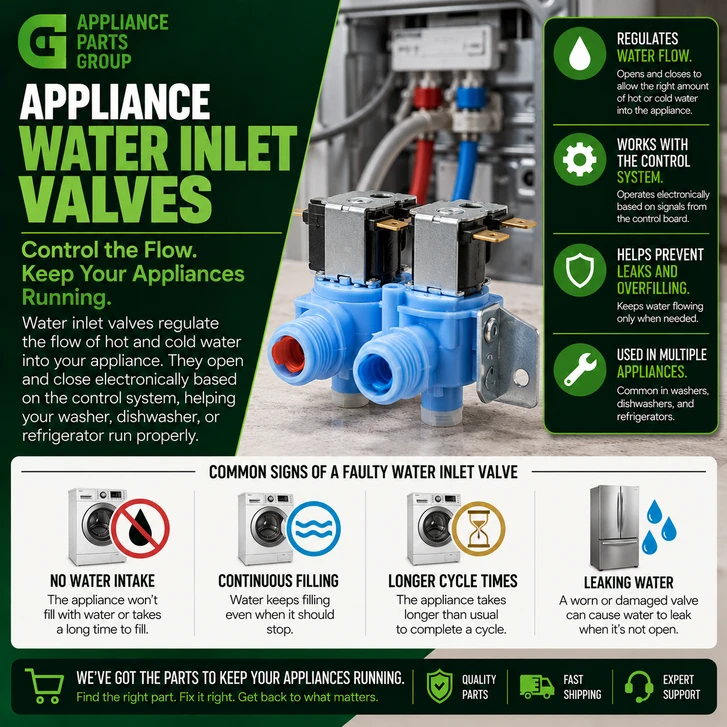
- Water inlet valves control when and how water enters appliances such as washing machines, refrigerators, and dishwashers.
- A failing inlet valve can cause an appliance to fill slowly, not fill at all, leak, overfill, or experience inconsistent water flow.
- Many water inlet valves use electrically operated solenoids that open when the appliance control system calls for water.
- Low household water pressure, clogged inlet screens, damaged wiring, or other appliance components can sometimes produce symptoms similar to a failed valve.
- Using the appliance model number to identify the correct genuine OEM water inlet valve is important because valve configurations, electrical connections, flow rates, and fittings vary between models.
Introduction
Many household appliances depend on a surprisingly small component to control one of their most important resources: water. The water inlet valve, sometimes called a water valve or fill valve, controls the flow of water from the household plumbing into an appliance.
Water inlet valves are commonly found in washing machines, refrigerators, dishwashers, ice makers, and other water-using appliances. Although their exact designs vary, their basic job is similar. When the appliance needs water, an electrical signal activates the valve. When enough water has entered, the appliance stops supplying power to the valve and water flow should stop.
When an inlet valve begins to fail, the symptoms can range from obvious to confusing. A washer may take much longer than normal to fill. A refrigerator's water dispenser may stop working. An ice maker may produce small cubes or no ice at all. A dishwasher may not receive enough water to wash properly. In other situations, a valve that does not close completely can allow water to continue entering an appliance when it should not.
Understanding how appliance water inlet valves work can make troubleshooting these problems much easier.
What Is an Appliance Water Inlet Valve?
A water inlet valve is an electrically controlled valve positioned between the home's water supply and the appliance's internal water system. Depending on the appliance, it may control one water source or several separate water paths.
Most modern appliance inlet valves contain one or more solenoids. A solenoid is an electromagnetic component that allows the appliance to electrically control a mechanical valve.
When the appliance needs water, its control system supplies electrical power to the appropriate solenoid. The energized solenoid opens the valve and allows pressurized household water to pass through. When power is removed, the valve should close and stop the flow.
Some valves are relatively simple single-outlet components. Others may contain several independently controlled solenoids and multiple outlets in one assembly.
Where Are Water Inlet Valves Used?
Although the operating principle is similar, water inlet valves perform somewhat different functions depending on the appliance.
Washing Machine Water Inlet Valves
Washing machines commonly have connections for both hot and cold household water supplies. The washer's inlet valve determines when each water source enters the machine.
Depending on the washer design, the valve assembly may contain multiple solenoids that allow the machine to control hot water, cold water, detergent dispensers, fabric softener compartments, bleach dispensers, or other water paths.
Some washer valve assemblies may also incorporate sensors or additional components used by the washer's control system. For example, certain OEM washer valve assemblies incorporate a thermistor that helps the control system monitor incoming water temperature.
Refrigerator Water Inlet Valves
Refrigerators equipped with an automatic ice maker or water dispenser require a controlled connection to the household water supply.
The refrigerator water inlet valve may contain separate solenoids for the ice maker and water dispenser. When you press the dispenser paddle, the refrigerator energizes the appropriate valve circuit. When the ice maker requests water, another circuit may direct water toward the ice maker fill tube.
A refrigerator valve problem can therefore affect the dispenser, ice maker, or both, depending on the valve design and which portion has failed.
Dishwasher Water Inlet Valves
A dishwasher inlet valve controls the water entering the dishwasher during the fill portion of a wash cycle.
If insufficient water enters the tub, the dishwasher may still appear to operate, but cleaning performance can suffer significantly. The wash pump needs an appropriate amount of water to circulate through the spray arms.
A dishwasher that sounds like it is running normally but leaves dishes dirty may therefore have a water-supply problem among the possible causes.
Common Symptoms of a Bad Water Inlet Valve
Water inlet valve symptoms depend on the appliance and the way the valve has failed. Common warning signs include:
- Appliance does not fill with water
- Appliance fills very slowly
- Only hot or only cold water enters a washer
- Washer displays a fill-related error code
- Refrigerator water dispenser stops working
- Refrigerator dispenser has unusually weak water flow
- Ice maker stops producing ice
- Ice cubes become unusually small or hollow
- Dishwasher receives too little water
- Water continues entering when it should have stopped
- Water appears inside an appliance while it is turned off
- Visible leaking occurs around the valve or its connections
These symptoms do not automatically prove that the inlet valve is defective. Several other conditions can create similar problems, so some troubleshooting is worthwhile before ordering a replacement.
Why Do Appliance Water Inlet Valves Fail?
Mineral and Sediment Buildup
Household water can contain minerals, sediment, and other particles. Over time, these materials can restrict inlet screens or interfere with internal valve operation.
Homes with hard water may be particularly susceptible to mineral accumulation in water-handling components.
Failed Solenoid
The electromagnetic solenoid that operates the valve can fail electrically. If a solenoid cannot activate, the corresponding water path may remain closed even when the appliance is requesting water.
Mechanical Valve Failure
An inlet valve can also fail mechanically. Internal components can wear or become damaged, preventing the valve from opening or closing correctly.
A valve that fails to close completely can be especially important to address because household water pressure remains present at the valve even when the appliance is not operating.
Low Household Water Pressure
Sometimes the valve is not actually the problem. Water inlet valves are designed to operate with an adequate incoming water supply.
A partially closed shutoff valve, kinked supply hose, plumbing restriction, clogged filter, or unusually low household water pressure can reduce appliance water flow.
Electrical or Control Problems
The inlet valve cannot open electrically unless it receives the appropriate signal from the appliance.
Depending on the appliance, a wiring problem, damaged connector, failed electronic control, faulty pressure-sensing system, door or lid switch issue, or another component may prevent the valve from being energized.
Why a Refrigerator Can Make Ice but Have No Water — or the Opposite
One particularly confusing refrigerator symptom occurs when the ice maker works but the water dispenser does not, or when the dispenser works but the ice maker does not.
Many refrigerator inlet valve assemblies contain multiple solenoids controlling different water circuits. This means one portion of the valve can potentially operate while another does not.
However, the valve is only one possibility. Frozen water lines, clogged water filters, dispenser switches, ice maker components, wiring, controls, and other restrictions can also affect refrigerator water delivery.
Troubleshooting the specific failed function is therefore more useful than assuming the entire refrigerator water system has stopped working.
Why a Washing Machine May Fill Slowly
A slow-filling washer is another common problem associated with inlet valves.
Before replacing the valve, check whether both household water faucets are fully open and inspect the supply hoses for kinks. If the problem affects only hot or cold water, compare the flow from the two household supplies.
Restricted inlet screens can also reduce water flow. These screens are intended to prevent debris from entering the valve, but accumulated material can eventually create a restriction.
If the external water supply is adequate but the washer still fills slowly, the inlet valve may be restricted or failing internally.
What Happens When a Water Inlet Valve Will Not Close?
Most people associate valve failure with an appliance that does not receive enough water. However, an inlet valve can also fail in the opposite direction.
If the valve cannot seal completely, water may slowly pass into the appliance even when the valve is not electrically energized.
For example, water may gradually appear inside a washing machine tub when the machine has not been used. Depending on the refrigerator design, a leaking valve can also contribute to ice maker filling problems or unwanted water flow.
Uncontrolled water entering an appliance should be investigated promptly. Turning off the appliance's household water supply can help prevent additional water from entering while the problem is being diagnosed.
Step-by-Step Troubleshooting
- Disconnect power. Unplug the appliance or disconnect power at the appropriate circuit breaker before accessing internal components.
- Turn off the water supply. Close the appliance's household water shutoff valve before disconnecting hoses, tubing, or valve connections.
- Confirm the household supply. Make sure the shutoff valve is fully open during normal operation and verify that the home's plumbing is supplying adequate water.
- Inspect supply hoses and tubing. Look for kinks, crushed sections, leaks, or obvious restrictions.
- Check filters where applicable. A clogged refrigerator water filter can reduce dispenser and ice maker water flow and can resemble a valve problem.
- Inspect inlet screens. Some valves have screens that catch debris before it enters the valve. Heavy restriction can reduce flow.
- Look for visible leakage. Inspect the valve body, hose connections, tubing connections, and surrounding area.
- Inspect electrical connections. With power disconnected, look for loose connectors, corrosion, damaged wiring, or overheated terminals.
- Consider other components. Pressure sensors, electronic controls, switches, filters, fill tubes, and wiring can all affect water delivery depending on the appliance.
- Identify the correct replacement by model number. If testing confirms that the inlet valve has failed, use the complete appliance model number to locate the correct OEM replacement.
Electrical testing of an energized appliance and pressurized water-system repairs can present shock, flooding, and property-damage risks. If you are not comfortable performing the required diagnosis or repair, contact a qualified appliance service professional.
Can You Clean a Water Inlet Valve Instead of Replacing It?
There is an important distinction between cleaning accessible debris from an external inlet screen and attempting to disassemble the valve itself.
Some inlet screens may collect sediment that can be carefully removed when appropriate for the appliance and valve design. However, a mechanically or electrically failed valve is generally replaced as an assembly rather than internally rebuilt.
Do not remove an inlet screen permanently to improve water flow. The screen helps prevent debris from entering the valve.
Always follow the appliance manufacturer's service information for the specific model.
Common Parts That May Need Replacement
Water Inlet Valve
The valve itself is the primary replacement component when diagnosis confirms that it cannot properly control water flow. Appliance Parts Group carries genuine OEM water inlet valves for many appliance models and manufacturers.
Washer Fill Hoses
Washing machine supply hoses connect the household plumbing to the washer's inlet valve. Hoses that are damaged, deteriorated, kinked, or leaking should be replaced with the correct type.
Refrigerator Water Filters
A restricted refrigerator filter can dramatically reduce water flow. Before assuming the inlet valve is defective, check the condition and replacement interval of the refrigerator's water filter where applicable.
Refrigerator Water Tubing
Damaged, frozen, kinked, or restricted tubing can prevent water from reaching the dispenser or ice maker even when the inlet valve is operating properly.
Dishwasher Water Supply Components
Dishwasher fill problems can involve the inlet valve, supply line, electrical connections, float-related components, controls, or other model-specific parts.
Why the Appliance Model Number Matters
Water inlet valves are not universal.
Two valves may look similar while having different:
- Electrical specifications
- Solenoid configurations
- Water flow characteristics
- Mounting brackets
- Hose or tubing connections
- Outlet arrangements
- Wiring connectors
- Integrated sensors
The safest way to identify a replacement is to use the appliance's complete model number. Depending on the manufacturer, the model number may be located on a label inside a washer lid or door opening, along a refrigerator interior wall, around a dishwasher door frame, or in another manufacturer-designated location.
Appliance Parts Group specializes in genuine OEM appliance replacement parts. Matching the part to the complete appliance model helps ensure that you order the valve designed for the equipment being repaired.
Preventative Maintenance Tips
- Inspect washing machine hoses periodically. Look for bulging, cracking, corrosion, or leakage around connections.
- Replace refrigerator water filters as recommended. An excessively restricted filter can reduce water flow through the refrigerator system.
- Address slow filling early. A gradual reduction in flow may indicate a developing restriction.
- Know where your shutoff valves are located. Being able to quickly shut off water can be extremely valuable if a hose, fitting, or appliance component leaks.
- Do not ignore unexplained water. Water appearing inside or around an appliance while it is not operating deserves investigation.
- Use the correct replacement part. Always verify replacement components using the appliance model number rather than relying on appearance alone.
Frequently Asked Questions
What does an appliance water inlet valve do?
A water inlet valve controls the flow of household water into an appliance. The appliance typically energizes an electrical solenoid when water is needed and stops energizing it when the required fill is complete.
How do I know if my water inlet valve is bad?
Common symptoms include no water, slow filling, inconsistent water flow, leakage, or water continuing to enter when it should be stopped. These symptoms can have other causes, so the complete water and electrical system should be considered before replacing the valve.
Can a bad water inlet valve cause a washer not to fill?
Yes. A failed solenoid, internal mechanical problem, or restriction can prevent enough water from entering the washer. Closed faucets, kinked hoses, low water pressure, wiring problems, and other components can cause similar symptoms.
Can a water inlet valve cause a washing machine to fill slowly?
Yes. A restricted inlet valve can reduce flow. However, restricted inlet screens, partially closed faucets, supply-hose problems, and low household water pressure should also be checked.
Can a refrigerator water inlet valve stop the ice maker from working?
Yes. If the portion of the valve supplying the ice maker cannot open or provides insufficient flow, the ice maker may receive little or no water. Ice maker failures, frozen fill tubes, filters, and other water-system problems can produce similar symptoms.
Can the refrigerator dispenser work if part of the inlet valve is bad?
Yes. Some refrigerator valve assemblies use separate solenoids or water circuits for the dispenser and ice maker. One function may therefore work while another does not.
Can a bad inlet valve cause a dishwasher not to clean properly?
Potentially. If the dishwasher does not receive enough water, wash performance can suffer because there may not be sufficient water for proper circulation. Several other problems can also cause poor cleaning performance.
Can a water inlet valve leak even when the appliance is off?
Yes. If the valve cannot seal properly, household water pressure may allow water to pass through even when the valve is not electrically energized.
Can I repair a water inlet valve?
A failed appliance inlet valve is typically replaced as an assembly rather than internally repaired. Follow the manufacturer's service information for the specific appliance and valve.
Are appliance water inlet valves universal?
No. Valves can differ in electrical specifications, fittings, mounting arrangements, flow characteristics, solenoid configuration, and other features. Use the appliance's complete model number to identify the correct replacement.
Should I replace a water inlet valve if the appliance fills slowly?
Not automatically. First check the household water supply, shutoff valves, hoses, filters, tubing, and accessible inlet screens. If those are normal and diagnosis indicates that the valve is restricted or failing, replacement may be appropriate.
Where can I find the correct replacement water inlet valve?
Search using the complete appliance model number and verify that the replacement valve is specified for that model. Appliance Parts Group carries genuine OEM appliance parts, including water inlet valves for many major appliance brands.
Entities and Terms
- Water inlet valve
- Fill valve
- Solenoid valve
- Washer water inlet valve
- Refrigerator water inlet valve
- Dishwasher water inlet valve
- Ice maker
- Water dispenser
- Washer fill hose
- Inlet screen
- Refrigerator water filter
- Water supply tubing
- Electronic control board
- Water pressure
- Genuine OEM appliance parts
This article was written by an AI program as part of a beta test by Appliance Parts Group to explore how artificial intelligence can help inform and educate our customers.
Our goal is to use AI tools to provide clear, reliable information so you can make confident, well-informed purchasing decisions.