
Key Takeaways
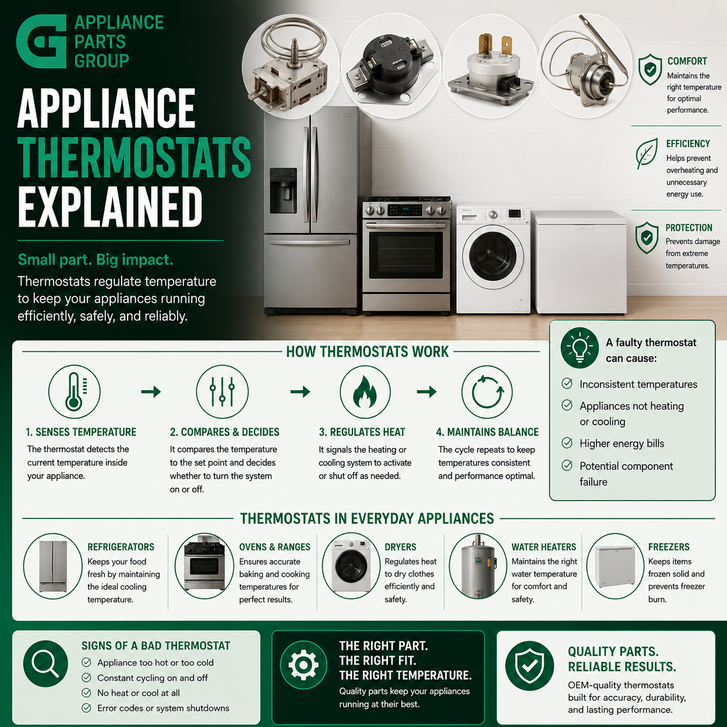
- Appliance thermostats help regulate temperature in dryers, ovens, refrigerators, dishwashers, and other household appliances.
- A bad thermostat can cause no heat, overheating, poor cooling, long cycle times, or inconsistent temperatures.
- Common thermostat types include cycling thermostats, high-limit thermostats, defrost thermostats, oven thermostats, and electronic temperature sensors.
- Thermostat problems should be diagnosed carefully because heating elements, thermal fuses, sensors, wiring, and control boards can cause similar symptoms.
- Using the correct OEM replacement thermostat helps maintain proper fit, safe operation, and manufacturer-intended performance.
Introduction
Appliance thermostats are small parts with a big job. Whether your dryer is producing heat, your oven is holding a baking temperature, your refrigerator is keeping food cold, or your dishwasher is heating water, a thermostat or temperature sensor is usually involved.
When a thermostat works properly, most homeowners never notice it. The appliance simply heats, cools, cycles, and shuts off when it should. But when a thermostat fails, the symptoms can be frustrating. A dryer may run but not heat. An oven may burn food or never reach the selected temperature. A refrigerator may become too warm or too cold. A dishwasher may leave dishes wet because the water or drying temperature is not being controlled correctly.
This guide explains what appliance thermostats do, the different types used in common appliances, how thermostat failures show up, and when replacement may be the right repair.
What Is an Appliance Thermostat?
An appliance thermostat is a temperature-control device that opens or closes an electrical circuit based on temperature. In simple terms, it helps the appliance decide when to heat, when to stop heating, when to cool, or when to shut down a system for safety.
Thermostats may be mechanical, electronic, or sensor-based depending on the appliance design. Older and simpler appliances often use mechanical thermostats with internal contacts. Many newer appliances use thermistors or temperature sensors that send readings to an electronic control board.
Although the designs vary, the purpose is similar: monitor temperature and help the appliance operate within the correct range.
Why Thermostats Matter in Appliance Repair
Temperature control affects performance, safety, energy use, and part life. A dryer that runs too hot may damage clothing or repeatedly blow a thermal fuse. An oven that does not regulate temperature correctly may ruin meals. A refrigerator with poor temperature sensing may allow food to spoil. A dishwasher with heating issues may struggle to clean or dry dishes properly.
Because thermostats are tied directly to heating and cooling operation, they are often part of the diagnostic process when an appliance has temperature-related symptoms.
Common Types of Appliance Thermostats
Cycling Thermostat
A cycling thermostat is commonly found in clothes dryers. It helps regulate normal operating temperature by cycling the heat source on and off. When the air temperature reaches a certain point, the thermostat opens the circuit and interrupts power to the heating system. As the temperature drops, the thermostat closes again and allows heat to resume.
If a cycling thermostat fails, the dryer may not heat correctly, may take too long to dry, or may run hotter than normal.
High-Limit Thermostat
A high-limit thermostat is a safety device. It is designed to interrupt power if temperatures rise beyond a safe limit. High-limit thermostats are often used in dryers, ovens, dishwashers, and other heated appliances.
If a high-limit thermostat trips or fails, it may stop the appliance from heating. If the appliance repeatedly overheats, the underlying cause may be restricted airflow, a failing heating element, damaged wiring, or another related issue.
Defrost Thermostat
A defrost thermostat is commonly used in refrigerators and freezers with automatic defrost systems. It monitors evaporator coil temperature and helps control when the defrost heater should operate.
If the defrost thermostat fails, frost may build up on the evaporator coils. This can restrict airflow and eventually cause cooling problems in the fresh food or freezer compartments.
Oven Thermostat
Some ovens use a dedicated oven thermostat to regulate baking and broiling temperatures. In many modern ovens, this function may be handled by an oven temperature sensor and electronic control board instead.
When oven temperature control fails, the appliance may run too hot, too cold, or fluctuate during cooking.
Temperature Sensor or Thermistor
A thermistor or temperature sensor changes electrical resistance as temperature changes. The control board reads this change and adjusts appliance operation accordingly.
Temperature sensors are common in refrigerators, ovens, washers, dryers, and dishwashers. Even though they are not always called thermostats, they perform a similar temperature-monitoring role.
How Appliance Thermostats Work
Most mechanical thermostats work by reacting to heat. Inside the thermostat, a temperature-sensitive component changes shape or position as the temperature rises or falls. This movement opens or closes electrical contacts.
For example, in an electric dryer, heated air moves through the drum. The cycling thermostat monitors that air temperature. When the dryer reaches the proper operating range, the thermostat opens the circuit to stop the heating element. When the temperature falls, the thermostat closes again so the heating element can turn back on.
This cycle repeats throughout the drying process.
Electronic systems work differently. A sensor reports temperature information to the control board. The board then decides when to energize or shut off components such as compressors, heaters, fans, or relays.
Symptoms of a Bad Appliance Thermostat
The Appliance Does Not Heat
A failed thermostat can prevent power from reaching the heating circuit. This may happen in dryers, ovens, dishwashers, and other heated appliances. However, no-heat symptoms can also be caused by a blown thermal fuse, failed heating element, bad igniter, faulty control board, damaged wiring, or incoming power problem.
The Appliance Overheats
If a thermostat fails in a closed position, the appliance may continue heating beyond the correct range. In a dryer, this can lead to unusually hot clothing, burning smells, or repeated thermal fuse failure. In an oven, it can cause food to burn even when the temperature setting appears correct.
Temperatures Fluctuate
A weak or failing thermostat may cause uneven temperatures. Ovens may bake inconsistently. Refrigerators may alternate between too warm and too cold. Dryers may take longer than normal because the heat cycles are not being controlled properly.
The Appliance Shuts Off Unexpectedly
Some thermostat-related problems cause an appliance to shut down during operation. This may happen when a high-limit thermostat opens because the appliance is overheating. The appliance may restart after cooling, only to shut off again later.
Food Spoils or Freezes in the Refrigerator
Temperature-control problems in refrigerators may cause fresh food to freeze, freezer temperatures to rise, or food to spoil faster than expected. Thermostats, thermistors, dampers, fans, defrost parts, and control boards may all need to be considered during diagnosis.
Common Appliances That Use Thermostats
Dryers
Dryers often use several temperature-related parts, including cycling thermostats, high-limit thermostats, thermal fuses, thermistors, and heating elements. These parts work together to control heat and reduce the risk of overheating.
Ovens and Ranges
Ovens use thermostats or temperature sensors to regulate cooking temperature. A faulty sensor or thermostat can cause incorrect oven temperatures, long preheat times, or uneven baking.
Refrigerators and Freezers
Refrigerators use thermostats, thermistors, defrost thermostats, and control boards to manage cooling and defrost cycles. A failure in one of these parts can cause frost buildup, poor cooling, or unstable temperatures.
Dishwashers
Dishwashers may use thermostats or temperature sensors to monitor water temperature and drying temperature. If a thermostat fails, the dishwasher may not heat water properly or may leave dishes wet at the end of the cycle.
Washers
Some washing machines use temperature sensors or thermostats to help regulate water temperature. A failure may cause incorrect wash temperatures or error codes on electronically controlled models.
Step-by-Step Troubleshooting
- Disconnect power. Before inspecting or testing any appliance part, unplug the appliance or turn off power at the breaker.
- Identify the symptom. Note whether the appliance has no heat, too much heat, inconsistent temperature, poor cooling, or unexpected shutdowns.
- Locate the thermostat or sensor. Use the model number and parts diagram to identify the correct thermostat location.
- Inspect the part visually. Look for burned terminals, damaged wires, corrosion, cracks, or signs of overheating.
- Check nearby components. Thermostat symptoms can overlap with heating elements, thermal fuses, igniters, fans, relays, and control boards.
- Test continuity when applicable. Many mechanical thermostats can be tested with a multimeter. Always compare results to manufacturer specifications.
- Test resistance for sensors. Thermistors and temperature sensors are usually checked by measuring resistance and comparing it to a temperature chart.
- Correct root causes. If overheating caused the thermostat failure, clean vents, inspect airflow, and check related components before replacing the part.
- Replace with the correct OEM part. Match the part using the appliance model number to help ensure proper fit and function.
Common Parts That May Need Replacement
Cycling Thermostat
The cycling thermostat controls normal dryer operating temperature. A faulty cycling thermostat may cause no heat, overheating, or long drying times.
High-Limit Thermostat
The high-limit thermostat protects against unsafe heat levels. If it fails or opens due to overheating, the appliance may stop heating.
Defrost Thermostat
The defrost thermostat helps control refrigerator defrost operation. A failed defrost thermostat can contribute to frost buildup and cooling problems.
Oven Temperature Sensor
An oven temperature sensor reports oven cavity temperature to the control board. A bad sensor may cause inaccurate temperatures or oven error codes.
Thermistor
A thermistor is an electronic temperature sensor used in many refrigerators, dryers, washers, and dishwashers. It may need replacement if resistance readings are outside specification.
Thermal Fuse
A thermal fuse is a one-time safety device that opens when temperatures become too high. If the fuse is blown, the appliance may not heat or may not run at all.
Heating Element
A heating element creates heat in electric dryers, ovens, and dishwashers. A failed element can look like a thermostat problem because the appliance may run without producing heat.
Electronic Control Board
In modern appliances, the control board uses sensor input to control heating and cooling operation. If the board fails, it may misread temperatures or fail to energize components.
OEM Thermostats and Why Fit Matters
Thermostats are designed for specific temperature ranges, mounting locations, wiring connections, and appliance operating conditions. Even parts that look similar may have different temperature ratings or electrical characteristics.
That is why matching the thermostat by appliance model number is important. OEM replacement thermostats are designed to meet the specifications intended for that appliance. This helps support proper cycling, safe operation, and reliable repair results.
Preventative Maintenance Tips
- Clean dryer lint screens after every load.
- Inspect and clean dryer venting regularly to prevent overheating.
- Keep refrigerator condenser coils clean for better cooling performance.
- Avoid blocking refrigerator air vents inside the fresh food and freezer compartments.
- Do not ignore burning smells, repeated shutoffs, or repeated thermal fuse failures.
- Use the correct wash, dry, and cooking settings for the appliance.
- Replace damaged wiring, terminals, or connectors when found during repair.
- Use the appliance model number when ordering replacement parts.
Frequently Asked Questions
What does an appliance thermostat do?
An appliance thermostat monitors temperature and helps control heating or cooling operation. It may turn power on or off to maintain the correct temperature range.
Can a bad thermostat stop a dryer from heating?
Yes. A failed cycling thermostat or high-limit thermostat can prevent a dryer from heating. However, the heating element, thermal fuse, timer, motor switch, wiring, and power supply should also be checked.
Can a bad thermostat make an appliance overheat?
Yes. If a thermostat fails closed or does not respond correctly to temperature, the appliance may continue heating longer than it should.
How do I know which thermostat my appliance needs?
The best way is to search using the appliance model number. This helps identify the correct OEM thermostat or temperature sensor for that specific appliance.
Are thermostat and thermistor the same thing?
They are related but not exactly the same. A thermostat often opens or closes a circuit, while a thermistor changes resistance and sends temperature information to a control board.
Can I test an appliance thermostat with a multimeter?
Many mechanical thermostats can be tested for continuity with a multimeter. Electronic sensors are usually tested by measuring resistance and comparing the reading to manufacturer specifications.
Why did my thermal fuse blow after a thermostat problem?
A thermal fuse may blow when the appliance overheats. The root cause could be a failed thermostat, clogged vent, restricted airflow, shorted heating element, or another overheating condition.
Do refrigerators have thermostats?
Yes. Refrigerators may use cold controls, defrost thermostats, thermistors, and electronic control boards to regulate cooling and defrost operation.
Can a bad oven thermostat cause uneven baking?
Yes. If the oven thermostat or temperature sensor is inaccurate, the oven may run too hot, too cool, or fluctuate during cooking.
Should I replace a thermostat myself?
Some thermostat replacements are straightforward for experienced DIYers, but appliance repairs involve electricity, heat, and sharp metal edges. Disconnect power first and follow the manufacturer’s instructions.
Why does my appliance have more than one thermostat?
Many appliances use more than one temperature-control part. For example, a dryer may have a cycling thermostat for normal operation and a high-limit thermostat for safety protection.
Should I use an OEM thermostat?
Using an OEM thermostat helps ensure the part matches the appliance’s original temperature rating, mounting style, wiring design, and operating requirements.
Entities and Terms
- Appliance thermostat
- Cycling thermostat
- High-limit thermostat
- Defrost thermostat
- Oven thermostat
- Temperature sensor
- Thermistor
- Thermal fuse
- Heating element
- Control board
- Dryer vent
- Evaporator coil
- Condenser coil
- Multimeter
- Continuity test
- OEM replacement parts
Conclusion
Appliance thermostats help keep household appliances operating at the right temperature. They support comfort, food safety, drying performance, cooking accuracy, and overheating protection. When a thermostat fails, the appliance may stop heating, overheat, cool poorly, or cycle unpredictably.
Because thermostat symptoms often overlap with other part failures, careful troubleshooting is important. Checking airflow, wiring, heating elements, fuses, sensors, and control boards can help confirm the real cause before replacement. When a thermostat does need to be replaced, using the correct OEM part matched to the appliance model number is one of the best ways to restore proper operation.
This article was written by an AI program as part of a beta test by Appliance Parts Group to explore how artificial intelligence can help inform and educate our customers.
Our goal is to use AI tools to provide clear, reliable information so you can make confident, well-informed purchasing decisions.