
Key Takeaways
- Appliance safety thermostats monitor temperature and interrupt heating when unsafe conditions develop.
- A failed thermostat may cause overheating, no heat, temperature fluctuations, or repeated thermal fuse failures.
- Restricted airflow, blocked vents, failing fans, damaged wiring, and defective heating components can trigger a safety thermostat.
- Testing usually requires disconnecting power, locating the thermostat, inspecting its wiring, and checking continuity with a multimeter.
- The replacement thermostat must match the appliance model, temperature rating, mounting design, and manufacturer specifications.
Introduction
Many household appliances rely on heat to perform their jobs. Dryers heat moving air, ovens maintain cooking temperatures, dishwashers heat water, and refrigerators periodically energize a defrost heater. Although heat is necessary, excessive heat can damage wiring, melt plastic components, reduce appliance life, and create a serious safety concern.
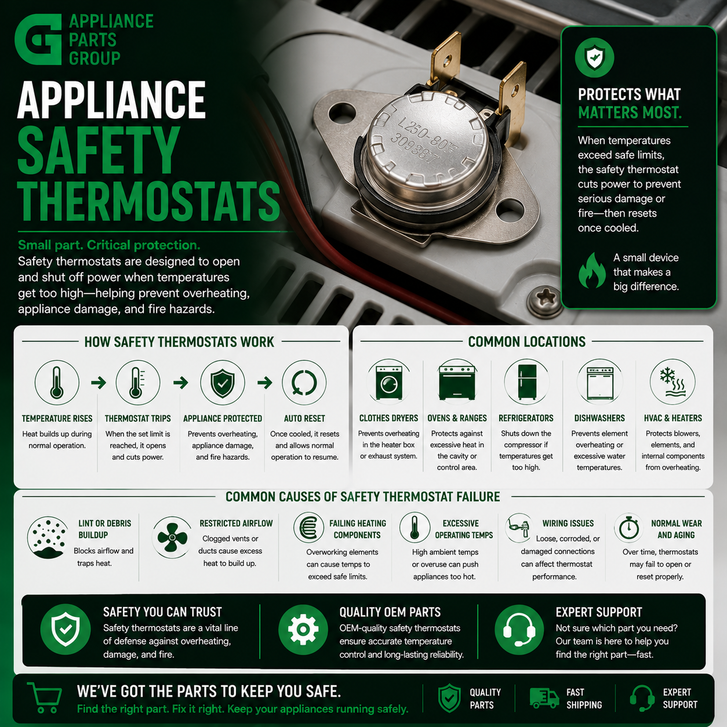
Appliance safety thermostats help prevent these conditions. These compact temperature-sensitive switches monitor specific areas of an appliance and respond when temperatures rise beyond a predetermined limit. Depending on the appliance and thermostat design, the thermostat may temporarily open the electrical circuit until the appliance cools or remain open after activation and require replacement.
A safety thermostat is not always the original cause of an appliance problem. It frequently reacts to another condition, such as restricted airflow, a blocked exhaust vent, a stalled circulation fan, a shorted heating element, or an electronic control problem. Replacing the thermostat without correcting the underlying cause can result in another shutdown.
This guide explains how appliance safety thermostats work, where they are used, what causes them to fail, how they can be tested, and how to identify the correct OEM replacement part.
What Is an Appliance Safety Thermostat?
An appliance safety thermostat is an automatic temperature-control device designed to protect an appliance when temperatures become excessive. It is typically connected in series with a heating element, gas valve circuit, motor circuit, or another temperature-sensitive system.
Many safety thermostats contain a bimetal disc. This disc is manufactured from two metals that expand at different rates when heated. At a specific temperature, the disc changes shape and opens or closes a pair of electrical contacts.
In a normally closed safety circuit, electricity flows through the thermostat during ordinary operation. If the surrounding temperature reaches the thermostat’s opening temperature, the contacts separate and interrupt the circuit. This may shut off a heating element, stop a burner, or disable part of the appliance.
Some thermostats automatically reset when the temperature falls to a specified level. Others function as one-time protective devices. A one-time thermal cutoff or thermal fuse must be replaced after it opens.
Safety Thermostats Versus Operating Thermostats
An operating thermostat and a safety thermostat may look similar, but they serve different purposes.
The operating thermostat cycles the heat during normal use. For example, a dryer’s cycling thermostat repeatedly turns the heating system on and off to maintain the selected drying temperature. It is expected to operate throughout every cycle.
A high-limit or safety thermostat serves as backup protection. It normally remains closed and should open only when the appliance becomes hotter than intended. Frequent activation of a high-limit thermostat indicates that the normal temperature-control system may not be working correctly.
An appliance may contain several temperature-related components, including:
- An operating or cycling thermostat
- A high-limit safety thermostat
- A thermal fuse or thermal cutoff
- A thermistor
- An electronic temperature sensor
- A temperature-control board
Correctly identifying the failed component is important because these parts are not automatically interchangeable.
Where Safety Thermostats Are Used
Clothes Dryers
Dryers commonly use cycling thermostats, high-limit thermostats, and thermal fuses. Depending on the model, these components may be attached to the blower housing, heater housing, burner assembly, or exhaust duct.
The high-limit thermostat helps stop heating when temperatures around the heater become excessive. A thermal fuse may disable the heating circuit, motor circuit, or entire dryer after a dangerous temperature condition develops.
Restricted exhaust airflow is one of the most important conditions to investigate when a dryer thermostat or thermal fuse opens. Lint accumulation, a crushed transition duct, an obstructed exterior vent hood, or an excessively long vent route can trap heat inside the appliance.
Ovens and Ranges
Ovens may use a high-limit thermostat or thermal cutoff to protect the control area, oven liner, wiring, and surrounding cabinetry. The device may interrupt power to the heating elements or oven control if temperatures become excessive.
An oven safety thermostat can be triggered by a failed cooling fan, blocked ventilation opening, shorted heating element, damaged temperature sensor, or control board that keeps the heat energized too long.
Dishwashers
Dishwasher thermostats help manage water heating and protect the tub and heating system. A high-limit thermostat may open if the heating element remains energized too long or if water circulation is insufficient.
A failed dishwasher thermostat may contribute to poor drying, water that does not heat, unusually long cycles, or an appliance that stops during a heated portion of the program.
Refrigerators and Freezers
Refrigerators commonly use defrost thermostats, sometimes called defrost limit switches or bimetal thermostats. The thermostat is normally attached to the evaporator tubing in the freezer compartment.
During defrost, the thermostat monitors evaporator temperature and interrupts power to the defrost heater after the frost has melted and the evaporator reaches its opening temperature. This prevents unnecessary heating inside the freezer compartment.
A defective defrost thermostat can contribute to frost accumulation, rising fresh-food temperatures, poor airflow, or a defrost heater that does not operate when required.
Commercial and Specialty Appliances
Commercial cooking equipment, warming cabinets, laundry equipment, ice machines, beverage systems, and other specialty appliances may use multiple high-limit thermostats. These components protect heaters, compressors, motors, boilers, and control compartments.
Because commercial equipment may operate for extended periods, thermostat ratings and mounting locations are especially important. A replacement should match the equipment model and the manufacturer’s specifications.
Symptoms of a Failed Safety Thermostat
Symptoms vary according to the appliance and whether the thermostat has failed open, failed closed, or begun operating intermittently.
The Appliance Produces No Heat
If a normally closed thermostat opens and does not reset, electricity may no longer reach the heating element, burner control, or gas valve circuit. A dryer may tumble without heating, a dishwasher may use cold water, or an oven may remain below the selected temperature.
The Appliance Overheats
A thermostat with contacts that remain closed may fail to interrupt the heating circuit at the correct temperature. Overheating can also occur when the thermostat does not sense temperature accurately because it is loose, incorrectly mounted, or no longer making proper contact with the surface it monitors.
Heating Is Intermittent
Worn contacts, loose terminals, damaged wiring, or an aging bimetal mechanism can cause intermittent operation. Heat may work at the beginning of a cycle and then stop unexpectedly.
A Thermal Fuse Repeatedly Opens
Repeated thermal fuse failure is a warning that another problem has not been corrected. In dryers, the exhaust system and blower airflow should be checked. In ovens, the cooling fan, temperature sensor, control relays, heating elements, and ventilation openings should be inspected.
The Appliance Stops Mid-Cycle
Some safety devices interrupt power to a motor or control circuit rather than only the heater. An appliance may stop after warming up and begin operating again after it cools.
Visible Heat Damage
Discolored terminals, melted wire insulation, brittle connectors, scorched mounting surfaces, or a burned odor indicate an overheating or electrical problem. The damaged wiring and the cause of the excess heat must be addressed before the appliance is returned to service.
What Causes a Safety Thermostat to Open?
A safety thermostat may open because the thermostat itself is defective, but it may also be responding correctly to an unsafe operating condition.
Restricted Airflow
Airflow removes heat from dryers, ovens, refrigerators, and other appliances. Blocked vents, clogged filters, lint accumulation, obstructed ducts, dirty condenser coils, or stalled fans can cause temperatures to rise rapidly.
Failed Cooling or Circulation Fan
A fan motor may stop because of worn bearings, a blocked blade, damaged wiring, or a failed control. Without airflow, heat can accumulate around the heater, compressor, electronic controls, or oven cavity.
Shorted or Grounded Heating Element
An electric heating element can crack or sag and contact its metal housing. Depending on the circuit, this may cause the element to continue producing heat when it should be off.
Stuck Relay or Defective Electronic Control
A relay on an electronic control board can stick closed and keep a heater energized. Replacing only the thermostat will not correct a relay that continues sending voltage to the heating circuit.
Incorrect Thermostat Installation
A thermostat must be mounted in the correct position and firmly attached to the intended surface. Moving it away from its sensing location, using the wrong mounting hardware, or installing an incorrect temperature rating can compromise protection.
Loose or Damaged Wiring
Loose terminals create electrical resistance and heat. This can damage the thermostat, connector, and surrounding wiring even when appliance temperatures are otherwise normal.
Normal Age and Contact Wear
Thermostat contacts can deteriorate after years of heating cycles. The bimetal mechanism may also lose accuracy, causing the component to open too early, too late, or inconsistently.
Step-by-Step Troubleshooting
- Disconnect the appliance from power.
Unplug the appliance or switch off the appropriate circuit breaker. Shut off the gas supply when servicing a gas appliance. Do not test resistance or continuity on an energized circuit.
- Record the model and serial numbers.
Use the appliance identification label rather than relying only on appearance. Similar appliances may use thermostats with different temperature ratings, terminals, or mounting brackets.
- Review the symptoms.
Determine whether the appliance has no heat, overheats, stops during operation, or repeatedly opens a fuse. The symptom helps identify which thermostat and related systems should be checked.
- Locate the safety thermostat.
Consult the model-specific service information or parts diagram. Common locations include the dryer heater housing, blower housing, oven rear panel, dishwasher tub base, and refrigerator evaporator assembly.
- Inspect airflow and ventilation.
Before replacing a thermostat, check vents, filters, ducts, fan blades, blower wheels, and air passages. Correct lint accumulation or other obstructions that may have produced the overtemperature condition.
- Inspect the thermostat and wiring.
Look for loose terminals, corrosion, melted connectors, discoloration, damaged insulation, or a thermostat that is no longer secured against its mounting surface.
- Photograph and label the wires.
Take a clear photo before disconnecting any terminals. Pull connectors from the terminal body rather than pulling on the wire.
- Test continuity.
Remove at least one wire from the thermostat to isolate it from the circuit. Set a multimeter to continuity or the lowest resistance range and place one probe on each thermostat terminal.
- Interpret the result carefully.
A normally closed thermostat should generally show continuity at the temperature specified for testing. A reading that indicates an open circuit may identify a failed or activated thermostat. Temperature-sensitive components must be evaluated according to their documented opening and closing specifications.
- Check the underlying cause.
Test related components such as the operating thermostat, thermistor, fan motor, heating element, temperature sensor, control relay, and wiring before installing the replacement.
- Install the correct replacement.
Transfer wires one at a time, use the proper mounting hardware, and ensure the thermostat sits firmly in its intended sensing position.
- Reassemble and monitor operation.
Restore power only after all panels and protective covers are installed. Observe the first operating cycle for abnormal heat, odors, noises, or repeated shutdowns.
Safety note: Stop troubleshooting when you encounter burned wiring, damaged gas components, inaccessible high-voltage circuits, or a repair procedure beyond your experience. A qualified appliance technician can perform live-voltage, temperature, and control-system testing safely.
Common Parts That May Need Replacement
High-Limit Thermostat
The high-limit thermostat is a secondary protective switch that opens when temperatures exceed its design limit. It is commonly found in dryers, ovens, dishwashers, and commercial heating equipment.
Thermal Fuse or Thermal Cutoff
A thermal fuse is generally a one-time device. Once it opens, it must be replaced. The airflow, heater, fan, wiring, and temperature-control system should be inspected before the new fuse is installed.
Operating or Cycling Thermostat
If the normal operating thermostat does not cycle the heater correctly, the appliance may repeatedly reach the high-limit temperature. Replacing a failed operating thermostat can restore normal temperature regulation.
Defrost Thermostat
A refrigerator defrost thermostat monitors evaporator temperature during the defrost cycle. A failed thermostat may prevent the heater from energizing or fail to interrupt the heater at the intended temperature.
Thermistor or Temperature Sensor
Many newer appliances use electronic sensors instead of mechanical thermostats for normal temperature regulation. A sensor with an incorrect resistance reading can cause the control board to operate the heater or cooling system incorrectly.
Heating Element
A cracked, grounded, or shorted heating element can create abnormal temperatures. The element should be inspected and electrically tested when a high-limit device has opened.
Fan Motor or Blower Wheel
A stalled fan, loose blower wheel, or obstructed fan blade can reduce airflow and trigger a safety thermostat. The complete air-moving system should be checked rather than assuming the thermostat failed on its own.
Electronic Control Board
A stuck heater relay or inaccurate control response can keep a heating circuit energized. Board replacement may be necessary when the thermostat, sensor, wiring, and airflow systems test correctly but uncontrolled heating continues.
Always match replacement parts using the complete appliance model number. The thermostat’s opening temperature, reset temperature, electrical rating, terminal configuration, bracket, and sensing location must correspond to the original design.
Choosing the Correct OEM Replacement Thermostat
Thermostats that look alike may operate at different temperatures. Installing a component based only on size or terminal layout can cause premature shutdowns or inadequate overheating protection.
When selecting an OEM replacement thermostat, confirm:
- The complete appliance model and serial number
- The manufacturer’s current replacement part number
- The thermostat’s opening and closing temperatures
- Whether the device resets automatically
- The number and style of electrical terminals
- The mounting bracket and screw pattern
- The thermostat’s electrical load rating
- Whether a kit includes a fuse, jumper wire, bracket, or updated harness
Manufacturers occasionally revise thermostat kits or substitute a newer part number. The updated component may look different while remaining the approved replacement for the appliance model. Follow the instructions included with the part and any model-specific service information.
Preventative Maintenance Tips
- Clean the dryer lint filter after every load. A clean screen supports airflow and helps reduce heat accumulation.
- Inspect the complete dryer exhaust system. Check the transition duct, wall duct, and exterior vent hood for lint, crushing, kinks, or obstructions.
- Keep appliance vents open. Do not cover oven vents, refrigerator air channels, or equipment ventilation openings.
- Clean refrigerator condenser coils. Dust and pet hair can reduce the refrigerator’s ability to release heat.
- Watch for slow or noisy fans. Grinding, squealing, rattling, or unusually weak airflow may indicate fan or blower trouble.
- Do not ignore unusually hot surfaces. Excess cabinet heat, burning odors, or repeated shutdowns should be investigated promptly.
- Repair damaged wiring correctly. Loose, overheated, or discolored connectors should be replaced with properly rated components.
- Avoid bypassing safety devices. A jumper wire may defeat an important layer of overheating protection.
- Use model-specific replacement parts. Similar appearance does not confirm that two thermostats have the same specifications.
- Address the original cause. When a thermostat or fuse opens, inspect the heating, airflow, fan, control, and wiring systems before returning the appliance to service.
Frequently Asked Questions
What does an appliance safety thermostat do?
A safety thermostat monitors temperature in a specific part of an appliance. When the temperature exceeds its designed limit, the thermostat opens an electrical circuit to stop heating or disable another protected function.
Is a safety thermostat the same as a thermal fuse?
No. Some safety thermostats reset automatically after cooling, while a thermal fuse is usually a one-time protective device that must be replaced after it opens.
Can a bad thermostat cause an appliance to stop heating?
Yes. If a normally closed thermostat fails open, electricity may not reach the heating element, burner circuit, or gas valve controls.
Can a failed thermostat cause overheating?
Yes. A thermostat with stuck contacts, an inaccurate temperature response, or an incorrect mounting position may allow heating to continue beyond the intended limit.
Why does my dryer thermal fuse keep blowing?
Repeated dryer fuse failure often points to restricted exhaust airflow, lint accumulation, a damaged blower wheel, a failing operating thermostat, or another condition that causes excessive heat.
Can I reset an appliance safety thermostat?
It depends on the design. Some thermostats reset automatically after cooling, some have a manual reset mechanism, and others are one-time devices that require replacement.
How do I test a safety thermostat with a multimeter?
Disconnect power, remove at least one wire from the thermostat, and test across its terminals using the continuity or resistance setting. Compare the result with the thermostat’s specified condition and testing temperature.
Should a thermostat always have continuity?
No. Continuity depends on whether the thermostat is normally open or normally closed and on its current temperature. Consult model-specific documentation before deciding that a reading indicates failure.
Can I temporarily bypass a high-limit thermostat?
A safety thermostat should not be bypassed for normal operation. Bypassing it can remove overheating protection and expose the appliance, property, and occupants to unnecessary risk.
Why should I check airflow before replacing a dryer thermostat?
Poor airflow traps heat in the dryer. A new thermostat or fuse may open again if a blocked vent, lint restriction, crushed duct, or damaged blower is not corrected.
How do I find the correct replacement thermostat?
Locate the appliance model number and use it to identify the manufacturer-approved part number. Verify the temperature rating, reset behavior, terminals, mounting design, and any replacement-kit instructions.
When should I call an appliance technician?
Professional service is recommended when the appliance has burned wiring, uncontrolled heating, damaged gas components, repeated safety-device failures, or a repair that requires energized electrical testing.
Entities and Terms
- Safety thermostat
- High-limit thermostat
- Operating thermostat
- Cycling thermostat
- Thermal fuse
- Thermal cutoff
- Defrost thermostat
- Bimetal disc
- Thermistor
- Temperature sensor
- Heating element
- Blower wheel
- Cooling fan
- Electronic control board
- Heater relay
- Evaporator coil
- Exhaust vent
- Continuity test
- OEM replacement part
This article was written by an AI program as part of a beta test by Appliance Parts Group to explore how artificial intelligence can help inform and educate our customers. Our goal is to use AI tools to provide clear, reliable information so you can make confident, well-informed purchasing decisions.