
Key Takeaways
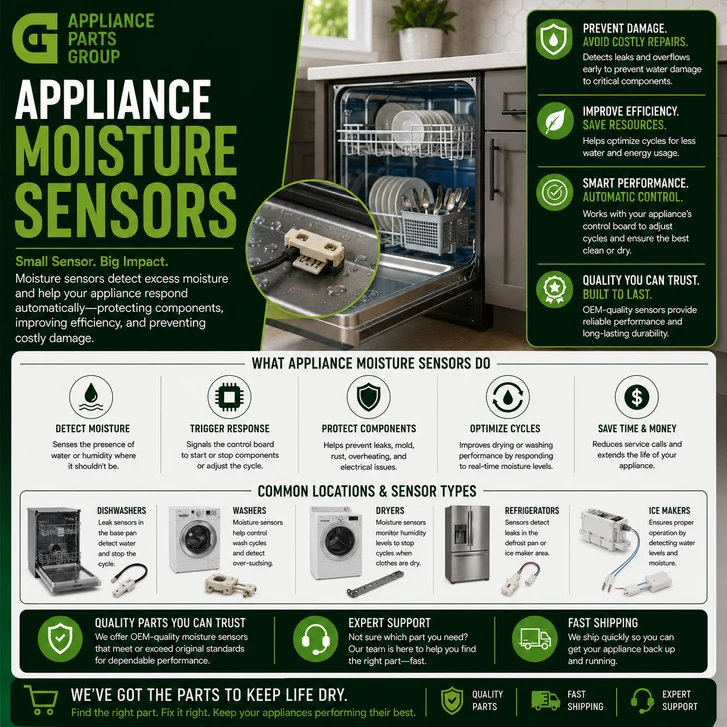
- Moisture sensors help modern appliances monitor moisture conditions and make automatic operating decisions.
- Dryer moisture sensors are especially important because they help automatic drying cycles determine when clothing has reached the selected dryness level.
- Dirty sensor bars, loose wiring, damaged components, airflow problems, and control issues can all cause symptoms that resemble moisture sensor failure.
- A dryer that stops too early, runs too long, or leaves clothing damp may have a moisture-sensing problem, but the entire drying system should be checked before replacing parts.
- When replacement is necessary, use the appliance model number to identify the correct OEM moisture sensor or related component.
Introduction
Modern appliances make hundreds of small decisions during normal operation. A dryer determines whether clothing is still damp. A washer adjusts cycles based on conditions inside the machine. Advanced laundry systems monitor temperature, airflow, water, and moisture to improve performance while reducing unnecessary energy consumption.
Behind many of these decisions are sensors.
One particularly important component in modern laundry equipment is the moisture sensor. Although relatively small compared with a motor, drum, or electronic control board, a moisture sensor can have a major influence on how an appliance performs.
Dryers provide the most familiar example. Instead of simply running for a predetermined number of minutes, many modern dryers offer automatic or sensor-dry cycles. During these cycles, the dryer monitors the condition of the laundry and uses that information to determine when the load is sufficiently dry.
When the moisture-sensing system works correctly, it can help prevent overdrying, reduce unnecessary cycle time, conserve energy, and protect fabrics. When it does not work correctly, homeowners may experience frustrating symptoms such as damp clothing, unusually long cycles, or a dryer that shuts off only a few minutes after starting.
Understanding how appliance moisture sensors work can make these problems much easier to diagnose.
What Is an Appliance Moisture Sensor?
A moisture sensor is a component designed to help an appliance detect the presence or relative level of moisture. The exact design and operating principle vary considerably depending on the appliance and manufacturer.
In household dryers, one common design uses two conductive metal sensor bars located where tumbling clothing can contact them. Damp laundry can create an electrical path between the bars. The dryer's electronics interpret changes in that signal as part of the process of determining whether the load is still wet or approaching the selected dryness level.
The sensor does not work independently. Its information is interpreted by the dryer's electronic controls along with other operating conditions.
This distinction is important when troubleshooting. A dryer displaying symptoms associated with moisture detection does not automatically have a bad moisture sensor.
How Dryer Moisture Sensors Work
Traditional timed-dry cycles are relatively straightforward. The homeowner selects a drying time, and the dryer attempts to operate for approximately that amount of time unless another control or safety device interrupts the cycle.
Automatic drying is more sophisticated.
As wet clothing tumbles through the drum, fabric repeatedly contacts the moisture sensor bars. Damp fabric conducts electricity differently from dry fabric, allowing the electronic system to monitor changes as moisture is removed from the load.
The control system uses these readings to estimate when the laundry has reached the selected dryness target.
As clothing becomes progressively drier, sensor activity changes. Eventually, the control determines that the selected dryness level has been reached and begins completing or ending the cycle.
Depending on the dryer, moisture information may work alongside inputs from components such as:
- Thermistors
- Temperature sensors
- Electronic control boards
- Cycle controls
- Airflow systems
- Heating components
This coordinated approach allows an automatic dryer cycle to respond to actual conditions rather than relying exclusively on a timer.
Why Moisture Sensors Matter
Moisture sensing may seem like a convenience feature, but it can affect several aspects of dryer operation.
Reduced Overdrying
Continuing to tumble already-dry laundry exposes fabrics to additional heat and mechanical movement. Accurate automatic drying can stop or reduce heating once the desired dryness level has been reached.
Potential Energy Savings
If a load requires 45 minutes to dry, there is little reason to operate the heating and airflow systems for 70 minutes. Sensor-controlled drying can reduce unnecessary operating time when conditions allow.
Better Fabric Care
Repeated overdrying can be hard on certain fabrics. Automatic dryness detection helps the appliance better match cycle duration to the actual condition of the load.
More Convenient Drying
Homeowners do not have to accurately predict how long every load will require. Towels, lightweight shirts, bedding, and mixed loads can contain very different amounts of water after washing.
The moisture-sensing system gives the appliance information it can use to make that decision automatically.
Common Symptoms of a Dryer Moisture Sensor Problem
A moisture-sensing problem can produce several noticeable symptoms. However, these symptoms can also have other causes, so diagnosis should come before replacement.
Dryer Stops Before Clothes Are Dry
One of the most recognizable complaints is an automatic cycle ending while the load is still noticeably damp.
If the dryer incorrectly determines that the laundry is dry, it may advance toward the end of the cycle prematurely.
Sensor contamination is one possible cause, but also check the cycle selection, load composition, wiring, airflow, heating performance, and related controls.
Dryer Runs Too Long
The opposite problem can occur when the appliance continues interpreting the load as wet after the clothing is already dry.
Long cycles should not immediately be blamed on the sensor. A restricted exhaust vent, clogged lint filter, weak heating system, overloaded drum, or excessively wet laundry entering the dryer can significantly increase drying time.
Automatic Cycles Behave Differently From Timed Dry
This is a particularly useful diagnostic clue.
If the dryer performs reasonably well during a timed cycle but behaves unpredictably during sensor-controlled cycles, the moisture detection system deserves closer inspection.
It does not prove the sensor is defective, but it helps narrow the investigation.
Clothes Are Consistently Overdried
A dryer that repeatedly continues heating well after laundry feels dry may not be interpreting moisture information correctly. Cycle settings and load size should be checked before assuming a component has failed.
Inconsistent Results Between Loads
Not every inconsistent load indicates a repair problem. Mixed fabrics can make moisture detection more difficult because thin garments may dry much faster than heavy towels, jeans, or bedding.
Very small loads can also have less consistent contact with sensor bars.
Why Moisture Sensor Bars Become Dirty
One of the advantages of checking moisture sensor bars is that apparent sensor trouble does not always require a new part.
The metal sensing surfaces can accumulate residue over time. Laundry products, fabric treatments, dryer sheets, lint, and other deposits may leave a film on the bars.
If enough residue accumulates, the sensing surface may have difficulty responding normally to damp fabric.
Cleaning procedures vary by manufacturer, so consult the appliance's use-and-care or service information before applying a cleaner. Avoid aggressive abrasives or chemicals that could damage the sensor, surrounding plastic, or drum finish.
If careful cleaning restores normal automatic-cycle operation, replacement may not be necessary.
Moisture Sensors in Heat Pump and Ventless Dryers
Moisture detection is becoming even more relevant as laundry technology evolves.
Heat pump dryers, condenser dryers, and washer-dryer combination machines manage moisture differently from conventional vented dryers. Instead of simply exhausting warm, humid air outdoors, these appliances may condense moisture and recirculate air internally.
Electronic controls coordinate multiple components, potentially including temperature sensors, moisture sensors, pumps, fans, heat exchangers, compressors, and other devices depending on the design.
A moisture-related drying complaint in one of these appliances therefore requires a system-level approach. A sensor may be functioning correctly while another condition prevents the appliance from actually removing moisture at the expected rate.
For example, restricted airflow, dirty filters, heat-exchanger contamination, drainage trouble, or a heating-system problem can leave clothes damp even though the moisture sensor is correctly reporting that moisture remains.
Moisture Sensor vs. Thermistor: What's the Difference?
These components are easy to confuse because both provide information to an appliance's electronic controls.
A moisture sensor helps determine moisture conditions, particularly the dryness of laundry in a dryer.
A thermistor responds to temperature. Its electrical resistance changes as temperature changes, giving the electronic control information about operating temperature.
Both can influence a dryer's automatic cycles, but they perform different jobs.
This is one reason diagnosing a modern dryer based only on symptoms can be misleading. Long drying times, premature shutdown, or poor drying performance may involve moisture detection, temperature detection, airflow, heat generation, or electronic controls.
Step-by-Step Troubleshooting
- Disconnect power. Unplug the appliance or disconnect electrical power according to the manufacturer's service instructions before accessing components.
- Identify the affected cycles. Determine whether the problem occurs during automatic sensor cycles, timed cycles, or both.
- Check the load. Very small loads, overloaded drums, or loads containing dramatically different fabric weights can produce inconsistent drying results.
- Inspect the lint filter. A heavily restricted lint filter can reduce airflow and extend drying time.
- Check the exhaust system on vented dryers. Restricted ductwork can prevent moisture from leaving the dryer efficiently and should be corrected promptly.
- Locate the moisture sensor. Refer to the model-specific service information. Many dryers use metal sensing bars near the lint-filter or drum-opening area.
- Inspect the sensing surface. Look for visible residue, lint, corrosion, physical damage, or other contamination.
- Clean the sensor appropriately. Follow manufacturer recommendations and avoid damaging the sensing surface.
- Inspect wiring and connectors. Loose, damaged, corroded, or disconnected wiring can prevent a functioning sensor from communicating properly with the control system.
- Check related components. Depending on the symptom, inspect temperature sensors, heating components, airflow components, and electronic controls.
- Run a test cycle. After reassembly, compare automatic-cycle performance with the original symptoms.
- Replace the appropriate component if testing confirms failure. Use the complete appliance model number to identify the correct OEM replacement part.
Common Parts That May Need Replacement
Moisture Sensor Bars
Conductive sensor bars are among the most recognizable dryer moisture-sensing components. They are positioned so damp laundry can contact them while tumbling.
Physical damage, corrosion, connection problems, or a sensor that cannot be restored through proper cleaning may justify replacement.
Moisture Sensor Harnesses and Wiring
A good sensor cannot communicate with the electronic controls through damaged wiring. Inspect connectors, terminals, harnesses, and attachment points when troubleshooting sensor-related symptoms.
Thermistors
A dryer thermistor monitors temperature rather than moisture, but its information can significantly affect automatic drying performance.
A thermistor providing inaccurate information may create symptoms that appear to involve moisture sensing.
Electronic Control Boards
The control board interprets sensor information and coordinates dryer operation. A control problem can therefore affect how moisture-sensor information is processed.
Because control boards can be more expensive than individual sensors, confirm the surrounding system before replacing one.
Heating Elements and Gas Heating Components
A moisture sensor cannot dry clothing by itself. If the heating system is not producing the required heat, the laundry may remain wet regardless of how accurately the sensor operates.
Blower Wheels and Airflow Components
Drying requires both heat and airflow. A damaged blower wheel or severe airflow restriction can cause long drying times that might initially be mistaken for sensor trouble.
Lint Filters and Filter Assemblies
A damaged or badly restricted filter can interfere with airflow. Heat pump and ventless dryers may contain additional filtration components that require regular maintenance.
Condensate Pumps and Drain Components
Ventless and heat pump appliances may use pumps and drainage systems to remove condensed water. A drainage failure can affect overall drying performance even if the moisture-sensing system itself is operating normally.
Always match replacement parts using the complete model number from the appliance identification label. Even visually similar sensors can have different mounting arrangements, connectors, electrical characteristics, or applications.
Should You Replace a Moisture Sensor or Clean It?
Replacement should not automatically be the first step.
If sensor bars are simply coated with residue and are otherwise intact, proper cleaning may restore performance. If the bars are damaged, the connections are compromised, or model-specific testing indicates that a sensor component has failed, replacement may be appropriate.
It is equally important to avoid replacing the moisture sensor when the real problem is elsewhere.
If clothing takes a very long time to dry on both timed and automatic cycles, investigate airflow and heating performance. If the dryer produces no heat, diagnose the heating circuit. If a ventless dryer cannot remove condensed water, inspect its filters and condensation-management system.
Good appliance repair is based on identifying the failed function rather than replacing the component whose name most closely matches the symptom.
Why the Appliance Model Number Matters
Searching for a "dryer moisture sensor" is only the beginning of finding a replacement.
Manufacturers use different moisture sensors across appliance families, and designs can change between model revisions. The correct component may be an individual sensor bar, a pair of bars, a harness, a sensor assembly, or part of a larger housing.
The appliance model number is therefore one of the most important pieces of information when purchasing OEM appliance parts.
Depending on the manufacturer, a dryer model tag may be found around the door opening, on the cabinet frame, behind the door, or on another identification label specified by the manufacturer.
Use the complete model number whenever possible rather than relying exclusively on the appliance's appearance or marketing name.
Preventative Maintenance Tips
- Clean the lint filter regularly. Proper airflow is essential for effective moisture removal.
- Maintain the exhaust vent. Vented dryers need an unobstructed path for humid air to leave the home.
- Keep sensor bars clean. If the manufacturer recommends periodic cleaning, preventing residue buildup can improve reliable sensor contact.
- Avoid routinely overloading the dryer. Clothing needs room to tumble and contact sensing surfaces.
- Sort extremely different fabrics when practical. Heavy towels and lightweight synthetic clothing may reach the desired dryness level at different times.
- Maintain ventless dryer filters and heat exchangers. Follow manufacturer instructions because these systems depend heavily on clean internal airflow.
- Pay attention to changing cycle times. A gradual increase in drying time can indicate an airflow, heating, sensing, or maintenance issue.
- Address damaged wiring promptly. Loose connections and heat-damaged terminals can create intermittent problems.
- Use the correct cycle. Automatic drying performs best when the selected cycle matches the fabric and load type.
- Follow manufacturer maintenance instructions. Sensor designs and recommended cleaning methods vary by model.
The Growing Role of Sensors in Modern Appliances
Moisture sensors are part of a much larger transition toward sensor-driven appliances.
Modern refrigerators use temperature sensors to regulate cooling. Washers can use pressure, water-level, position, and load-sensing technologies. Dishwashers may monitor temperature and water conditions. Dryers combine moisture and temperature information with increasingly sophisticated electronic controls.
As heat pump dryers, combination laundry machines, and connected appliances become more common, accurate sensor information becomes increasingly important.
That also changes appliance repair. Mechanical components such as belts, bearings, rollers, motors, and pumps remain important, but technicians and homeowners increasingly encounter sensors, wiring harnesses, electronic controls, diagnostic codes, and feedback systems.
Understanding the relationship between these components helps prevent unnecessary part replacement and makes troubleshooting more systematic.
Frequently Asked Questions
What does a dryer moisture sensor do?
A dryer moisture sensor helps the appliance determine whether clothing is still damp during an automatic drying cycle. The electronic controls use sensor information to help decide when the load has reached the selected dryness level.
Where is the moisture sensor located in a dryer?
Location varies by manufacturer and model. Many dryers use metal sensor bars near the lint-filter housing or inside the drum area where tumbling clothing can contact them. Check model-specific documentation before disassembly.
What are the symptoms of a bad dryer moisture sensor?
Possible symptoms include automatic cycles ending too early, clothes remaining damp, cycles running longer than expected, overdrying, or inconsistent sensor-dry performance. These symptoms can also have other causes.
Can dryer moisture sensors get dirty?
Yes. Residue from laundry products, lint, and other deposits can accumulate on some sensor bars and interfere with normal sensing. Follow the manufacturer's recommendations when cleaning them.
Can I clean a dryer moisture sensor instead of replacing it?
Sometimes. If contamination is causing the problem and the sensor is otherwise undamaged, proper cleaning may restore operation. Damaged or electrically failed components may require replacement.
Why does my dryer stop when my clothes are still damp?
Possible causes include sensor contamination, small or mixed loads, incorrect cycle selection, wiring problems, moisture-sensing issues, airflow restrictions, or control problems. Diagnose the complete drying system before replacing parts.
Why does my sensor dry cycle take so long?
Long sensor-dry cycles can result from very wet laundry, overloading, restricted airflow, a clogged exhaust vent, inadequate heating, sensor problems, or related temperature and control issues.
Is a moisture sensor the same as a thermistor?
No. A moisture sensor helps detect moisture conditions, while a thermistor responds to temperature. Both may provide information used by a dryer's electronic control system.
Do heat pump dryers use moisture sensors?
Many modern heat pump and ventless dryers use moisture sensing as part of their automatic drying systems. Exact sensor designs and operating strategies vary by manufacturer and model.
Can a clogged dryer vent look like a moisture sensor failure?
Yes. Restricted airflow can cause unusually long drying times and damp laundry. Always inspect the airflow system when diagnosing poor dryer performance.
How do I find the correct replacement moisture sensor?
Locate the complete appliance model number and use it to identify compatible replacement components. Do not assume that two sensors are interchangeable simply because they look alike.
Should I replace the control board if a moisture sensor cycle does not work?
Not without further diagnosis. Check the sensor surfaces, wiring, connectors, airflow, heating system, temperature sensors, and other relevant components before concluding that the electronic control board has failed.
Entities and Terms
- Appliance moisture sensor
- Dryer moisture sensor
- Moisture sensor bar
- Sensor dry cycle
- Automatic drying cycle
- Thermistor
- Temperature sensor
- Electronic control board
- Wiring harness
- Lint filter
- Dryer exhaust vent
- Blower wheel
- Heating element
- Heat pump dryer
- Ventless dryer
- Condenser dryer
- Condensate pump
- OEM dryer parts
- OEM appliance parts
Final Thoughts
Moisture sensors demonstrate how a relatively small component can influence the performance of an entire appliance. In modern dryers, accurate moisture detection helps automatic cycles determine when laundry has reached the desired dryness level, potentially reducing unnecessary drying time and improving fabric care.
When automatic drying stops working correctly, however, avoid assuming the moisture sensor itself has failed. Dirty sensor bars, restricted airflow, heating problems, wiring faults, temperature-sensing issues, load conditions, and electronic controls can produce similar symptoms.
Start with simple maintenance and inspection, diagnose the complete system, and use the appliance's full model number when replacement parts are required. Correct identification is especially important as today's heat pump, ventless, combination, and electronically controlled appliances rely on increasingly integrated sensor systems.
This article was written by an AI program as part of a beta test by Appliance Parts Group to explore how artificial intelligence can help inform and educate our customers.
Our goal is to use AI tools to provide clear, reliable information so you can make confident, well-informed purchasing decisions.