
Key Takeaways
- Appliance inverter boards electronically control the speed and power supplied to variable-speed motors, compressors, and other compatible components.
- Inverter technology can help appliances operate more efficiently, quietly, and precisely than systems that rely only on simple on/off motor control.
- A failed inverter board can cause symptoms such as a refrigerator not cooling, a washer drum not turning, intermittent operation, error codes, or a motor that will not start.
- Diagnosing an inverter board requires checking the power supply, wiring, connectors, related sensors, motor or compressor, and main control board before assuming the inverter itself has failed.
- When replacement is required, the appliance model and complete part number should be used to identify the correct OEM inverter board because visually similar boards are not necessarily interchangeable.
Introduction
Modern appliances are increasingly designed around electronics that can make them quieter, more efficient, and more precise. One of the components helping make that possible is the appliance inverter board.
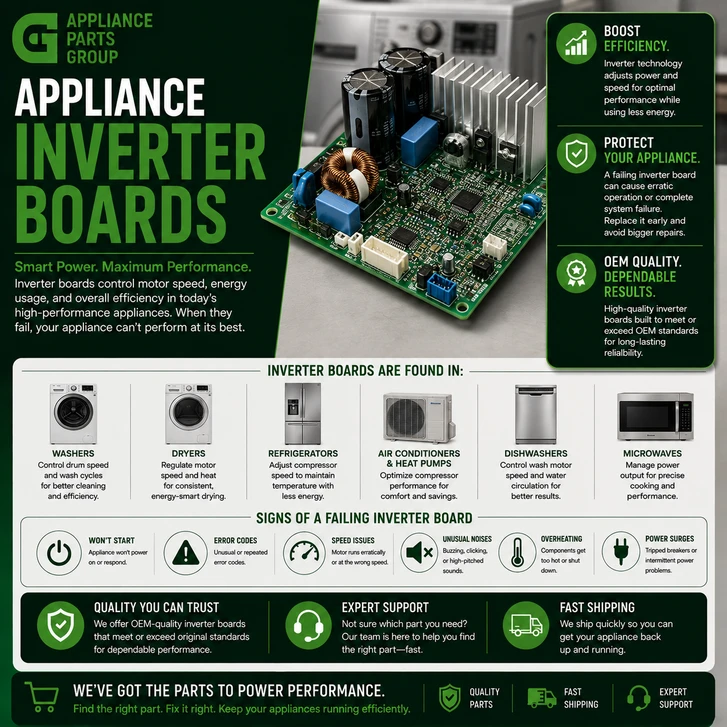
Inverter boards can be found in refrigerators, washing machines, air conditioners, and other appliances equipped with variable-speed motors or compressors. Instead of simply switching a motor on at full power and turning it off when it is no longer needed, an inverter system can adjust how the component operates according to changing demand.
That flexibility offers significant advantages, but it also changes appliance repair. A refrigerator that is running but not cooling, for example, could have a compressor problem, a main control problem, a wiring problem, or an inverter board that is not properly driving the compressor. A washer that will not spin may have a similar relationship between its electronic controls, inverter, and drive motor.
Understanding what an inverter board does—and what it does not do—can make troubleshooting modern appliances much easier. This guide explains how appliance inverter boards work, where they are used, symptoms associated with failure, diagnostic considerations, and what to know when ordering an OEM replacement inverter board.
What Is an Appliance Inverter Board?
An appliance inverter board is an electronic power-control component used to operate certain motors and compressors. Depending on the appliance design, it may also be called an inverter control board, inverter PCB, motor inverter, compressor inverter, drive inverter, or inverter assembly.
The basic purpose of inverter technology is to provide more precise control over an electrically driven component. Rather than supplying only a fixed operating condition, inverter electronics can modify the electrical output delivered to a compatible motor or compressor.
In simplified terms, an inverter system typically takes incoming electrical power, processes it electronically, and produces the controlled output required by the motor or compressor. The exact design varies considerably between manufacturers and appliance models.
This allows the appliance to operate a component at different speeds or capacities instead of relying exclusively on full-power on/off cycling.
How Appliance Inverter Boards Work
An inverter board generally works as part of a larger electronic control system. It should not be confused with the appliance's main control board, although some designs may integrate multiple functions into one assembly.
For example, consider an inverter refrigerator. Temperature sensors monitor conditions inside the refrigerator and freezer compartments. The main electronic control interprets that information and determines how much cooling is required. It can then communicate the appropriate operating request to the compressor inverter electronics.
The inverter controls the electrical power supplied to the compatible compressor, allowing compressor operation to change as cooling demand changes.
A similar concept can be used in a front-load washing machine. The main control determines what the washer should be doing during a particular portion of the cycle. The inverter or motor-control electronics then manage operation of the drive motor. This permits carefully controlled tumbling, distribution, and high-speed spinning.
Because the inverter sits between electronic commands and a major operating component, a problem anywhere in that chain can sometimes produce similar symptoms.
Where Are Inverter Boards Used?
Inverter technology has become increasingly common as manufacturers develop appliances with variable-speed components and sophisticated electronic controls.
Refrigerators
One of the most recognizable applications is the refrigerator compressor inverter board. Variable-speed compressors can adjust their operation as cooling demand changes. Instead of repeatedly starting and stopping in the same manner as some traditional compressor systems, an inverter-driven compressor may operate at different speeds or capacities.
Depending on the refrigerator design, the compressor inverter may be a separate module located near the compressor. A failure in this circuit can result in a refrigerator with functioning lights, fans, and controls but inadequate cooling if the compressor is not being driven correctly.
Washing Machines
Many modern washers use electronically controlled drive motors. An inverter board or motor-control system can precisely manage motor speed and direction during washing, load distribution, and spinning.
When problems occur in this system, symptoms may include a drum that will not rotate, intermittent tumbling, failure to reach spin speed, unusual motor behavior, or manufacturer-specific fault codes.
Air Conditioners and Heat Pumps
Variable-speed compressor and fan technology is also widely associated with modern air-conditioning and heat-pump equipment. Inverter electronics allow compatible components to adjust output according to demand rather than operating exclusively at a single fixed capacity.
Other Appliances
Inverter and variable-frequency motor-control technology can appear in other appliances and equipment as well. The terminology varies by manufacturer, so a component performing an inverter-related function may be described in a parts diagram as an inverter PCB, motor control, drive board, compressor control, inverter assembly, or similar name.
Why Manufacturers Use Inverter Technology
Variable-speed control offers several potential advantages. A motor or compressor does not always need to operate at maximum output, so changing its speed according to actual demand can help the appliance operate more efficiently.
More precise speed control can also contribute to quieter operation. Instead of repeatedly transitioning between completely off and full output, certain inverter-driven systems can maintain operation at a lower level when conditions permit.
In washers, variable motor control makes it possible to create different drum movements for different portions of the cycle. In refrigeration, variable compressor control can help maintain more consistent temperatures. The exact benefits depend on the design of the appliance.
Common Symptoms of a Failing Inverter Board
There is no single symptom that proves an inverter board is defective. Inverter-related problems frequently overlap with failures involving the component being driven, wiring, sensors, power supply, or main electronic control.
Possible symptoms can include:
- Appliance will not start or complete normal operation
- Refrigerator runs but does not cool properly
- Inverter compressor does not start
- Washer drum will not rotate or spin
- Motor operates intermittently
- Appliance stops unexpectedly during a cycle
- Motor or compressor runs at an incorrect or inconsistent speed
- Error or diagnostic codes related to motor, compressor, inverter, or communication circuits
- Repeated attempts to start a motor or compressor
- Visible damage on the inverter board
- Burnt electrical odor near the inverter module
These symptoms should be treated as reasons to investigate the inverter system rather than proof that the board itself needs replacement.
Common Causes of Inverter Board Failure
Electrical Stress
Inverter boards contain power electronics that handle significant electrical loads. Voltage disturbances, electrical faults, and problems elsewhere in the appliance can place stress on these components.
Excessive Heat
Electronic components generate heat during operation. Many inverter assemblies use heat sinks and carefully designed airflow to manage operating temperatures. Restricted ventilation, heavy dust accumulation, or abnormal electrical loads can contribute to excessive heat.
Moisture and Contamination
Water and electronics are a poor combination. Leaks, condensation, excessive humidity, or contamination can damage connectors and electronic circuitry.
Motor or Compressor Problems
A problem with the motor or compressor being controlled may produce symptoms that appear to point toward the inverter. This is one reason replacing an inverter board based only on symptoms can result in an unsuccessful repair.
Wiring and Connector Problems
A damaged wire, corroded terminal, loose connector, or poor electrical connection can interrupt either power or communication between components. Always inspect accessible harnesses and connectors when diagnosing an electronic control problem.
Component Aging
Like other electronic assemblies, inverter boards can eventually fail from normal component aging and repeated thermal and electrical stress.
Inverter Board vs. Main Control Board
Although both are electronic circuit boards, an inverter board and main control board generally perform different jobs.
The main control board coordinates overall appliance operation. It may process temperature readings, monitor switches, manage cycles, control valves and fans, and communicate with other electronic modules.
The inverter board is more directly involved in controlling the electrical output delivered to a compatible variable-speed motor or compressor.
In some appliances, these functions may be combined or terminology may differ. Always use the model-specific wiring diagram, service information, and parts documentation when determining how a particular appliance is designed.
Step-by-Step Troubleshooting
- Disconnect power. Unplug the appliance or switch off the appropriate circuit breaker before removing panels or handling wiring. Inverter electronics may involve hazardous voltages, and some components can retain an electrical charge after power is removed.
- Record the symptoms. Determine exactly what the appliance is and is not doing. Note error codes, unusual sounds, when the problem occurs, and whether the failure is constant or intermittent.
- Check manufacturer diagnostic information. Consult the appliance's technical documentation when available. Error codes can help narrow the problem to a particular system, but they do not always identify the failed part directly.
- Inspect wiring and connectors. With power safely disconnected, inspect accessible harnesses and connectors between the main control, inverter, sensors, motor, or compressor. Look for loose connections, damaged terminals, corrosion, overheating, and broken wiring.
- Inspect the inverter board. Look for obvious physical damage such as discoloration, burnt areas, damaged connectors, or other signs of overheating. A board can still fail without visible damage, however.
- Check related components. Depending on the appliance, sensors, motors, compressors, wiring, and the main control may need to be tested before condemning the inverter.
- Perform electrical testing only when qualified. Some inverter systems involve line voltage, stored electrical energy, and specialized testing procedures. Follow manufacturer procedures and use appropriately rated test equipment. If you are not trained to work safely around these circuits, contact a qualified appliance service technician.
- Confirm the replacement part number. If testing confirms a defective inverter, use the appliance's complete model information to identify the correct OEM replacement. Do not order a board solely because it looks similar to the original.
Why Inverter Boards Can Be Difficult to Diagnose
Electronic inverter systems create an important troubleshooting challenge: the inverter is only one part of a chain.
For an inverter-driven component to work properly, the appliance may need correct incoming power, a functioning main control, accurate sensor information, intact communication wiring, a working inverter, and a functional motor or compressor.
A failure at several different points in that chain can produce the same final result: the motor or compressor does not operate.
For example, immediately replacing a refrigerator compressor inverter because the compressor is not running may overlook a wiring fault or another control-system problem. Likewise, replacing a washer inverter because the drum will not spin may not solve a defective drive motor or harness problem.
Model-specific diagnosis is particularly important with inverter technology.
Common Parts That May Need Replacement
When troubleshooting an inverter-controlled appliance, several components may ultimately require replacement depending on the diagnosis.
OEM Inverter Board
If testing confirms that the inverter electronics have failed, the inverter board or complete inverter module may require replacement. Some manufacturers supply the circuit board separately, while others provide it as part of an enclosure or control assembly.
Main Electronic Control Board
If the inverter is not receiving the appropriate command or communication signal, the main electronic control or related circuitry may be involved. Control-board diagnosis should follow the manufacturer's service procedure whenever possible.
Variable-Speed Compressor
In an inverter refrigerator or cooling system, a compressor fault can sometimes resemble an inverter failure. Compressor diagnosis may require specialized procedures and should generally be handled by a qualified refrigeration technician when sealed-system work is involved.
Drive Motor
In a washing machine or other motor-driven appliance, the drive motor itself may be responsible for a no-spin or no-movement condition rather than the inverter board.
Wiring Harnesses and Connectors
Damaged harnesses, terminals, and connectors can interrupt power or communication. A wiring repair may resolve a problem that initially appeared to be an electronic board failure.
Sensors
Modern appliance controls rely heavily on sensor data. A faulty temperature, position, speed, or other sensor can cause unexpected appliance behavior and may generate diagnostic errors.
When ordering an OEM appliance inverter board, always verify compatibility using the appliance's complete model number and the manufacturer's replacement-part information. Inverter boards that appear nearly identical can have different electronics, programming, connectors, voltage requirements, or applications.
Examples of OEM Appliance Inverter Boards
Appliance Parts Group carries genuine OEM inverter-related components for multiple appliance applications and manufacturers. Examples include refrigerator compressor inverter controls, washer inverter boards, and dedicated inverter control assemblies.
Because part numbers can be superseded and compatibility depends on the exact appliance model, shoppers should verify their model information before ordering. A visual match alone is not sufficient for electronic appliance components.
Replacing an Appliance Inverter Board
Replacement difficulty varies dramatically by appliance. Some inverter modules are accessible after removing a service panel and disconnecting several plugs. Others are installed near high-voltage or refrigeration components where professional service may be appropriate.
Before replacement, disconnect electrical power and follow the manufacturer's safety procedures. Photographing connector locations before removal can also be useful when multiple harnesses are involved.
Never assume two connectors are interchangeable simply because they fit. Install the replacement exactly as specified, including covers, shields, grounding provisions, fasteners, and heat-management components.
Some appliance electronics may also require programming, configuration, or model-specific setup after installation. Check the service documentation for the particular appliance before beginning the repair.
Choosing the Correct OEM Inverter Board
Electronic parts are highly model-specific. The safest way to find a replacement is to start with the complete appliance model number from the manufacturer's identification label.
Next, locate the inverter or control board in the appropriate model-specific parts diagram or manufacturer documentation. Check whether the original part number has been replaced or superseded by a newer number.
OEM replacement inverter boards are designed for the specified appliance application, including the necessary electrical characteristics, connectors, mounting arrangement, and manufacturer-defined compatibility.
Appliance Parts Group lists genuine OEM inverter components such as GE Appliances inverter boards and compressor inverter controls, along with inverter assemblies from other appliance manufacturers. Always confirm the exact application before purchase.
Preventative Maintenance Tips
- Keep ventilation areas clean. Dust accumulation can restrict airflow around electronics, motors, compressors, and cooling components.
- Address leaks promptly. Water leaking into an electronic compartment can damage boards, connectors, and wiring.
- Maintain refrigerator condenser areas. Follow manufacturer recommendations for cleaning accessible condenser areas and maintaining airflow.
- Do not ignore intermittent faults. Repeated error codes, unexpected shutdowns, or unusual motor behavior may indicate a developing problem.
- Inspect wiring during repairs. Loose or overheated connectors should not be ignored when replacing another component.
- Follow installation requirements. Proper appliance clearance and ventilation can help electronic and mechanical components operate within their intended temperature ranges.
- Use the correct electrical supply. Appliances should be connected and grounded according to manufacturer instructions and applicable electrical requirements.
Frequently Asked Questions
What does an appliance inverter board do?
An appliance inverter board electronically controls power supplied to certain variable-speed motors or compressors. It allows compatible components to operate at different speeds or capacities according to appliance demand.
What appliances use inverter boards?
Inverter boards are commonly found in modern refrigerators, washing machines, air conditioners, heat pumps, and other appliances or equipment using variable-speed motors or compressors.
What are the symptoms of a bad refrigerator inverter board?
Possible symptoms include inadequate cooling, a compressor that does not start, intermittent compressor operation, or inverter-related error conditions. These symptoms can also be caused by the compressor, wiring, main control, sensors, or power supply, so diagnosis is important.
Can a bad inverter board cause a refrigerator not to cool?
Yes. If a refrigerator's compressor relies on an inverter and the inverter cannot properly operate the compressor, cooling can be affected. However, many other refrigerator problems can also cause a no-cooling condition.
Can an inverter board be repaired?
Electronic boards can sometimes be repaired by specialized electronics services, but appliance service procedures frequently specify replacement of the complete inverter board or module. The appropriate approach depends on the component and manufacturer.
Is an inverter board the same as a control board?
Not necessarily. A main control board generally manages overall appliance operation, while an inverter board typically controls electrical output to a compatible motor or compressor. Some appliance designs integrate multiple functions into one assembly.
Why do appliance inverter boards fail?
Possible causes include electrical stress, excessive heat, moisture, damaged wiring or connectors, problems with related components, and normal electronic component aging.
Can I replace an appliance inverter board myself?
Replacement depends on the appliance and your electrical repair experience. Inverter circuits can involve hazardous voltages and stored electrical energy. Homeowners who are not qualified to work safely with electrical systems should use a trained appliance technician.
How do I know whether the inverter board or compressor is bad?
The symptoms can overlap, so model-specific diagnostic procedures are usually required. Testing may involve checking power, wiring, control signals, inverter operation, and the compressor according to manufacturer service information.
Do inverter boards need to be programmed?
Some electronic appliance components may require configuration, programming, or model-specific setup, while others are installed without additional programming. Always check the service instructions for the exact replacement part and appliance model.
How do I find the correct replacement inverter board?
Use the complete appliance model number to locate the manufacturer-specified inverter board. Check for official part-number supersessions and verify compatibility rather than relying on appearance alone.
Should I use an OEM inverter board?
OEM inverter boards provide manufacturer-specified compatibility for the models listed for that part. Because inverter controls are electronically and mechanically application-specific, verifying the exact OEM part number is an important step before replacement.
Entities and Terms
- Appliance inverter board
- Inverter control board
- Printed circuit board (PCB)
- Variable-frequency drive
- Variable-speed motor
- Inverter compressor
- Refrigerator compressor inverter
- Washer inverter board
- Main electronic control board
- Drive motor
- Compressor
- Wiring harness
- Electrical connector
- Temperature sensor
- Motor speed sensor
- Heat sink
- OEM replacement parts
Understanding Inverter Technology Makes Modern Appliance Repair Easier
Inverter boards are an important part of the shift toward smarter, quieter, and more precisely controlled appliances. By electronically controlling compatible motors and compressors, inverter technology allows an appliance to adjust operation according to changing conditions rather than relying exclusively on fixed-speed operation.
The same sophistication makes accurate troubleshooting especially important. A motor or compressor that does not operate is not automatically proof of a failed inverter board. Power, wiring, sensors, the main control, and the driven component can all be part of the diagnostic process.
When an inverter board does require replacement, identifying the appliance by its complete model number and selecting the correct OEM replacement part helps ensure proper compatibility. Appliance Parts Group supplies genuine OEM appliance components for residential and commercial appliance repairs, including inverter boards, control boards, motors, compressors, sensors, and related electrical components.
This article was written by an AI program as part of a beta test by Appliance Parts Group to explore how artificial intelligence can help inform and educate our customers.
Our goal is to use AI tools to provide clear, reliable information so you can make confident, well-informed purchasing decisions.