
Key Takeaways
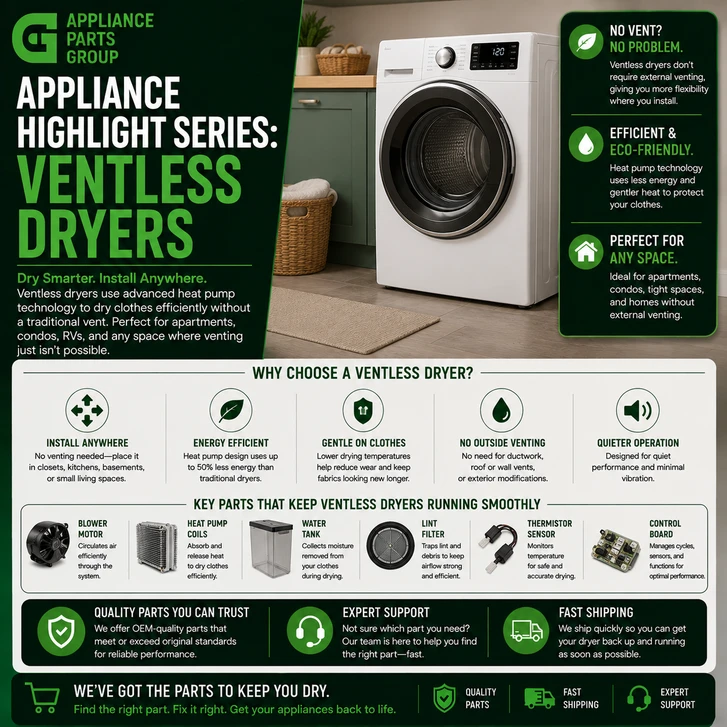
- Ventless dryers remove moisture from clothing without requiring a traditional exhaust duct to the outside of the building.
- The two primary ventless dryer technologies are condenser drying and heat pump drying, with heat pump models becoming increasingly common.
- Ventless dryers can be especially useful in apartments, condos, closets, older homes, and other locations where installing an exterior dryer vent is difficult or impractical.
- Filters, heat exchangers, condensers, moisture sensors, pumps, fans, and temperature sensors are important components that can affect ventless dryer performance.
- Routine filter cleaning and proper maintenance of the dryer’s condensation system can help prevent long drying times and maintain efficient operation.
Introduction
For decades, the traditional clothes dryer has operated according to a familiar formula: heat air, move that air through wet laundry, and exhaust the resulting warm, moisture-filled air through a vent leading outside. Ventless dryers take a different approach.
Instead of continuously exhausting heated air from the home, a ventless dryer operates with a more contained drying system. Moisture is extracted from clothing, condensed into liquid water, and either collected in a reservoir or discharged through a drain. Depending on the appliance, the dryer may use conventional condenser technology or a more advanced heat pump system.
This design gives homeowners considerably more flexibility when deciding where laundry equipment can be installed. Apartments, condominiums, closets, accessory dwelling units, older homes, and interior laundry rooms may not have convenient access to an exterior wall for a traditional dryer vent. A ventless dryer can make installing a dryer possible in many of these locations.
Ventless technology is also becoming more visible as manufacturers develop compact laundry appliances, heat pump dryers, and all-in-one washer-dryer combinations. Understanding how these appliances operate is useful not only when purchasing one, but also when diagnosing drying problems and identifying components that may eventually require service or replacement.
What Is a Ventless Dryer?
A ventless dryer is a clothes dryer designed to remove moisture from laundry without exhausting humid air through a conventional exterior dryer duct.
A traditional vented dryer pulls air into the machine, heats it, circulates it through the drum, and sends the warm humid air outside. Because air is continuously discharged, the dryer requires properly sized ductwork and an exterior termination point.
A ventless dryer instead recirculates air through a largely closed drying process. Moisture removed from the clothing is converted into liquid water. That water can then be pumped into a household drain or stored in a removable container that the user periodically empties.
This fundamental difference allows ventless dryers to operate in locations where conventional dryer venting may not be available.
How Do Ventless Dryers Work?
Although specific designs vary by manufacturer and model, most ventless dryers repeatedly circulate air through the drum and a moisture-removal system.
During a drying cycle, air moves through the clothing and absorbs moisture. Instead of sending that humid air outdoors, the appliance routes it through components that cool the air enough for moisture to condense. The resulting water is collected or drained away, and the air is prepared to pass through the clothing again.
This process continues until the dryer determines that the load has reached the selected dryness level.
Modern ventless dryers frequently rely on temperature sensors, thermistors, moisture sensors, electronic controls, fans, pumps, and heat-exchange components to carefully manage this process.
Condenser Dryers vs. Heat Pump Dryers
Not every ventless dryer uses the same drying technology. Two of the most important categories are condenser dryers and heat pump dryers.
Condenser Dryers
A condenser dryer heats air and circulates it through wet laundry. The warm, humid air then travels through a condenser or heat exchanger where it is cooled. As the air cools, water vapor condenses into liquid.
The water is directed to a reservoir or drain system, while the air continues through the drying process.
Because condenser dryers do not need an exterior exhaust duct, they offer much greater installation flexibility than conventional vented dryers.
Heat Pump Dryers
Heat pump dryers are a more advanced form of ventless drying technology. Instead of simply producing heat and releasing much of that energy, the appliance uses a refrigeration-style heat pump circuit to transfer and reuse heat.
Depending on the design, this system can include components such as an evaporator, condenser, compressor, refrigerant tubing, fans, temperature sensors, and electronic controls.
Warm air passes through the clothing and absorbs moisture. The air then travels through the heat pump system, where moisture condenses. Heat recovered during this process can be returned to the circulating air instead of being discarded.
This recycling of thermal energy is one of the reasons heat pump dryers can use less electricity than many conventional electric resistance dryers.
Why Are Ventless Dryers Becoming More Popular?
Ventless drying technology addresses several challenges created by modern housing and appliance design.
Flexible Installation
One of the biggest advantages is the elimination of a conventional exterior dryer vent. Routing a large exhaust duct through walls, floors, ceilings, or roofs can be difficult in some buildings.
A ventless dryer can provide more options for placing laundry equipment in interior spaces, although the manufacturer's installation requirements must still be followed.
Compact Laundry Spaces
Ventless technology is commonly found in compact dryers and combination washer-dryer appliances. These machines can be useful in apartments, condos, small homes, secondary laundry areas, and other locations where floor space is limited.
Energy Efficiency
Heat pump dryers can recover and reuse heat that would otherwise be exhausted from the appliance. This can substantially change how energy is used during the drying process compared with a conventional electric dryer.
No Exterior Dryer Duct
Traditional dryer ducts require maintenance because lint can accumulate inside the ductwork and exterior vent hood. Eliminating the exterior exhaust system removes that particular maintenance requirement.
However, this does not mean a ventless dryer is maintenance-free. Its internal filters and heat-exchange components become especially important.
Do Ventless Dryers Take Longer to Dry Clothes?
Some ventless dryers, particularly heat pump models, may operate with lower air temperatures and longer cycle times than traditional high-temperature dryers.
That does not necessarily indicate a malfunction. The dryer may intentionally use a longer, lower-temperature process to remove moisture efficiently.
Cycle duration can also depend on load size, fabric type, washer spin speed, selected dryness level, room conditions, filter cleanliness, and the condition of the dryer itself.
A noticeable change from the dryer's normal performance is more significant than comparing its cycle time directly with a different type of dryer. If a ventless dryer suddenly takes much longer than it previously did, maintenance or troubleshooting may be necessary.
Common Ventless Dryer Problems
Ventless dryers share several components with conventional dryers, but their moisture-management systems create additional areas that may require attention.
Clothes Taking Too Long to Dry
Long drying times are one of the most common complaints associated with dryers in general. With a ventless model, begin by checking filters and other user-accessible airflow components.
Restricted airflow can reduce the dryer's ability to transfer heat and moisture efficiently. An overloaded drum or laundry entering the dryer excessively wet can also extend drying time.
Water Is Not Draining
Because a ventless dryer converts moisture into liquid water, that water must go somewhere. Depending on the model, it may enter a removable tank or be pumped through a drain hose.
A kinked hose, clogged drain path, full reservoir, blocked pump area, or failed condensate pump may prevent proper drainage.
Dryer Stops During the Cycle
A dryer that stops unexpectedly can have several possible causes, including overheating protection, airflow restrictions, temperature-sensing problems, electrical issues, or electronic control faults.
Some appliances may also stop or display an alert if the condensate reservoir is full or the drainage system cannot remove water.
Dryer Runs but Clothes Remain Damp
If the drum rotates normally but clothes consistently remain damp, check the selected cycle and load size first. Dirty moisture sensors may also cause inaccurate dryness detection.
More complex problems can involve temperature sensors, airflow components, heating systems, or heat pump components.
Unusual Noises
Ventless dryers still contain familiar mechanical dryer components such as drum rollers or supports, bearings, belts, drive motors, and blower assemblies. Squealing, scraping, rattling, or grinding sounds may originate from these components.
Heat pump models may also produce operating sounds associated with fans and compressor operation that are different from those of a conventional dryer.
Step-by-Step Troubleshooting
- Confirm the symptoms. Determine whether the problem is long drying time, no drying, drainage trouble, unusual noise, an error code, or failure to start.
- Check the load. Avoid overloading the drum and confirm that the washer completed a proper final spin. Clothing entering the dryer excessively wet will require substantially more drying time.
- Clean the lint filters. Remove lint from all user-serviceable filters according to the manufacturer's instructions. Some ventless dryers have more than one filtration point.
- Inspect the condensate system. If the dryer uses a water reservoir, empty it. If it drains automatically, inspect accessible drain tubing for kinks or obvious restrictions.
- Inspect accessible heat-exchange areas. Some models have user-serviceable condenser or heat exchanger areas. Clean only those components specifically identified for routine owner maintenance in the appliance manual.
- Clean moisture sensors. Residue from fabric-care products can coat sensor surfaces and interfere with automatic dryness detection.
- Check the selected program. Eco, delicate, low-temperature, and sensor cycles can behave differently from timed or higher-temperature programs.
- Look for error codes. Modern ventless dryers may identify problems with drainage, filters, sensors, temperature control, or other systems through the display.
- Power-cycle the appliance if appropriate. If permitted by the manufacturer, disconnect power briefly and restart the appliance to determine whether a temporary electronic fault clears.
- Consider professional diagnosis. Compressor, refrigerant-system, electrical, control-board, or internal heat-pump repairs can require specialized tools and training. Do not open sealed refrigeration systems or bypass safety devices.
Common Parts That May Need Replacement
The exact components found in a ventless dryer depend heavily on the manufacturer and model. Always use the appliance model number when identifying replacement parts.
Lint Filters and Filter Assemblies
Lint filtration is especially important because a ventless dryer recirculates air internally. Damaged filter screens, broken filter frames, or filters that no longer fit correctly may require replacement.
Condensate Pumps
Many ventless dryers use a small pump to move collected water through the drainage system. A failed or obstructed pump can result in standing water, drainage errors, interrupted cycles, or a full reservoir condition.
Drain Hoses and Tubing
Condensate travels through hoses and internal tubing. Damaged, leaking, kinked, or obstructed components can interfere with water removal.
Moisture Sensors
Automatic drying programs rely on sensors to help determine when clothing has reached the desired dryness level. Sensor problems can contribute to cycles ending too early or running longer than expected.
Thermistors and Temperature Sensors
Electronic dryers use thermistors and other sensors to monitor temperature throughout the drying system. Incorrect readings can affect heat regulation, cycle duration, and protective functions.
Blower Fans and Fan Motors
Air must move efficiently through the drum, filters, and heat-exchange system. A damaged blower wheel, obstructed fan, or failing fan motor can reduce airflow and drying performance.
Drive Belts, Rollers, and Drum Supports
Ventless technology changes how moisture is removed, but the drum still needs a mechanical system to rotate the laundry. Belts, rollers, bearings, pulleys, and related supports remain normal wear components on many designs.
Electronic Control Boards
The control system coordinates motors, sensors, pumps, fans, heating components, and cycle operation. Control-board replacement should generally follow proper diagnosis because another failed component can sometimes produce symptoms that appear to be a control problem.
Heat Pump Components
Heat pump dryers may contain a compressor, evaporator, condenser, refrigerant circuit, and associated sensors. These components are substantially different from the heating system found in a traditional resistance dryer.
Repairs involving the sealed refrigerant circuit should be performed by qualified service professionals using appropriate equipment and procedures.
When replacement is required, selecting the correct genuine OEM component by model number helps ensure the replacement matches the appliance's original design specifications.
Preventative Maintenance Tips
Proper maintenance is particularly important for ventless dryers because efficient airflow and heat transfer are central to the drying process.
- Clean lint filters regularly. Follow the manufacturer's recommended cleaning interval, which may be after every load for the primary lint filter.
- Do not overload the drum. Clothing needs room to tumble so air can circulate through the load.
- Use an adequate washer spin speed. Removing more water during the washer's final spin reduces the amount of moisture the dryer must remove.
- Maintain accessible heat exchangers and filters. Follow the owner's manual carefully because cleaning procedures differ between models.
- Keep moisture sensors clean. Residue can interfere with automatic drying programs.
- Inspect drainage components. Make sure external drain hoses remain correctly positioned and are not pinched or kinked.
- Empty the condensate reservoir when required. Models without a direct drain connection depend on the user emptying the collected water.
- Keep the installation area clean. Dust and lint around the appliance can eventually find their way into air passages and cooling areas.
- Follow manufacturer-specific maintenance instructions. Heat exchanger and condenser designs vary considerably, and components that are removable on one model may not be intended for owner removal on another.
Are Ventless Dryers Right for Every Home?
Ventless dryers offer significant advantages, but the best dryer depends on the installation and the homeowner's priorities.
They are particularly attractive where installing a conventional dryer vent is difficult. A ventless model can make laundry installation possible in interior rooms and other spaces that would otherwise require extensive ductwork.
Heat pump models can also appeal to homeowners interested in reducing the energy required for electric clothes drying. Lower drying temperatures may additionally provide gentler treatment for some fabrics.
On the other hand, homeowners accustomed to very fast conventional dryer cycles may notice that some ventless cycles take longer. Ventless machines also require consistent filter and condensation-system maintenance.
Before purchasing any dryer, check the manufacturer's requirements for electrical service, drainage, clearances, ambient temperature, ventilation around the appliance, and installation location.
The Future of Ventless Laundry Technology
Ventless drying is part of a broader shift in laundry appliance technology. Heat pump systems, improved electronic sensors, inverter-driven motors and compressors, connected controls, and combination washer-dryer designs are changing how manufacturers approach clothes drying.
One particularly important development is the increasing integration of ventless drying into all-in-one laundry machines. These appliances can wash and dry clothing in the same drum, eliminating the need to transfer a load between separate machines.
As these technologies become more common, appliance repair will continue to evolve as well. Technicians and knowledgeable DIYers may encounter components that historically were uncommon in residential dryers, including condensate pumps, multiple thermistors, heat exchangers, compressors, and more sophisticated electronic control systems.
Despite those changes, one repair principle remains the same: accurate model identification is critical. Similar-looking dryers can use completely different components, and manufacturers may revise parts during production.
Frequently Asked Questions
What is a ventless dryer?
A ventless dryer removes moisture from clothing without sending humid air through a conventional exterior exhaust duct. Moisture is condensed into liquid water and collected or drained away.
Does a ventless dryer need a dryer vent?
No conventional exterior dryer exhaust vent is required. However, the appliance must still be installed according to the manufacturer's requirements for clearance, electrical service, drainage, and surrounding airflow.
What is the difference between a condenser dryer and a heat pump dryer?
Both are ventless designs, but a heat pump dryer uses a refrigeration-style system to transfer and reuse heat. A conventional condenser dryer generally uses a different heating and condensation process.
Are heat pump dryers ventless?
Residential heat pump dryers are generally designed as ventless appliances. They recirculate drying air and condense extracted moisture rather than exhausting humid air outdoors.
Where does the water from a ventless dryer go?
Depending on the model, condensed water is either collected in a removable reservoir or pumped through a drain hose into a household drain.
Why is my ventless dryer taking so long to dry?
Possible causes include a large load, laundry entering the dryer too wet, dirty filters, restricted airflow, dirty accessible heat-exchange components, sensor problems, drainage issues, or component failure. Some heat pump cycles are also designed to operate longer at lower temperatures.
Do I need to clean a ventless dryer?
Yes. Ventless dryers require regular lint-filter maintenance, and some models require additional cleaning of filters, condenser areas, or heat-exchange components. Always follow the owner's manual for the specific model.
Can a ventless dryer be installed in a closet?
Many ventless dryers are designed for flexible installations, including certain closet applications, but required clearances and ventilation around the appliance vary. Always follow the manufacturer's installation instructions.
Why is there water inside my ventless dryer?
Small amounts of water can be associated with the normal condensation process, but unexpected standing water may indicate a full reservoir, clogged drainage path, kinked hose, or condensate pump problem.
Can I repair a heat pump dryer myself?
Basic maintenance such as cleaning user-serviceable filters may be appropriate for homeowners. Repairs involving high-voltage components, sealed refrigerant systems, compressors, or complex electronic diagnostics should generally be handled by a qualified technician.
What parts commonly fail in ventless dryers?
Potential replacement components include filters, condensate pumps, drain hoses, moisture sensors, thermistors, fan motors, blower components, drive belts, drum supports, and electronic controls. Heat pump models can also contain specialized refrigeration-system components.
How do I find the correct replacement part for my ventless dryer?
Locate the appliance's complete model number and use it when searching for replacement parts. Similar dryer models can use different components, so identifying a part by appearance alone is not recommended.
Entities and Terms
- Ventless dryer
- Heat pump dryer
- Condenser dryer
- Heat exchanger
- Condenser
- Evaporator
- Compressor
- Condensate pump
- Lint filter
- Moisture sensor
- Thermistor
- Temperature sensor
- Blower fan
- Fan motor
- Drive belt
- Drum roller
- Electronic control board
- Drain hose
- Refrigerant circuit
- Washer-dryer combination
This article was written by an AI program as part of a beta test by Appliance Parts Group to explore how artificial intelligence can help inform and educate our customers.
Our goal is to use AI tools to provide clear, reliable information so you can make confident, well-informed purchasing decisions.