
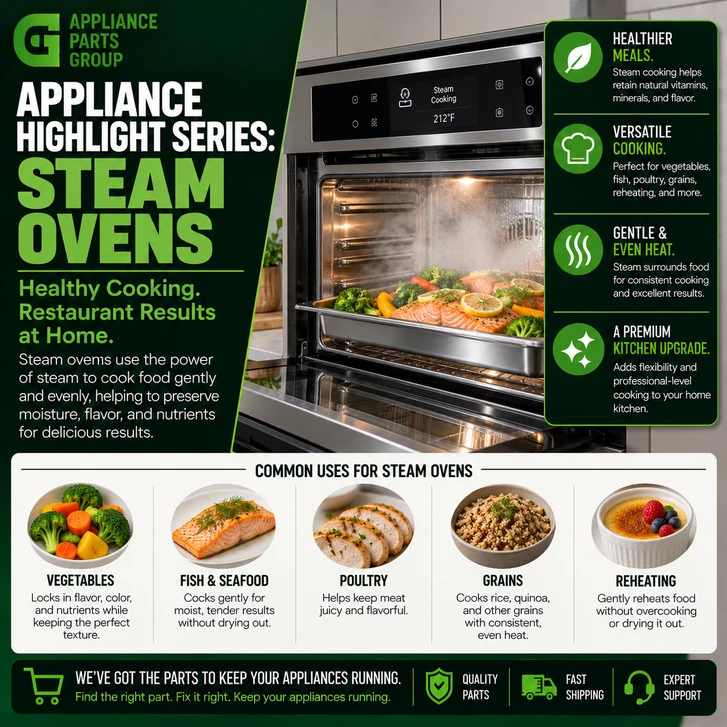
Steam ovens have moved beyond commercial kitchens and specialty cooking applications to become an increasingly popular option in modern homes. By using heated water vapor to cook food, these appliances offer a different approach from traditional ovens that rely primarily on dry heat. Depending on the appliance, a steam oven may cook entirely with steam or combine steam with conventional or convection heat for greater versatility.
For homeowners, steam ovens can provide precise temperature control, excellent moisture retention, and new ways to prepare everything from vegetables and seafood to bread, meats, leftovers, and desserts. For appliance service professionals, they also introduce specialized components such as water reservoirs, steam generators, pumps, valves, sensors, and drainage systems that are not normally found in a conventional wall oven.
In this installment of the Appliance Highlight Series, we'll look at how steam ovens work, the different types available, their major components, common problems, maintenance considerations, and the replacement parts that help keep them operating properly.
Key Takeaways
- Steam ovens use heated water vapor to transfer heat to food while helping retain moisture.
- Some models are dedicated steam ovens, while combination steam ovens can also use convection or traditional dry heat.
- Steam ovens may use a removable water reservoir or a direct household water connection, depending on the design.
- Water-related components such as steam generators, pumps, valves, hoses, sensors, and drains are important parts of the system.
- Regular cleaning and descaling can help reduce mineral buildup and maintain proper steam production.
What Is a Steam Oven?
A steam oven is a cooking appliance designed to introduce controlled amounts of water vapor into the cooking cavity. Instead of relying only on heated air, the appliance uses steam as part or all of the cooking process.
The basic idea is relatively simple. Water enters a steam-generating system, is heated until it becomes vapor, and is then introduced into the oven cavity. Sensors and electronic controls regulate temperature, cooking time, and, on more advanced models, the amount of steam used during different portions of the cooking cycle.
There are several variations of this technology. A dedicated steam oven primarily uses steam, while a combination steam oven can combine steam with convection heat. Some conventional wall ovens and ranges also offer steam-assisted cooking modes without functioning as full steam ovens.
How Is Steam Cooking Different From Conventional Baking?
A traditional oven heats food primarily through hot, relatively dry air and radiant heat. As food cooks, moisture naturally escapes from its surface. That moisture loss is useful for browning and crisping, but it can also dry out certain foods if cooking continues too long.
Steam creates a moist cooking environment. When hot vapor contacts cooler food, heat is transferred efficiently while the humid environment reduces surface moisture loss. This can be particularly useful for foods where tenderness and moisture retention are important.
Combination steam ovens attempt to provide the advantages of both methods. Steam can help maintain moisture while convection or other dry-heat elements provide the higher temperatures and surface conditions needed for browning.
Types of Steam Ovens
Dedicated Steam Ovens
Dedicated steam ovens are designed primarily around steam cooking. They are commonly installed as compact built-in appliances and may be paired with a conventional wall oven.
These appliances can be particularly useful for vegetables, seafood, grains, eggs, and other foods that respond well to a moist cooking environment.
Combination Steam Ovens
Combination steam ovens, sometimes called combi-steam ovens, combine steam with conventional or convection heating. This significantly expands the types of cooking the appliance can perform.
Depending on the model, users may be able to select steam-only cooking, convection cooking, or a combination mode that automatically introduces steam during certain portions of the cycle.
Steam-Assist Ovens
Some conventional ovens include steam-assisted functions rather than a complete steam cooking system. These features may introduce moisture during bread baking, roasting, or other selected cooking modes.
The exact capabilities vary considerably by manufacturer and model, so the terms "steam oven" and "steam assist" should not automatically be considered interchangeable.
Where Does the Water Come From?
Steam ovens generally receive water in one of two ways.
Water Reservoir Systems
Many residential steam ovens use a removable reservoir or water tank. The user fills the reservoir before cooking, and the appliance draws water from it as needed.
This design simplifies installation because the oven does not require a dedicated household water supply. However, the reservoir must be filled, cleaned, and correctly installed for the steam system to operate.
Plumbed Water Systems
Some steam ovens connect directly to the home's water supply. An inlet valve controls water entering the appliance, much like water valves used in other household appliances.
Depending on the design, a plumbed steam oven may also incorporate additional tubing, filters, pumps, drain components, or water-level sensors.
How Does a Steam Oven Generate Steam?
The exact design varies, but many steam ovens contain a steam generator or boiler assembly. Water is delivered to this component and heated by an electrical heating element.
As the water reaches the appropriate temperature, steam travels into the oven cavity through ports or channels. Temperature sensors and electronic controls monitor the process so that the appliance can maintain the conditions required by the selected cooking program.
Some designs generate steam directly within the oven cavity rather than in a separate boiler. Because of these differences, replacement parts and troubleshooting procedures can vary substantially from one model to another.
Important Steam Oven Components
Steam Generator or Boiler
The steam generator converts liquid water into steam. Mineral deposits can accumulate inside water-heating components over time, particularly in areas with hard water.
Water Reservoir
On reservoir-fed models, the water tank stores the water needed for steam production. Reservoirs may incorporate seals, valves, floats, magnets, or other features that allow the appliance to detect the tank and draw water correctly.
Water Inlet Valve
Plumbed models may use an electrically operated inlet valve to control the flow of household water into the steam system.
Water Pump
Some designs use a small pump to move water from the reservoir to the steam generator or through other portions of the water system.
Temperature Sensors
Temperature sensors provide information to the electronic control system. Accurate temperature readings are important for regulating both cooking temperature and steam generation.
Water-Level Sensors
A steam oven may need to determine whether sufficient water is available or whether the steam generator contains the correct amount of water. Depending on the design, this may involve float switches, probes, or other sensing methods.
Heating Elements
Combination steam ovens can contain multiple heating elements. In addition to the steam generator heater, there may be bake, broil, convection, or ring heating elements depending on the appliance.
Convection Fan and Motor
Combination models may use a convection fan to circulate heated air and steam throughout the oven cavity. Proper circulation helps produce more consistent cooking conditions.
Door Gasket
The oven door gasket helps maintain the intended environment inside the cooking cavity. A damaged, loose, or deteriorated gasket can allow excessive heat and moisture to escape.
Electronic Control Board
The main control coordinates heating elements, valves, pumps, fans, sensors, displays, and cooking programs. Because steam ovens often have sophisticated cooking modes, their electronic controls can be more complex than those found in basic ovens.
What Can You Cook in a Steam Oven?
One of the biggest attractions of steam cooking is versatility. Exact capabilities depend on the oven, but common applications include:
- Vegetables
- Fish and seafood
- Poultry
- Rice and grains
- Eggs
- Dumplings
- Breads and rolls
- Casseroles
- Custards and desserts
- Reheating previously cooked foods
Combination steam ovens expand these possibilities because steam can be paired with dry heat. For example, moisture can support the early stages of bread baking while dry heat later in the cycle helps develop the crust.
Why Steam Ovens Are Useful for Reheating Food
Reheating is one area where steam can offer a noticeably different result from dry heat alone. Conventional ovens can gradually remove additional moisture from already-cooked food, while microwave heating can sometimes produce uneven textures.
A steam or combination-steam reheat cycle introduces moisture while warming the food. This can be especially useful for foods such as rice, pasta, vegetables, meat, bread, and prepared meals.
The appropriate mode, temperature, and cooking time vary by food and appliance, so owners should follow the instructions provided for their specific model.
Why Steam Ovens Need Descaling
Any appliance that repeatedly heats water can experience mineral accumulation. Calcium and other dissolved minerals remain behind as water is converted into steam, gradually forming deposits commonly referred to as scale.
Scale can collect inside steam generators, water passages, sensors, and other components. Excessive buildup may reduce steam production or interfere with normal operation.
Many steam ovens therefore include a descaling program or maintenance reminder. The manufacturer's recommended procedure should be followed because approved cleaning products and descaling methods can differ by model.
Common Steam Oven Problems
The Oven Is Not Producing Steam
If the appliance heats but does not generate steam, possible causes can include an empty or improperly installed reservoir, restricted water flow, a faulty pump, an inlet valve problem, mineral buildup, a steam generator failure, or a sensor or control issue.
The Oven Says the Water Tank Is Empty
If a filled reservoir is not being recognized, check that it is fully seated and installed correctly. Depending on the appliance, tank detection may rely on a switch, float, magnet, sensor, or valve mechanism.
Steam Production Is Weak
Reduced steam output may be associated with mineral buildup, restricted water passages, inadequate water supply, or a steam-generating component that is no longer operating correctly.
Water Remains Inside the Oven
Some condensation is normal because steam naturally converts back into liquid water as the oven cools. Excessive standing water, however, may indicate a drainage issue, blocked passage, pump problem, or another fault depending on the oven's design.
The Oven Leaks Water
Leaks can originate from a reservoir, hose, connection, valve, seal, drain component, or internal water-handling assembly. Identifying the source of the leak is important before replacing parts.
The Oven Does Not Heat Correctly
Combination steam ovens still rely on many components found in conventional ovens. A heating problem could involve a heating element, temperature sensor, convection system, wiring, control board, or another component unrelated to the water system.
Step-by-Step Steam Oven Troubleshooting
- Check the display for an error message. Error codes can help identify the system or component requiring attention.
- Confirm the water supply. On reservoir models, make sure the tank contains water and is completely seated. On plumbed models, verify that the household water supply is available.
- Inspect the reservoir. Look for cracks, damaged seals, debris, or components that could prevent proper water delivery.
- Consider whether descaling is overdue. Mineral buildup is an important maintenance consideration for any appliance that routinely heats water.
- Inspect accessible areas for leaks. Water around the reservoir or inside the appliance can provide clues about the source of a problem.
- Check the door and gasket. Make sure the door closes properly and the gasket is not visibly damaged.
- Determine whether other cooking modes work. If convection works but steam does not, for example, that information can help narrow the problem to the steam-related system.
- Consult the model-specific service information. Steam oven designs vary significantly, making model-specific troubleshooting particularly important.
Safety note: Steam can cause serious burns, and ovens contain high-voltage electrical components and very hot surfaces. Disconnect electrical power before servicing an appliance, allow components to cool, and follow the manufacturer's service procedures. Repairs involving internal electrical, water, or steam-generating systems may be best handled by a qualified appliance service professional.
Common Parts That May Need Replacement
The exact replacement parts used in a steam oven depend on the model, but service may involve components such as:
- Steam generators or boiler assemblies
- Steam generator heating elements
- Water reservoirs and tanks
- Water inlet valves
- Water pumps
- Drain pumps
- Water hoses and tubing
- Temperature sensors
- Water-level sensors
- Heating elements
- Convection fan motors
- Door gaskets
- Electronic control boards
- User interface controls
- Reservoir seals and related hardware
When replacing a steam oven component, the appliance model number is especially important. Similar-looking ovens can use different valves, sensors, pumps, controls, and steam-generating systems. Using the model number to identify the correct OEM replacement part helps ensure proper fit and compatibility.
Preventative Maintenance Tips for Steam Ovens
- Follow descaling reminders. Do not repeatedly ignore a manufacturer's descaling notification.
- Clean the water reservoir regularly. Follow the manufacturer's recommendations for cleaning and drying removable tanks.
- Do not allow water to sit unnecessarily. If recommended by the manufacturer, empty and dry the reservoir when the appliance will not be used for an extended period.
- Wipe down the oven cavity. Removing condensation and food residue can help keep the cavity clean.
- Keep steam openings clear. Avoid allowing food debris to obstruct accessible steam ports or drainage areas.
- Inspect the door gasket. Watch for tears, deformation, or other visible damage.
- Use the recommended water and maintenance procedures. Water recommendations vary by manufacturer, so follow the owner's manual rather than assuming distilled, filtered, softened, or tap water is appropriate for every model.
Frequently Asked Questions
What is a steam oven?
A steam oven is an appliance that uses heated water vapor as part or all of the cooking process. Some models cook primarily with steam, while combination models can use steam together with convection or conventional heat.
Does a steam oven replace a regular oven?
It depends on the model. A dedicated steam oven may be used alongside a conventional oven, while a combination steam oven may offer steam, convection, and traditional baking functions in one appliance.
Does a steam oven need a water line?
Not necessarily. Many residential steam ovens use a removable water reservoir. Other models connect directly to the household water supply.
Do steam ovens need to be descaled?
Many do. Heating water can leave mineral deposits inside the steam system, so manufacturers commonly specify periodic descaling procedures.
Why is my steam oven not making steam?
Possible causes include an empty or improperly seated reservoir, restricted water supply, mineral buildup, a pump or valve problem, a faulty steam generator, or a sensor or electronic control issue.
Is condensation inside a steam oven normal?
Yes. Steam naturally condenses back into water as it contacts cooler surfaces and as the oven cools. The amount of condensation considered normal depends on the appliance and cooking mode.
Can a steam oven bake bread?
Combination steam ovens can be particularly useful for bread because steam can be introduced during part of the baking process while dry heat helps develop the finished crust.
Can you reheat food in a steam oven?
Yes. Many steam and combination-steam ovens include modes designed for reheating prepared food while adding moisture to the cooking environment.
Why does my steam oven say the water reservoir is empty when it is full?
The reservoir may not be fully seated, or there may be an issue with the tank's detection mechanism, water-level sensing system, valve, float, or another component specific to the model.
What parts are unique to a steam oven?
Depending on the design, steam ovens may contain a steam generator, water reservoir, pumps, inlet valves, water-level sensors, tubing, drainage components, and other water-handling parts not normally found in a basic conventional oven.
How often should a steam oven be descaled?
There is no universal interval. Descaling frequency depends on the manufacturer's recommendations, appliance design, usage, and water conditions. Follow the maintenance instructions for the specific model.
How do I find the correct replacement part for a steam oven?
Locate the appliance model number and use it to identify compatible replacement parts. Steam oven components can vary considerably between models, even when the appliances appear similar.
Entities and Terms
- Steam oven
- Combination steam oven
- Combi-steam oven
- Steam-assisted cooking
- Steam generator
- Boiler assembly
- Water reservoir
- Water inlet valve
- Water pump
- Drain pump
- Water-level sensor
- Temperature sensor
- Convection fan
- Heating element
- Door gasket
- Electronic control board
- Descaling
- Mineral buildup
- OEM appliance parts
Finding OEM Steam Oven Replacement Parts
Steam ovens combine traditional oven technology with water-handling and steam-generation systems, which means accurate part identification is particularly important when a repair is needed. Pumps, valves, steam generators, sensors, heating components, gaskets, and electronic controls may all be specific to an individual appliance model.
When searching for a replacement part, start with the complete model number from the appliance's model and serial tag. Appliance Parts Group carries OEM appliance parts for many major appliance brands, helping homeowners and service professionals locate the correct components for their repairs.
As steam cooking becomes more common in residential kitchens, understanding how these appliances generate, control, and manage steam will become increasingly important for both appliance owners and technicians. Although their cooking technology is different from a traditional oven, the same basic repair principle applies: identify the symptoms, understand the system involved, and use the appliance model number to locate the correct replacement component.
This article was written by an AI program as part of a beta test by Appliance Parts Group to explore how artificial intelligence can help inform and educate our customers.
Our goal is to use AI tools to provide clear, reliable information so you can make confident, well-informed purchasing decisions.