
Key Takeaways
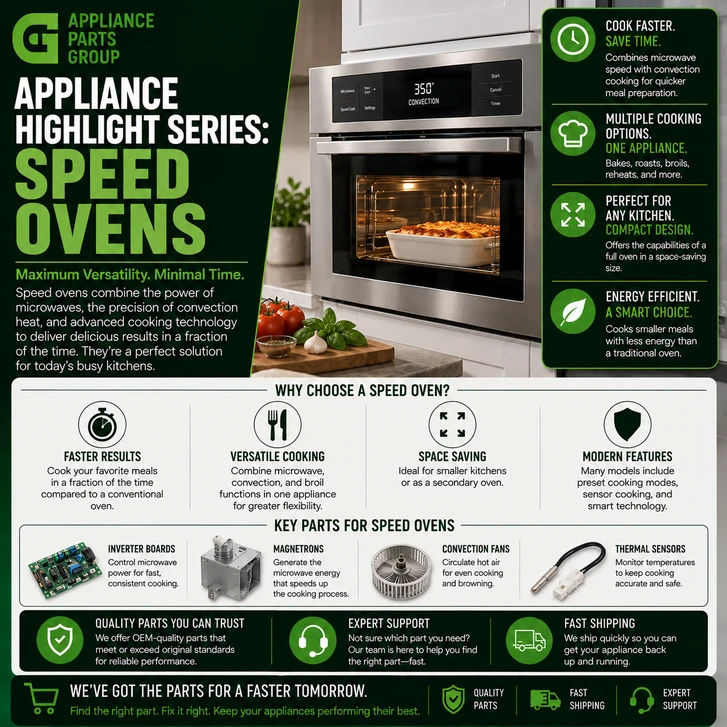
- Speed ovens combine microwave energy with conventional or convection heat to cook food quickly while still providing browning, roasting, and crisping capabilities.
- Many speed ovens can operate as a microwave, convection oven, broiler, or combination cooking appliance, making them useful as a compact second oven.
- Combination cooking can reduce cooking time because microwave energy heats food rapidly while convection heat and broiling help develop exterior color and texture.
- Common service components can include door switches, control boards, cooling fans, convection fans, heating elements, temperature sensors, turntable components, and microwave-system parts.
- Because speed ovens contain high-voltage microwave circuitry, some repairs should only be performed by qualified appliance service professionals.
Introduction
Modern kitchens are asking individual appliances to do more. Homeowners want faster meal preparation, flexible cooking modes, efficient use of space, and appliances that can handle everything from reheating leftovers to preparing a complete dinner. The speed oven is designed around exactly that idea.
A speed oven combines technologies normally associated with two or more different appliances. Depending on the model, it may provide microwave cooking, convection baking, roasting, broiling, and combination modes that operate more than one cooking system at the same time. Manufacturers including Bosch and Thermador, for example, offer speed ovens that combine microwave operation with convection and broiling functions.
The result is an appliance that can fill the role of an everyday microwave while also performing many jobs normally assigned to a conventional oven. That versatility has made speed ovens an increasingly notable category in premium and space-conscious kitchen designs.
In this installment of the Appliance Highlight Series, we will look at how speed ovens work, what makes them different from standard microwaves and ovens, the components inside them, common problems, basic troubleshooting, and the OEM replacement parts that may be involved when something stops working.
What Is a Speed Oven?
A speed oven is a compact cooking appliance that typically combines microwave energy with convection heating and, on many models, a broiling element. Individual cooking technologies may be used separately or together depending on the selected program.
Microwave energy is particularly effective for quickly heating food. Conventional resistance heating and convection, meanwhile, can provide the surface browning and crisping that microwave-only cooking generally cannot produce in the same way.
Combination cooking brings these capabilities together. The microwave system helps accelerate heating inside the food while convection airflow or a broiling element provides conventional oven heat around its exterior.
This distinction is important. A speed oven is not simply a microwave with a different name. Many models are designed to perform genuine baking, roasting, convection, and broiling functions in addition to traditional microwave tasks.
How Does a Speed Oven Work?
The exact design varies by manufacturer and model, but most speed ovens rely on several cooking systems working independently or together.
Microwave Cooking
Like a conventional microwave oven, a speed oven uses a magnetron and related high-voltage components to generate microwave energy. That energy interacts with food and produces rapid heating.
This mode is useful for familiar microwave tasks such as reheating beverages, warming leftovers, defrosting foods, or quickly cooking items that do not require exterior browning.
Convection Cooking
Convection operation uses heated air circulated through the oven cavity by a fan. Moving hot air promotes more uniform heat distribution and can help foods bake, roast, brown, and crisp.
When used without microwave assistance, convection mode can allow a speed oven to operate much more like a compact conventional oven.
Broiling
Many speed ovens also incorporate a broil or grill element. This provides intense radiant heat that can help brown the tops of casseroles, crisp foods, or finish meat and vegetables.
Combination Cooking
This is where the appliance earns the “speed” part of its name. Combination programs can use microwave energy and conventional heat during the same cooking cycle.
For example, microwave energy may accelerate the heating of a casserole while convection heat helps brown its exterior. Some manufacturers also provide programs that combine microwave operation with broiling.
The available combinations and cookware requirements vary significantly, so owners should always follow the use-and-care instructions supplied with their specific appliance.
Speed Oven vs. Microwave: What Is the Difference?
A traditional microwave is primarily intended for rapid heating, reheating, and defrosting. A speed oven adds conventional cooking capabilities that expand what the appliance can accomplish.
A speed oven may be capable of:
- Microwaving
- Convection baking
- Convection roasting
- Broiling or grilling
- Combination microwave/convection cooking
- Combination microwave/broil cooking
- Sensor cooking
- Automatic cooking programs
- Keeping food warm
Available modes depend on the model. Some current premium speed ovens also incorporate touchscreen controls, guided cooking programs, food sensors, and connected features.
Speed Oven vs. Conventional Oven
A conventional wall oven generally provides a larger cavity and is better suited to oversized cookware, multiple racks, large roasts, and high-volume baking. A speed oven is usually more compact.
Its advantage is versatility and rapid cooking rather than maximum cavity capacity.
In kitchens equipped with both appliances, the speed oven can serve as a second oven when the primary wall oven is occupied. For smaller meals, homeowners may also prefer using the speed oven rather than heating a larger oven cavity.
This makes the category particularly interesting for busy households, kitchens with stacked built-in appliances, and homeowners who want microwave functionality without giving up the capabilities of a secondary oven.
Common Speed Oven Problems and Symptoms
Because a speed oven combines several cooking technologies, troubleshooting can involve components associated with microwaves as well as conventional ovens.
Speed Oven Is Not Heating
The first question is whether the problem occurs in every mode or only one. If convection works but microwave mode does not, the failure is very different from an appliance that will not heat at all.
Possible causes can include a door-switch problem, heating element failure, temperature sensor issue, control problem, wiring fault, or a malfunction within the microwave generation system.
Convection Mode Is Not Heating Properly
If microwave operation works normally but convection cooking does not, inspect symptoms related to the convection heating system. A failed heating element, fan, temperature sensor, relay, or control could prevent proper oven temperatures.
Convection Fan Is Not Running
A speed oven may use one or more fans for convection cooking and cooling. A failed convection fan motor can cause poor heat circulation, uneven cooking, or error conditions.
Keep in mind that fan operation varies by mode. A fan that is stationary at a particular point in a cooking program is not automatically defective.
Turntable Is Not Rotating
On models equipped with a rotating turntable, problems can involve the tray, roller support, coupler, or turntable motor. Food may still heat when the turntable stops, but heating uniformity can be affected.
Control Panel Is Unresponsive
An unresponsive display or keypad may result from a power problem, control lock setting, user-interface issue, loose connection, or electronic control failure.
Door Will Not Close or Appliance Will Not Start
Microwave-equipped appliances use door-interlock switches to verify that the door is safely closed. A damaged latch, misaligned door, or defective switch can prevent operation.
Door safety systems should never be bypassed.
Step-by-Step Troubleshooting
- Verify power. Make sure the appliance display is operating and check the appropriate household circuit breaker if the unit appears completely dead.
- Check the selected cooking mode. Confirm whether the problem affects microwave, convection, broil, or every operating mode.
- Inspect the door. Make sure it closes completely and that no cookware, debris, or food residue is interfering with the latch area.
- Check control settings. Look for control lock, delayed-start, timer, demonstration, or other settings that could prevent normal cooking.
- Test another appropriate cooking mode. If one heating method works and another does not, that information can help isolate the affected system.
- Observe fan operation. Listen for unusual scraping, rattling, or excessive vibration. Do not disassemble the appliance simply to inspect an internal fan.
- Inspect removable accessories. If equipped with a turntable, verify that the tray, coupler, and roller support are seated correctly.
- Record error codes. If the display provides an error message or code, write it down before disconnecting power and consult the manufacturer's documentation.
- Locate the model number. Speed oven parts are model-specific. Record the complete model and serial information before searching for replacement components.
- Stop before high-voltage diagnosis. If troubleshooting points toward the magnetron, capacitor, transformer, inverter, or other internal microwave circuitry, contact a qualified service professional.
Safety note: Microwave appliances can contain high-voltage components capable of retaining a dangerous electrical charge even after power has been disconnected. Internal microwave-system diagnosis is not an appropriate DIY repair for an inexperienced homeowner.
Common Parts That May Need Replacement
Speed ovens contain more components than many standard microwave ovens because multiple cooking systems are packaged into a single appliance. The exact parts vary by manufacturer and model.
Door Switches and Latch Components
Door switches are part of the safety interlock system. If a switch, holder, or latch component becomes damaged or misaligned, the appliance may fail to recognize that the door is properly closed.
Convection Heating Element
The convection element supplies heat during convection cooking on models using a dedicated resistance element. A failed element can result in slow preheating, low temperatures, or no convection heat.
Broil or Grill Element
If broiling functions stop heating while other modes continue working, the broil element or its associated control circuitry may require diagnosis.
Convection Fan Motor
The convection fan circulates heated air through the cavity. A worn motor or damaged fan assembly can contribute to uneven cooking and abnormal noise.
Cooling Fan
Electronic and microwave components generate considerable heat. Cooling fans help control internal component temperatures. Problems with these fans can trigger overheating protection or error conditions.
Temperature Sensors and Thermostats
Temperature sensors provide information used by the electronic controls to regulate oven heat. Some appliances also incorporate thermostats or thermal protection devices for safety.
Electronic Control Boards and User Interfaces
Modern speed ovens rely heavily on electronic controls to coordinate microwave output, heaters, fans, sensors, timers, and automatic cooking programs. A control failure can therefore produce a wide range of symptoms.
Turntable Motors, Couplers, and Supports
For models using turntables, these relatively small components keep the tray moving smoothly during applicable cooking modes.
Microwave-System Components
The magnetron and its associated high-voltage components produce and control microwave energy. Diagnosis and replacement in this area should be performed by trained service personnel because of the electrical hazards involved.
When replacing a speed oven component, use the complete appliance model number to identify the correct OEM replacement part. Similar-looking components are not necessarily electrically or mechanically interchangeable.
Preventative Maintenance Tips
Good maintenance cannot prevent every component failure, but it can help a speed oven operate reliably and can reduce problems caused by contamination, blocked airflow, or improper use.
- Keep the cavity clean. Remove food splatter and grease according to the manufacturer's cleaning instructions.
- Clean spills promptly. Baked-on residue becomes more difficult to remove and may produce smoke or odors during convection cooking.
- Keep ventilation openings clear. Built-in cooking appliances require proper airflow for cooling.
- Use the correct cookware. Cookware suitable for convection cooking is not automatically microwave-safe. Combination modes may require cookware approved for both types of heating.
- Do not slam the door. The door contains latches and safety-interlock components that are important to microwave operation.
- Install accessories correctly. Racks, trays, and turntable components should be positioned according to the owner's manual for the selected mode.
- Pay attention to unusual noises. New rattling, grinding, or fan noise can provide an early indication of a mechanical issue.
- Address error codes promptly. Repeated fault codes should not simply be ignored or continually reset.
Are Speed Ovens Part of the Future of Kitchen Appliances?
Speed ovens fit a broader appliance trend toward multifunctional cooking equipment. Instead of dedicating separate kitchen space to a microwave and secondary oven, manufacturers can combine several capabilities into one built-in appliance.
The category is also becoming increasingly sophisticated. Current products can include sensor programs, automated combination cooking, touchscreen interfaces, temperature probes, and connected features. Fisher & Paykel, for example, offers connected convection-speed ovens with app-based monitoring on certain models, while manufacturers such as Bosch and Thermador emphasize combination microwave, convection, and broiling capabilities.
For the appliance repair industry, these designs also mean that technicians encounter increasingly integrated systems. A single speed oven may contain microwave high-voltage components, conventional heating elements, multiple fans, temperature sensing systems, electronic controls, and sophisticated door safety circuitry.
That makes accurate model identification and correct OEM part selection especially important when repairs are required.
Frequently Asked Questions
What is a speed oven?
A speed oven is a multifunction cooking appliance that typically combines microwave energy with convection heating and, on many models, broiling capabilities.
Is a speed oven the same as a microwave?
No. Although a speed oven can generally perform microwave functions, it also provides conventional heating capabilities such as convection baking, roasting, or broiling depending on the model.
Can a speed oven replace a microwave?
Many speed ovens are designed to perform common microwave tasks including reheating and defrosting, so they may replace a conventional microwave in some kitchens. Check the specific model's features and capacity before making that decision.
Can a speed oven replace a regular oven?
A speed oven can handle many baking and roasting jobs, but its cavity is generally smaller than a full-size oven. Many homeowners use one as a secondary oven rather than a complete replacement.
Why does a speed oven cook faster?
Combination modes can use microwave energy to accelerate heating while convection or radiant heat cooks and browns the exterior of the food.
Can you use metal pans in a speed oven?
It depends on the cooking mode and manufacturer instructions. Metal cookware may be appropriate during certain convection modes but unsafe during microwave or combination operation. Always follow the owner's manual.
Why is my speed oven not heating?
Possible causes depend on which mode has failed and can include control settings, door-switch problems, heating elements, temperature sensors, electronic controls, or microwave-system components.
Why does my speed oven fan keep running?
Some models operate a cooling fan during and after cooking to reduce internal component temperatures. Consult the owner's manual if fan operation appears unusually long or is accompanied by an error code or abnormal noise.
What parts commonly fail in a speed oven?
Potential service parts include door switches, latch components, fan motors, heating elements, sensors, thermostats, control boards, user-interface components, and turntable parts. Microwave-system components can also require professional service.
Can I repair a speed oven myself?
Basic external checks and certain model-specific mechanical repairs may be appropriate for experienced DIYers, but repairs involving internal microwave high-voltage circuitry should be left to qualified professionals.
How do I find the correct replacement part for a speed oven?
Locate the complete model number on the appliance and use it to identify compatible OEM parts. Do not select a component based only on its appearance.
How should I maintain a speed oven?
Keep the cavity and door area clean, maintain unobstructed ventilation, use cookware appropriate for the selected cooking mode, install racks and trays correctly, and investigate recurring error codes or unusual noises.
Entities and Terms
- Speed oven
- Microwave oven
- Convection oven
- Magnetron
- Convection heating element
- Broil element
- Convection fan motor
- Cooling fan
- Door interlock switch
- Door latch
- Temperature sensor
- Thermostat
- Electronic control board
- User interface
- Turntable motor
- Turntable coupler
- OEM appliance parts
- Combination cooking
Final Thoughts
Speed ovens are a good example of how appliance categories are becoming less rigid. By combining microwave technology with convection heating, broiling, and increasingly sophisticated electronic controls, these appliances can perform jobs that once required several separate pieces of cooking equipment.
That versatility also creates a more complex appliance. When a speed oven develops a problem, identifying exactly which cooking mode has failed can provide an important starting point for troubleshooting. From convection elements and fan motors to door switches, sensors, and electronic controls, accurate diagnosis should always come before replacing parts.
When replacement is necessary, use the appliance's complete model number to identify the correct OEM component. And because speed ovens incorporate microwave high-voltage systems, leave internal high-voltage diagnosis and repair to qualified professionals.
This article was written by an AI program as part of a beta test by Appliance Parts Group to explore how artificial intelligence can help inform and educate our customers.
Our goal is to use AI tools to provide clear, reliable information so you can make confident, well-informed purchasing decisions.