
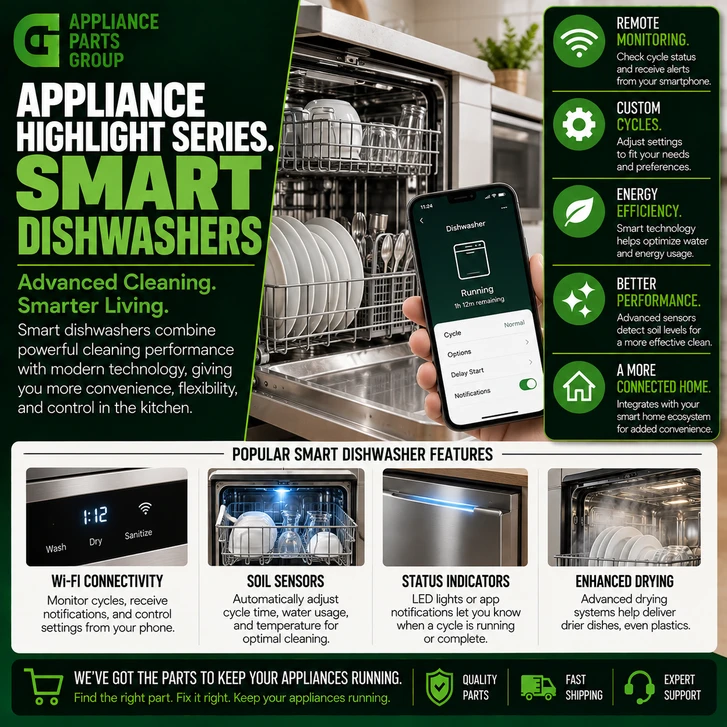
Dishwashers have evolved far beyond simple wash-and-dry appliances. Many of today's models incorporate Wi-Fi connectivity, mobile apps, advanced sensors, automatic cycle adjustments, remote notifications, and diagnostic features designed to make dishwashing more convenient and efficient. These connected appliances are commonly referred to as smart dishwashers.
While the fundamental job of a dishwasher has not changed, smart technology adds another layer of communication and control. Depending on the model and manufacturer, homeowners may be able to check cycle status from a phone, receive an alert when a cycle is complete, download additional wash cycles, monitor detergent supplies, or receive information that can help identify a problem.
In this Appliance Highlight Series article, we'll look at how smart dishwashers work, which features they may offer, the components behind those features, and what homeowners should know when troubleshooting or repairing one.
Key Takeaways
- Smart dishwashers combine traditional dishwasher components with Wi-Fi connectivity, electronic controls, sensors, and software.
- Features vary by manufacturer and model but may include remote monitoring, cycle notifications, diagnostics, maintenance alerts, and downloadable settings.
- A problem with a smart feature does not necessarily mean there is a problem with the dishwasher's washing system.
- Many repairs still involve familiar dishwasher components such as pumps, water inlet valves, heating elements, sensors, door switches, and electronic control boards.
- When replacement parts are required, always identify the dishwasher by its complete model number to find the correct genuine OEM part for that specific appliance.
What Is a Smart Dishwasher?
A smart dishwasher is generally a dishwasher equipped with network connectivity and electronic features that allow it to communicate with a smartphone, tablet, home network, or other compatible system. Wi-Fi is the most common method of connectivity, although the exact capabilities depend on the manufacturer and model.
It is important to distinguish between a dishwasher with advanced electronic controls and a truly connected dishwasher. Many modern dishwashers use sophisticated sensors and control boards to automatically adjust washing conditions even if they do not connect to the internet. A smart dishwasher typically adds external connectivity to those electronic systems.
The dishwasher itself still performs the physical work of filling, circulating water, dispensing detergent, heating, draining, and drying. Smart features primarily provide additional control, information, automation, or diagnostic capabilities.
What Can a Smart Dishwasher Do?
Smart dishwasher capabilities can vary considerably. Some models offer only a few connected functions, while others integrate with a larger manufacturer's smart-home platform.
Depending on the appliance, features may include:
- Cycle status monitoring: Check whether the dishwasher is washing, rinsing, drying, or finished.
- Cycle notifications: Receive an alert when the wash cycle has finished or when attention may be required.
- Remote controls: Certain models may allow some settings or functions to be controlled through an app, subject to built-in safety restrictions.
- Maintenance reminders: Receive reminders related to filters, cleaning, rinse aid, or other routine maintenance.
- Diagnostics: Some connected systems can provide error information or assist in identifying possible appliance problems.
- Downloadable or customizable cycles: Certain manufacturers allow additional cycles or settings to be selected through their apps.
- Usage information: Some systems provide information about appliance operation, cycle history, or resource consumption.
- Detergent monitoring: Select models may track or estimate detergent supplies or work with automatic detergent-dispensing systems.
- Smart-home integration: Compatible dishwashers may interact with other connected devices or supported home automation platforms.
Not every smart dishwasher supports every feature. Capabilities can also change as manufacturers update their apps and software, so the owner's manual and manufacturer's current documentation are the best sources for features available on a particular model.
How Smart Dishwashers Work
Underneath the connected technology, a smart dishwasher operates much like any other modern electronic dishwasher.
When a cycle begins, the dishwasher's electronic control system coordinates several components. The water inlet valve allows water into the tub. A circulation or wash pump moves water through the spray arms. Detergent is released at the appropriate point in the cycle. Sensors may monitor conditions such as temperature, water level, or soil levels. The drain system removes dirty water, while a heating system may assist with washing or drying depending on the dishwasher's design.
The difference is that a connected model also has hardware and software capable of communicating information outside the appliance. The connectivity system may be integrated into the main control board or use a separate communication or Wi-Fi module.
Information gathered by the dishwasher's controls can then be made available through the manufacturer's app or connected platform. In the opposite direction, supported commands or settings from the app can be communicated back to the dishwasher.
The Role of Sensors in Smart Dishwashers
Sensors are an important part of many modern dishwashers, whether or not the appliance has Wi-Fi connectivity. They allow the electronic controls to make decisions based on actual operating conditions instead of relying entirely on fixed cycle times.
For example, a turbidity or soil sensor may evaluate the condition of the wash water. The control can use this information to determine whether additional washing or rinsing is necessary. Temperature sensors can help the control monitor water temperature, while water-level or pressure-related components may help determine whether the appliance has filled properly.
This sensor data can improve cycle performance and, on some smart appliances, provide useful information for diagnostic systems.
Smart Diagnostics and Error Reporting
One of the potentially useful features of a connected dishwasher is improved access to diagnostic information. Traditional electronic dishwashers often communicate problems through flashing lights or error codes displayed on the control panel. A connected model may be able to provide additional information through its app.
That does not necessarily mean the appliance can determine exactly which part needs replacement. An error condition usually identifies what the control system detected, not automatically which component caused it.
For example, a dishwasher may report that it did not drain properly. The underlying cause could potentially involve a clogged filter, restricted drain hose, drain pump problem, wiring issue, electronic control problem, or another condition affecting the drain system.
Diagnostic information should therefore be treated as a starting point for troubleshooting rather than automatic confirmation that a specific component has failed.
Common Smart Dishwasher Problems
Because smart dishwashers combine mechanical, electrical, electronic, and networking systems, problems can fall into two broad categories: dishwasher operation problems and connectivity problems.
The Dishwasher Will Not Connect to Wi-Fi
If the dishwasher operates normally but will not connect to its app or network, the problem may be limited to the connected features. Possible causes can include network configuration, signal strength, app setup, account configuration, software, or a communication component within the dishwasher.
Always follow the manufacturer's pairing procedure for the specific model because setup requirements vary.
The App Shows the Dishwasher as Offline
An offline message does not necessarily mean the dishwasher itself has failed. Verify that the dishwasher has power and can be operated normally from its control panel. If normal operation is possible, investigate the network and connectivity system separately.
Remote Features Do Not Work
Some dishwasher functions cannot be activated remotely unless certain conditions have been met at the appliance. This can be intentional for safety or security. Consult the owner's manual before assuming that a remote-control problem indicates a malfunction.
The Dishwasher Displays an Error
If the dishwasher reports an error through either its control panel or app, record the exact error before resetting the appliance. The code may be useful when consulting technical information for the model.
The Smart Features Work, but the Dishwasher Does Not Wash Properly
Connectivity and washing performance are separate systems. A dishwasher can remain connected to an app while experiencing a problem with its circulation pump, spray arms, water inlet system, detergent dispenser, heating system, sensors, or other washing components.
Step-by-Step Troubleshooting
- Identify what is actually malfunctioning. Determine whether the problem affects the dishwasher's normal operation, only its smart features, or both. This distinction can significantly narrow the troubleshooting process.
- Check power to the dishwasher. Make sure the appliance is receiving power and that its control panel responds normally. If the entire dishwasher is dead, troubleshooting Wi-Fi connectivity should not be the first priority.
- Check the dishwasher display or app for errors. Record any error codes or messages before resetting the appliance.
- Verify the home network. If only smart functions are affected, make sure the home's network is operating normally and that other connected devices can access it.
- Follow the manufacturer's connection procedure. Pairing procedures, network requirements, and app settings vary among manufacturers. Follow the instructions for the exact dishwasher model.
- Inspect normal dishwasher functions. If the complaint involves washing, draining, filling, or drying, troubleshoot the appropriate mechanical and electrical systems just as you would on another electronic dishwasher.
- Look for simple maintenance problems. Check accessible filters, spray arms, and other homeowner-serviceable areas for debris or restrictions according to the owner's manual.
- Use the model number when researching parts. Similar-looking dishwashers may use different pumps, controls, sensors, and communication components. Never select a replacement part based only on appearance.
- Consult technical information when necessary. Error codes and diagnostic procedures can be model-specific. Service documentation may provide testing procedures that cannot be determined from the error message alone.
- Contact a qualified service professional when appropriate. Repairs involving electrical testing, internal wiring, electronic controls, or disassembly may be best handled by an experienced appliance technician.
Common Parts That May Need Replacement
Despite their advanced features, smart dishwashers still rely on many of the same service parts found in other modern dishwashers.
Electronic Control Board
The electronic control board coordinates many dishwasher functions. Depending on the design, it may process sensor information and control components such as pumps, valves, heaters, dispensers, and user-interface functions.
User Interface or Control Panel
The user interface allows the homeowner to select cycles and settings. A malfunctioning interface can cause buttons, touch controls, displays, or cycle selections to behave incorrectly.
Wi-Fi or Communication Module
Some connected appliances use a dedicated communication module, while others incorporate connectivity hardware into another electronic assembly. The exact configuration is model-specific.
Circulation Pump
The circulation pump moves wash water through the dishwasher's spray system. A dishwasher can have perfectly functional smart features while still washing poorly because of a circulation-system problem.
Drain Pump
The drain pump removes water from the dishwasher. Drain errors can sometimes be reported through a connected app, but proper diagnosis is still necessary to determine whether the pump itself or another part of the drain system is responsible.
Water Inlet Valve
The water inlet valve controls the flow of household water into the dishwasher. Problems with filling can affect wash performance and may trigger an error depending on the appliance's monitoring capabilities.
Temperature and Soil Sensors
Sensors provide information that helps the electronic controls manage cycles. A sensor problem can potentially affect cycle duration, water heating, washing performance, or diagnostic reporting.
Door Latch and Door Switch Components
The dishwasher must know that its door is properly closed before certain operations can begin. Problems with the latch or associated switches can prevent operation or cause unexpected interruptions.
Heating Components
Depending on the dishwasher design, heating components can assist with water heating, drying, or both. Heating problems may result in poor cleaning, wet dishes, unusually long cycles, or error conditions.
When replacing any dishwasher component, use the appliance's complete model number to locate the correct part. Appliance Parts Group supplies genuine OEM appliance parts and can help customers identify replacement parts designed for their specific models.
Are Smart Dishwashers Harder to Repair?
Not necessarily. Many common failures still involve familiar dishwasher systems. A clogged drain path, failed pump, defective inlet valve, damaged door latch, or malfunctioning heating component is fundamentally similar whether or not the dishwasher connects to Wi-Fi.
However, smart dishwashers can introduce additional electronic components and software-related considerations. Technicians may need to distinguish between a network problem, software condition, user-interface problem, communication failure, and a traditional appliance failure.
The increasing use of electronic controls also makes accurate model identification particularly important. Two dishwashers that look nearly identical from the outside may use different electronic components or revisions.
Can a Smart Dishwasher Still Work Without Wi-Fi?
In many cases, the dishwasher's primary washing functions can still be operated from its physical controls without an active internet connection. The connected features may become unavailable, but basic appliance operation may continue.
There can be exceptions, and individual features vary by manufacturer and model. Homeowners should consult the owner's manual for their specific dishwasher to determine which functions depend on connectivity.
This separation can also be useful during troubleshooting. If a dishwasher washes normally from the control panel but cannot connect to its app, the problem is likely different from a dishwasher that will not power on, fill, circulate, or drain.
Are Smart Dishwashers Worth Considering?
The value of smart features depends largely on how a household uses its appliances. For someone who simply wants to load the dishwasher, select a cycle, and return later, connectivity may not be a major consideration.
Other homeowners may appreciate receiving a notification when dishes are finished, checking cycle status without walking to the kitchen, getting maintenance reminders, or having easier access to diagnostic information.
The more important consideration is to evaluate the entire dishwasher rather than purchasing solely on the basis of Wi-Fi connectivity. Capacity, rack design, cleaning performance, drying system, noise level, cycle options, serviceability, and parts availability can all be important factors in long-term ownership.
Preventative Maintenance Tips
- Clean the dishwasher filter as recommended. A dirty filter can affect washing and draining performance.
- Inspect spray arms. Make sure spray-arm openings remain clear and that the arms can rotate properly.
- Load dishes correctly. Improper loading can block spray patterns, interfere with detergent dispensing, or prevent the spray arms from moving.
- Use the appropriate detergent. Follow the dishwasher and detergent manufacturers' recommendations.
- Use rinse aid when recommended. Rinse aid can play an important role in drying performance on many modern dishwashers.
- Keep the manufacturer's app updated. If you use connected features, current software may help maintain compatibility and functionality.
- Pay attention to alerts. Maintenance notifications and error messages can provide useful early indications that the appliance needs attention.
- Address leaks promptly. Water and electronic components are not a good combination. If a dishwasher is leaking, discontinue use when appropriate and investigate the cause.
- Keep the model number accessible. Recording the complete model number can make finding documentation and replacement parts much easier later.
The Growing Role of Connected Appliance Technology
Smart dishwashers are part of a larger shift toward connected household appliances. Refrigerators, ranges, ovens, washers, dryers, and other appliances increasingly incorporate network connectivity alongside advanced electronic controls and sensors.
For appliance owners, this can provide additional information and convenience. For service technicians, it creates new diagnostic possibilities while also introducing another system that may need to be evaluated when a problem occurs.
Regardless of how advanced the technology becomes, however, the physical fundamentals remain important. Dishwashers still require proper water flow, circulation, heating, draining, and electronic control. Understanding those basic systems remains essential when diagnosing a connected appliance.
Finding the Correct OEM Parts for a Smart Dishwasher
When a smart dishwasher needs a replacement component, begin with the appliance's model number rather than searching only by a description such as "dishwasher control board" or "Wi-Fi module."
Manufacturers can use different components across models, production periods, and engineering revisions. A component that looks identical to the original may not necessarily be electrically or electronically compatible with the appliance.
Appliance Parts Group is an authorized appliance parts distributor offering genuine OEM replacement parts for major appliance brands. Searching by model number can help identify parts designed for the exact appliance and reduce the possibility of ordering an incorrect component.
Frequently Asked Questions
What makes a dishwasher a smart dishwasher?
A smart dishwasher generally includes network connectivity that allows it to communicate with an app or compatible connected platform. Available features can include cycle monitoring, notifications, diagnostics, remote settings, and maintenance reminders.
Does a smart dishwasher need Wi-Fi to wash dishes?
Many smart dishwashers can perform their primary washing functions without an internet connection, although connected features may be unavailable. Check the owner's manual for the specific model.
Can I start a smart dishwasher from my phone?
Some models support remote functions, but capabilities and safety requirements vary. Certain dishwashers may require remote operation to be enabled at the appliance before a cycle can be started through an app.
Why does my smart dishwasher say it is offline?
An offline status can be caused by network availability, Wi-Fi signal strength, setup or account issues, software conditions, or a problem with the dishwasher's communication hardware. First determine whether the dishwasher itself still operates normally.
Can a smart dishwasher diagnose itself?
Connected diagnostics can provide valuable error information, but an error message does not always identify the exact failed component. Further troubleshooting may still be required.
Why does my dishwasher app show an error code?
The dishwasher's electronic control may have detected an operating condition outside its expected range. Record the exact code and consult information for the specific model before replacing any parts.
Are smart dishwashers more difficult to repair?
Many repairs involve the same pumps, valves, heaters, switches, sensors, and other components used in conventional electronic dishwashers. Connectivity can add another system that may need to be diagnosed.
Can a bad Wi-Fi module stop a dishwasher from washing?
This depends on the appliance's design. On many models, connectivity and primary dishwasher operation are largely separate, but the exact relationship between electronic components varies by model.
What parts commonly fail in a smart dishwasher?
Possible replacement parts include circulation pumps, drain pumps, water inlet valves, electronic controls, user interfaces, sensors, door-latch components, heating components, and, on applicable models, communication modules. Proper diagnosis should be performed before replacing a part.
How do I find parts for my smart dishwasher?
Locate the complete model number from the appliance's model and serial tag and use that information when searching for parts. Model-specific lookup is much more reliable than choosing a component based on appearance alone.
Should I use OEM parts when repairing a smart dishwasher?
Genuine OEM parts are designed for the manufacturer's specified applications. Because electronic components, sensors, pumps, and other parts can vary between similar models, identifying the correct OEM part by model number is important.
Do smart dishwashers receive software updates?
Some connected appliances and their associated apps can receive software or firmware updates. Update capabilities and procedures vary by manufacturer and model.
Entities and Terms
- Smart dishwasher
- Wi-Fi connectivity
- Electronic control board
- User interface
- Communication module
- Circulation pump
- Drain pump
- Water inlet valve
- Soil sensor
- Temperature sensor
- Door latch
- Door switch
- Heating element
- Spray arms
- Dishwasher filter
- OEM dishwasher parts
- Smart appliance diagnostics
Final Thoughts
Smart dishwashers demonstrate how traditional appliance systems are being combined with connected technology. Wi-Fi, mobile apps, sensors, notifications, and diagnostic features can provide useful conveniences, but the dishwasher still depends on familiar mechanical and electrical components to get dishes clean.
When something goes wrong, start by determining whether the problem involves connectivity or the dishwasher's actual operation. Error messages and smart diagnostics can provide useful clues, but they should be combined with proper troubleshooting before a replacement part is ordered.
If a repair does require a new component, use the dishwasher's complete model number to identify the correct genuine OEM replacement part. Accurate model lookup is particularly important with today's electronically controlled appliances, where components that look similar may not necessarily be interchangeable.
This article was written by an AI program as part of a beta test by Appliance Parts Group to explore how artificial intelligence can help inform and educate our customers.
Our goal is to use AI tools to provide clear, reliable information so you can make confident, well-informed purchasing decisions.