
Key Takeaways
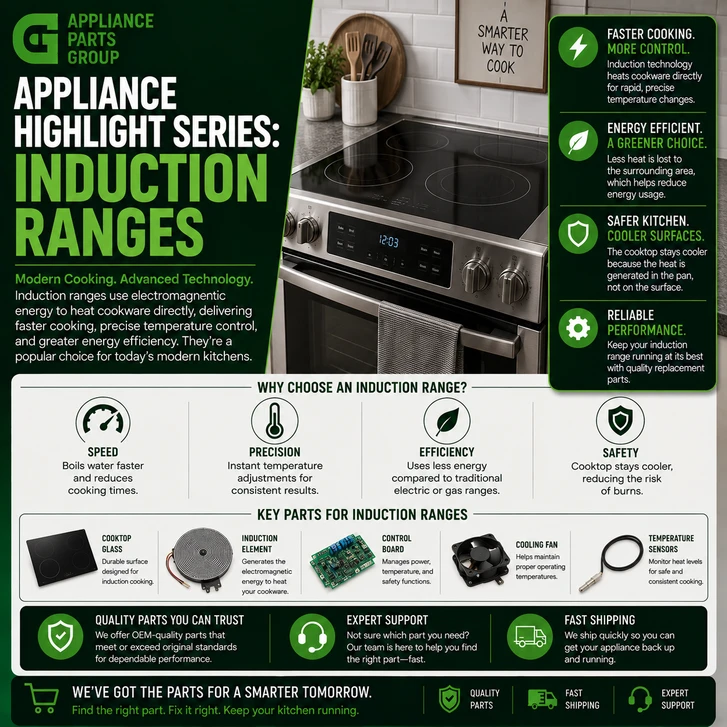
- Induction ranges use electromagnetic energy to heat compatible cookware directly instead of heating a traditional surface element first.
- Induction cooking can provide fast temperature response, precise control, and a cooktop surface that generally stays cooler than conventional radiant electric cooking surfaces.
- Common induction range components include induction coils, generator or inverter boards, cooling fans, temperature sensors, user-interface controls, and standard electric oven components.
- Problems such as a burner that will not heat do not always mean the induction system has failed; incompatible cookware, incorrect pan placement, control settings, or power issues should be checked first.
- When an induction range requires repair, using the complete model number is essential for identifying the correct OEM replacement part.
Introduction
For decades, residential ranges have primarily fallen into two familiar categories: gas and electric. Induction ranges introduce another option that combines an electric oven with a cooktop that heats cookware using electromagnetic energy.
Although induction cooking has existed for years, it has become increasingly visible in modern residential kitchens. Homeowners are attracted to its fast response, smooth glass cooking surface, precise control, and the absence of an open gas flame. At the same time, induction technology introduces components that are considerably different from those found underneath a conventional electric coil or radiant glass cooktop.
Instead of simply energizing a resistance heating element, an induction range relies on induction coils, electronic power modules, sensors, cooling systems, and compatible cookware. That can make troubleshooting an induction range seem intimidating when something stops working.
The good news is that many basic checks are still straightforward. Understanding how induction cooking works can help homeowners distinguish between normal operation, cookware problems, simple power issues, and symptoms that may indicate a component failure.
In this Appliance Highlight Series article, we'll look at how induction ranges work, common problems, troubleshooting steps, important components, OEM replacement parts, and preventative maintenance.
What Is an Induction Range?
An induction range combines an induction cooktop with an electric oven in a single appliance. From the outside, many models resemble conventional smooth-top electric ranges. The major difference is what happens underneath the glass cooking surface.
A conventional radiant electric cooktop uses resistance elements that become hot. Heat travels from the element through the glass and into the cookware.
An induction cooktop works differently. Beneath each cooking zone is an induction coil. Electronics send alternating electrical current through the coil, creating a changing magnetic field. When suitable magnetic cookware is placed above the cooking zone, this field induces electrical currents within the cookware itself. Resistance in the cookware converts that electrical energy into heat.
In simple terms, the pan becomes an active part of the heating process.
This is one reason induction cooking responds so quickly to adjustments. Rather than waiting for a traditional heating element to warm up or cool down, the amount of energy transferred to the cookware can be changed rapidly by the range's electronic controls.
Induction vs. Traditional Electric Ranges
Both induction and conventional electric ranges use electricity, but their cooktops generate heat differently.
A radiant electric cooktop typically contains heating elements underneath ceramic glass. The element becomes extremely hot, transfers heat through the glass, and then heats the pan.
An induction cooking zone creates an electromagnetic field that interacts with compatible cookware. Because much of the heat is generated in the cookware rather than by a glowing heating element, induction can respond quickly when the cooking level is changed.
The cooktop can still become hot during use. Hot cookware transfers heat back into the glass, so homeowners should never assume that an induction cooking surface is safe to touch immediately after cooking. Residual-heat indicators should always be taken seriously.
What Cookware Works With an Induction Range?
Cookware compatibility is one of the first things to understand about induction cooking. Not every pot or pan will work.
Induction requires cookware with magnetic properties. Many cast-iron and magnetic stainless-steel pans work well. Some aluminum, copper, glass, ceramic, and nonmagnetic stainless cookware will not operate on an induction burner unless the cookware includes an induction-compatible magnetic base.
A simple preliminary test is to place a household magnet against the bottom of the cookware. If it attaches firmly, the cookware may be induction compatible. However, the cookware manufacturer's specifications remain the best source for confirming compatibility.
Pan size and placement can matter as well. Some induction systems may not activate when a pan is too small for the selected cooking zone or is positioned incorrectly.
Why Induction Ranges Need Advanced Electronics
The technology that makes induction cooking responsive also makes the cooktop more electronically complex than a traditional resistance-element range.
An induction range may contain multiple electronic assemblies responsible for converting and controlling electrical power. Depending on the design, components may include generator boards, inverter or power boards, filters, communication boards, cooling fans, temperature sensors, and the user-interface assembly.
These electronics must manage substantial electrical loads while monitoring temperature and communicating with the controls.
Cooling is therefore especially important. Many induction ranges use internal fans to move air across power electronics. Hearing a cooling fan operate during cooking—or continue operating after cooking has stopped—can be normal on some models.
Common Induction Range Problems
Induction Burner Will Not Heat
A cooking zone that does not heat is one of the most common induction range complaints, but it does not automatically mean an induction coil or electronic board has failed.
First check the cookware. An incompatible pan may result in no heating at all. The range may display a cookware symbol, error message, or other indicator depending on the model.
Also verify that the pan is centered over the selected cooking zone and is large enough for that zone.
If compatible cookware works normally on other zones but not one particular zone, further diagnosis may be necessary.
Range Does Not Recognize the Pan
Pan-detection problems can result from incompatible cookware, a pan that is too small, incorrect placement, or an issue within the induction system.
Try another known induction-compatible pan before assuming that the appliance requires repair.
Cooktop Shuts Down While Cooking
An induction range may reduce power or shut down a cooking zone if internal temperatures become excessive. Restricted ventilation, a cooling fan problem, excessive heat around the appliance, or an electronic fault may contribute to overheating.
Check that ventilation openings are not blocked and follow the manufacturer's installation-clearance requirements.
Cooling Fan Is Noisy
Cooling fans are important because induction electronics generate heat during operation. Some fan noise is normal.
A new rattling, grinding, scraping, or unusually loud sound may indicate debris, a loose component, fan-blade interference, or a worn cooling fan motor.
Cooktop Displays an Error Code
Modern induction ranges continuously monitor operating conditions. An error code may relate to temperature, communication between electronic modules, power supply, controls, sensors, or another system.
Error codes are manufacturer- and model-specific. Always consult the technical information for the exact appliance rather than assuming that the same code has the same meaning across different brands.
Cooktop Works but Oven Does Not
The cooktop and oven are separate systems even though they share the same appliance cabinet and electrical supply.
An oven that does not heat may have a problem involving the bake element, broil element, convection element, temperature sensor, thermal protection device, control board, wiring, or another oven component rather than the induction cooktop.
Entire Range Has No Power
Induction ranges can require a substantial electrical supply. If the entire appliance is dead, check the household breaker before investigating internal components.
A partially tripped breaker or supply problem can also create unusual symptoms on some electric ranges. Electrical supply testing beyond basic breaker checks should be performed by a qualified technician when appropriate.
Step-by-Step Troubleshooting
- Confirm the range has power. Check the display and household circuit breaker. If the breaker repeatedly trips, stop using the appliance and have the electrical problem properly diagnosed.
- Check the cookware. Use a pot or pan specifically identified as induction compatible. If necessary, test another known-compatible pan.
- Center the cookware. Place the pan correctly over the cooking zone and verify that its base is appropriate for the selected zone.
- Check the controls. Make sure the correct burner is selected and verify that a control lock, child lock, timer, or other feature is not preventing operation.
- Look for error codes. Record the exact code before disconnecting power. Consult the owner's manual or technical information for the specific model.
- Allow an overheated range to cool. If the cooktop stopped after extended high-power cooking, allow it to cool and inspect accessible ventilation openings for obstructions.
- Listen to the cooling fans. Normal fan operation may continue during and after cooking. Grinding, rattling, or a fan that appears unable to operate may require further diagnosis.
- Compare cooking zones. If one zone fails but the others work with the same pan, the symptom can help narrow the problem to components associated with that zone.
- Check oven operation separately. Determine whether the problem affects only the induction cooktop, only the oven, or the entire range.
- Locate the model number. Before ordering a replacement component, find the complete model and serial information from the appliance data plate.
- Use model-specific service information. Induction electronics involve high voltage and sophisticated circuitry. Internal testing and repairs should be handled according to manufacturer procedures and by a qualified service professional when necessary.
Common Parts That May Need Replacement
Induction Coil
The induction coil sits beneath the glass cooking surface and generates the changing magnetic field used to transfer energy into compatible cookware. A range may contain several individual coils or coil assemblies depending on its design.
Induction coils should be identified using the appliance model number because physical size, electrical characteristics, mounting design, and connections can vary.
Induction Generator, Inverter, or Power Board
The induction power electronics are among the most important components in the cooktop. Depending on manufacturer terminology, these assemblies may be called generator boards, inverter boards, power modules, induction modules, or similar names.
They control the high-frequency electrical energy supplied to the induction coils. A failure can affect one or multiple cooking zones depending on the range design.
Cooling Fan
Cooling fans help control the temperature of induction electronics. A failed or obstructed fan can contribute to overheating, shutdowns, error codes, or reduced performance.
Because airflow is important to electronic component life, unusual cooling-fan noises should not be ignored.
Temperature Sensor
Temperature sensors allow the appliance electronics to monitor operating conditions. Sensor information may be used to protect the cooktop, regulate oven temperature, or manage cooling.
A faulty sensor or its associated wiring can sometimes produce error codes or abnormal operation.
User Interface or Touch Control
Many induction ranges use touch-sensitive controls, digital displays, or electronic user-interface boards. These components communicate cooking commands to the appliance's control electronics.
Before replacing a user interface, rule out control-lock settings, moisture or residue on the control area, and other model-specific conditions described in the owner's manual.
Main Electronic Control Board
The main control board may coordinate multiple appliance functions, including oven operation, temperature regulation, user inputs, and communication with other electronic modules.
Because several failures can produce similar symptoms, control boards should not be replaced based on symptoms alone without appropriate diagnosis.
Oven Heating Elements
Although the cooktop uses induction technology, most induction ranges still use conventional electric heating components inside the oven.
Depending on the model, these can include bake elements, broil elements, and convection elements. A cooktop that operates normally does not necessarily mean the oven's heating components are functioning correctly.
Convection Fan Motor
Many modern induction ranges include convection cooking. A convection fan motor circulates heated air through the oven cavity for more even heat distribution during applicable cooking modes.
Oven Temperature Sensor
The oven temperature sensor provides temperature information to the electronic controls. Problems involving the sensor, wiring, heating components, or control system can contribute to inaccurate oven temperatures.
Door Gasket
The oven door gasket helps limit heat loss around the oven door. A damaged, hardened, loose, or deteriorated gasket can affect cooking performance and allow excess heat to escape around the door.
Why OEM Parts Matter for Induction Ranges
Induction ranges depend on coordinated electronic and electrical systems. Components may look similar while having different power ratings, communication protocols, connectors, software compatibility, mounting points, or sensor specifications.
OEM replacement parts are manufactured to match the specifications established for compatible appliance models. This is especially important for components such as induction modules, control boards, sensors, cooling fans, user interfaces, and wiring assemblies.
Always begin with the complete appliance model number when searching for an induction range part. Manufacturers may revise components during production, so two visually similar ranges can sometimes require different parts.
How to Find the Correct Induction Range Part
Do not rely on appearance alone when identifying an induction range component.
Start with the appliance model number, which may be located around the oven door frame, behind or around a storage drawer, on the appliance frame, or in another manufacturer-designated location.
Copy the entire model number exactly, including letters, numbers, spaces, dashes, and suffixes.
If a component has already been removed, a number printed on the board, fan, sensor, or other part can provide additional information. However, numbers printed on electronic boards are not always orderable service-part numbers. Model-based parts documentation should be used to confirm compatibility.
Preventative Maintenance Tips
- Keep the cooktop clean. Clean spills according to the manufacturer's instructions and avoid allowing residue to build up around controls or cooking zones.
- Use flat, compatible cookware. Proper induction-compatible cookware helps the appliance detect the pan and transfer energy effectively.
- Avoid dragging cookware across the glass. Lift pans whenever possible to reduce scratching and surface wear.
- Protect ventilation openings. Do not block airflow around the range. Induction electronics depend on adequate cooling.
- Pay attention to fan noises. A noticeable change in cooling-fan sound can provide an early warning of a developing problem.
- Clean the oven regularly. Remove spills and food residue before they become heavily baked onto oven surfaces.
- Inspect the oven door gasket. Look for loose sections, tears, hardened material, or obvious gaps.
- Do not ignore repeated error codes. Record recurring codes and consult model-specific service information.
- Follow electrical requirements. An induction range should be installed according to the manufacturer's electrical and clearance specifications.
- Use the model number for replacement parts. Accurate model identification is especially important for induction electronics and controls.
Frequently Asked Questions
What is an induction range?
An induction range combines an electric oven with an induction cooktop. The cooktop uses electromagnetic energy to heat compatible cookware rather than relying on conventional resistance heating elements beneath the cooking surface.
How does an induction range heat a pan?
An induction coil beneath the cooktop creates a changing magnetic field. Compatible cookware interacts with that field, producing electrical currents and heat within the cookware itself.
Does an induction cooktop get hot?
Yes. Although induction does not heat the cooking surface in the same way as a radiant element, hot cookware transfers heat back into the glass. The surface can remain hot after cooking and should be treated accordingly.
Why won't my induction burner recognize my pan?
The cookware may not be induction compatible, may be too small for the selected cooking zone, or may not be positioned correctly. If multiple compatible pans fail on the same zone, the appliance may require further diagnosis.
What cookware works on an induction range?
Cookware needs appropriate magnetic properties. Many cast-iron and magnetic stainless-steel pans work with induction, while some aluminum, copper, glass, ceramic, and nonmagnetic stainless cookware may not unless designed with an induction-compatible base.
Why does my induction range make noise?
Some sounds can be normal. Cooling fans may operate during or after cooking, and certain cookware can produce humming or buzzing at some power settings. Grinding, scraping, or unusually loud fan noises should be investigated.
Why does my induction cooktop shut off while cooking?
Possible causes include overheating, restricted ventilation, a cooling-system problem, cookware detection, control settings, or an electronic fault. Check the owner's manual for model-specific behavior and error codes.
Can an induction coil be replaced?
Induction coils are serviceable components on many ranges, but replacement procedures vary by model. Because induction appliances contain high-voltage electronics, internal diagnosis and repair may require a qualified appliance technician.
What parts commonly fail in an induction range?
Possible replacement components include induction coils, power or inverter modules, cooling fans, temperature sensors, user-interface controls, electronic control boards, oven heating elements, convection motors, and door gaskets.
Why does the cooling fan keep running after I turn the range off?
On many induction ranges, this can be normal. The fan may continue operating after cooking to cool electronic components. Consult the owner's manual if the fan runs unusually long or produces abnormal noises.
Can the oven work if the induction cooktop has a problem?
Yes, depending on the failure. The oven and induction cooktop contain separate heating systems, although they may share power and electronic controls. A cooktop-related failure does not necessarily mean the oven heating system has failed.
How do I find the correct OEM part for my induction range?
Locate the complete model number on the appliance data plate and use it to identify compatible parts. Do not order electronic components based only on appearance because similar-looking parts can have different electrical or software specifications.
Entities and Terms
- Induction range
- Induction cooktop
- Induction coil
- Electromagnetic induction
- Induction-compatible cookware
- Pan detection
- Generator board
- Inverter board
- Induction power module
- Cooling fan
- Temperature sensor
- User interface
- Touch control
- Main electronic control board
- Bake element
- Broil element
- Convection element
- Convection fan motor
- Oven temperature sensor
- Oven door gasket
- OEM induction range parts
The Next Generation of Electric Cooking
Induction ranges represent an important evolution in residential cooking technology. They combine the familiar design of an electric range with an electronically controlled cooktop capable of transferring energy directly into compatible cookware.
That technology brings additional components into the appliance. Induction coils, power modules, temperature sensors, cooling fans, electronic controls, and user interfaces all work together to make the cooktop operate properly. Meanwhile, the oven continues to rely on components such as heating elements, temperature sensors, convection motors, controls, and door seals.
When an induction range develops a problem, start with the simplest possibilities. Confirm power, verify cookware compatibility, check pan placement, review control settings, record error codes, and make sure ventilation is unobstructed. These steps can sometimes resolve the issue without replacing a component and can provide valuable diagnostic information when professional service is necessary.
If a replacement component is required, use the complete model number to identify the correct OEM part. Induction appliances can contain model-specific electronics, making accurate parts identification particularly important.
Appliance Parts Group can help homeowners and service professionals locate genuine OEM replacement parts for ranges, ovens, and other major appliances. When you're unsure which component fits your appliance, start with the model number and let the APG team help identify the correct part.
This article was written by an AI program as part of a beta test by Appliance Parts Group to explore how artificial intelligence can help inform and educate our customers.
Our goal is to use AI tools to provide clear, reliable information so you can make confident, well-informed purchasing decisions.