
Key Takeaways
- Drawer refrigerators provide compact refrigerated storage in a convenient pull-out drawer design.
- They are commonly installed under counters, in kitchen islands, home bars, entertainment areas, offices, and outdoor kitchens when the appliance is rated for that environment.
- Depending on the model, drawer refrigerators may use many of the same refrigeration components found in conventional refrigerators, including compressors, evaporators, condenser systems, thermistors, fans, door or drawer gaskets, and electronic controls.
- Temperature problems can result from airflow restrictions, dirty condenser areas, damaged gaskets, faulty sensors, control problems, or refrigeration-system issues.
- When replacement parts are needed, always identify the appliance by its exact model number before ordering an OEM component.
Introduction
Most people picture a refrigerator as a tall appliance with one or more doors. Drawer refrigerators take a different approach. Instead of opening a large vertical compartment, the user pulls out a refrigerated drawer much like a cabinet drawer.
That relatively simple change in design creates some interesting possibilities. A drawer refrigerator can put beverages beside a home bar, ingredients beneath a kitchen island, snacks within easy reach in an entertainment room, or additional refrigerated storage in a kitchen without requiring another full-size refrigerator.
For this installment of the Appliance Highlight Series, we are looking at how drawer refrigerators work, where they are used, what can go wrong, and which components may eventually require service or replacement.
It is also important to distinguish a true drawer refrigerator from the ordinary crisper, deli, pantry, or freezer drawers located inside a conventional refrigerator. A drawer refrigerator is a self-contained refrigerated appliance or dedicated refrigerated compartment. Its drawers are part of the appliance's cooling system rather than simply storage bins inside a larger fresh-food compartment.
What Is a Drawer Refrigerator?
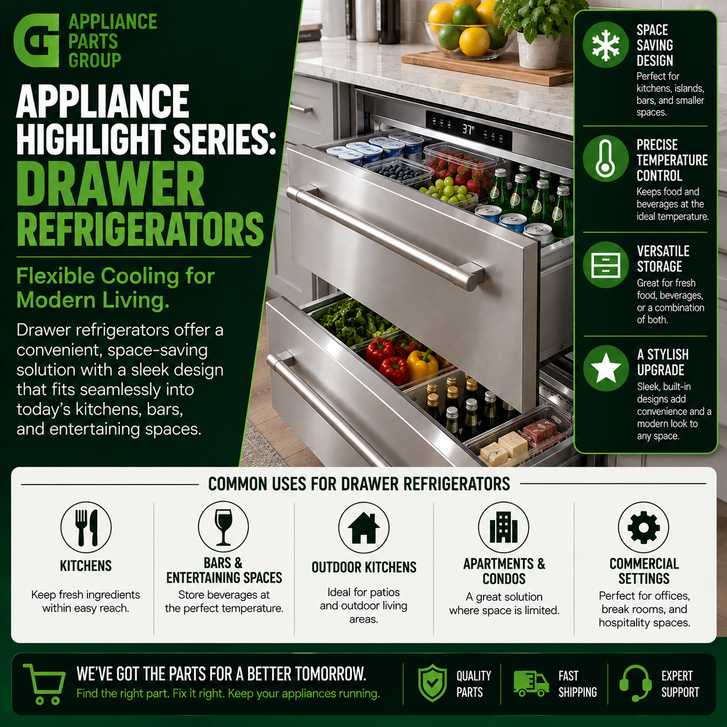
A drawer refrigerator is a refrigeration appliance designed around one or more horizontal pull-out compartments. Many are built for undercounter installation, allowing them to fit into cabinetry in places where a traditional refrigerator would be inconvenient or unnecessarily large.
Configurations vary considerably. Some appliances have two refrigerated drawers. Others combine refrigeration and freezer functions, while certain specialized models may provide independently controlled temperature zones.
The basic objective is the same: place refrigerated storage close to the location where food or beverages will actually be used.
Because drawer refrigerators are often integrated into cabinetry, their exterior design may also be an important part of the installation. Stainless-steel fronts are common, while some models can accept panels intended to coordinate with surrounding cabinetry.
Why Are Drawer Refrigerators Becoming Popular?
Modern kitchens increasingly use dedicated zones for food preparation, beverages, entertaining, and storage. A single refrigerator can still serve as the primary cold-storage appliance, but homeowners may want frequently used items closer to another part of the room.
A drawer refrigerator installed in an island, for example, can hold ingredients used during meal preparation. This may reduce trips across the kitchen to the main refrigerator. In a beverage area, refrigerated drawers can keep cans, bottles, mixers, and garnishes near the serving area.
The format can also make refrigerated items easier to see from above. Instead of reaching toward the back of a low refrigerator shelf, users pull the entire storage area outward.
Drawer refrigeration can be useful beyond the primary kitchen as well. Depending on the model and its approved installation requirements, these appliances may be found in home bars, entertainment rooms, offices, guest spaces, butler's pantries, outdoor kitchens, and other secondary food-storage areas.
How Does a Drawer Refrigerator Work?
Although the cabinet looks different, the underlying refrigeration process is familiar. A typical unit uses a sealed refrigeration system to move heat from inside the appliance to the surrounding environment.
The compressor circulates refrigerant through the system. The evaporator absorbs heat from the refrigerated compartment, while the condenser releases heat outside the cabinet. Depending on the appliance design, fans may move air across heat exchangers or circulate cold air through the drawers.
Temperature sensors or thermistors monitor conditions inside the appliance. An electronic control interprets those readings and operates components as necessary to maintain the selected temperature.
The drawer itself also plays a role in temperature stability. When closed, the drawer gasket creates a seal between the moving drawer assembly and the cabinet. A damaged, dirty, or poorly seated gasket can allow warm, humid room air into the refrigerated space.
Common Symptoms and Problems
Drawer Refrigerator Is Not Cooling
If the appliance is running but the drawers remain warm, start with the basics. Verify that the unit has power, that the controls are turned on, and that the selected temperature has not accidentally been changed.
Airflow and ventilation should also be inspected. Built-in refrigeration equipment requires installation according to the manufacturer's ventilation specifications. Blocking an intake, exhaust area, or condenser can interfere with heat removal.
If basic checks do not reveal the cause, possible areas requiring diagnosis include temperature sensors, fans, electronic controls, compressor-related components, or the sealed refrigeration system.
Temperature Is Too Warm or Inconsistent
A refrigerator does not necessarily have to stop cooling completely to have a problem. Food or beverages may simply feel warmer than expected, or temperatures may fluctuate.
Check that the drawer closes completely and inspect the gasket for debris, deformation, cracks, or damage. Overloading the drawer can also interfere with closing or with internal air circulation.
Frequent opening naturally introduces warm air as well. If the problem persists under normal use, the appliance may require further diagnosis.
Drawer Will Not Close Correctly
A refrigeration problem can sometimes begin as a mechanical drawer problem. Containers, packages, or other objects can prevent full closure. Drawer slides, rails, rollers, brackets, or related hardware can also become damaged or misaligned.
Even a small gap can allow room air into the compartment. That can make the refrigeration system work harder and may contribute to condensation or frost.
Excessive Frost or Condensation
Moist room air entering a cold compartment can produce condensation and, in sufficiently cold areas, frost. Inspect the gasket and make sure the drawer is not being held partially open.
Persistent frost can also indicate a problem involving temperature control, defrost components on applicable models, sensors, or airflow. The exact diagnostic procedure depends on the model.
Unusual Noise
Refrigeration appliances normally make some sound. Compressors cycle, refrigerant moves through tubing, and fans may start and stop.
New grinding, rattling, scraping, or unusually loud operating sounds deserve attention. A fan may be contacting ice or debris, a drawer component may be loose, or another mechanical component may require inspection.
Step-by-Step Troubleshooting
- Confirm power. Make sure the refrigerator is receiving power and that the controls or display are operating normally.
- Check the temperature setting. Verify that the selected setting is appropriate and has not been changed accidentally.
- Allow time after adjustments. Refrigeration temperatures do not change instantly. Follow the manufacturer's instructions before judging the result of a temperature adjustment.
- Inspect drawer closure. Remove anything preventing the drawer from closing completely.
- Inspect the gasket. Look for dirt, food residue, cracks, deformation, or areas where the gasket is not contacting the cabinet correctly.
- Check internal airflow. Avoid packing food or beverages tightly against air outlets or other ventilation openings inside the appliance.
- Check external ventilation. Make sure required ventilation areas around the appliance are not blocked. Follow the installation requirements for your exact model.
- Listen for abnormal operation. Note whether fans, the compressor, or other components appear to be operating and whether unusual sounds are present.
- Check for frost or moisture. Heavy frost, persistent condensation, or water accumulation can provide useful clues about gasket, airflow, or temperature-control problems.
- Locate the model number. Before ordering any replacement component, locate the complete model and serial information from the appliance identification label.
- Consult the service information. Use documentation intended for the specific model whenever electrical testing, disassembly, or component diagnosis is necessary.
- Use qualified service when appropriate. Sealed-system repairs, refrigerant work, and complex electrical diagnosis should be handled by properly trained technicians.
Common Parts That May Need Replacement
Drawer refrigerator construction differs by manufacturer and model, so there is no universal parts list. However, several component categories are commonly associated with refrigeration and drawer operation.
Drawer Gasket
The gasket helps seal the refrigerated compartment when the drawer is closed. A torn, deformed, loose, or otherwise damaged gasket can allow warm air to enter the appliance.
Drawer Slides, Rails, and Supports
Drawer hardware allows the compartment to move smoothly while maintaining proper alignment. Bent or damaged slides and supports can make a drawer difficult to operate and may prevent it from closing correctly.
Thermistor or Temperature Sensor
Many modern refrigerators use thermistors to monitor temperature. The electronic control uses sensor information to determine when cooling is needed. A faulty sensor can contribute to inaccurate or inconsistent temperature control.
Electronic Control Board
The control board can manage compressor operation, fans, temperature inputs, displays, alarms, and other appliance functions. Control boards should be diagnosed carefully rather than replaced solely because another component is not operating.
Evaporator or Circulation Fan
Where used, a fan helps distribute cold air or move air across the evaporator. A failed or obstructed fan may reduce cooling performance and produce unusual sounds.
Condenser Fan
Some designs use a condenser fan to help remove heat from the refrigeration system. Restricted airflow or fan failure can interfere with normal heat rejection.
Compressor and Refrigeration Components
The compressor is central to the refrigeration cycle. Compressor or sealed-system diagnosis generally requires specialized equipment and training. Refrigerant-system service should be left to technicians qualified to perform that work.
Drawer, Front, Handle, and Trim Components
Not every repair involves the refrigeration system. Drawer fronts, handles, trim, bins, supports, rails, and related mechanical pieces can become cracked or damaged through normal use.
When ordering OEM replacement parts, use the full model number rather than relying only on the appearance of the component. Similar-looking appliances can use different parts depending on model, production revision, voltage, or configuration.
Repair or Replace a Drawer Refrigerator?
A malfunction does not automatically mean the appliance should be replaced. A damaged gasket, sensor, fan, drawer rail, or control component may be serviceable individually if the correct part is available.
The decision becomes more involved when there is extensive cabinet damage, multiple failures, or a major sealed-system problem. Appliance age, repair cost, part availability, installation requirements, and the condition of the rest of the unit should all be considered.
Built-in appliances introduce another factor: replacement dimensions. A unit installed into custom cabinetry may occupy a specific opening, so replacing the entire appliance can involve more than simply purchasing another refrigerator.
Preventative Maintenance Tips
- Keep the gasket clean. Wipe away food residue and spills so the sealing surface can make proper contact.
- Do not overload drawers. Packages should not interfere with closure or internal airflow.
- Clean accessible condenser areas as directed. Follow the manufacturer's maintenance instructions for your model.
- Keep ventilation openings clear. Built-in refrigeration depends on proper heat dissipation.
- Clean spills promptly. Sticky liquids can work into drawer slides, seals, and other moving components.
- Pay attention to changing sounds. A new scraping or rattling sound can be an early sign that something requires inspection.
- Monitor temperature. Unexpected temperature changes can reveal a developing problem before cooling is lost completely.
- Close drawers gently. Repeated impacts can place unnecessary stress on slides, handles, fronts, and other hardware.
Frequently Asked Questions
What is a drawer refrigerator?
A drawer refrigerator is a refrigerated appliance that uses pull-out drawers instead of, or in addition to, conventional hinged doors. Many models are designed for built-in or undercounter installation.
Are refrigerator drawers the same as crisper drawers?
No. A crisper drawer is a storage bin located inside a refrigerator. A drawer refrigerator is an actively refrigerated appliance or dedicated refrigerated compartment with its own cooling-related components.
Where can a drawer refrigerator be installed?
Depending on the model, drawer refrigerators may be installed in kitchens, islands, home bars, entertainment areas, offices, pantries, and other approved locations. Always follow the manufacturer's installation and ventilation requirements.
Can a drawer refrigerator be installed outdoors?
Only if the specific appliance is designed and approved for outdoor installation. An indoor-rated refrigerator should not be assumed to be suitable for an outdoor kitchen.
Why is my drawer refrigerator not cooling?
Possible causes include an incorrect setting, incomplete drawer closure, damaged gasket, blocked ventilation, airflow problems, sensor failure, fan problems, control issues, or a refrigeration-system fault.
Why does my refrigerator drawer have condensation?
Warm, humid air entering the cold compartment can create condensation. Check for frequent opening, an obstructed drawer, gasket problems, or other conditions preventing a complete seal.
Why is my drawer refrigerator making noise?
Some compressor and fan noise is normal. New grinding, scraping, rattling, or unusually loud sounds can indicate a loose component, fan obstruction, ice buildup, or another mechanical problem requiring inspection.
Can a drawer refrigerator gasket be replaced?
Many models use replaceable gaskets, but the correct component depends on the exact model. Confirm the model number and parts documentation before ordering.
Can drawer slides or rails be replaced?
On many appliances, drawer slides, rails, supports, or related hardware are serviceable components. Availability and installation procedures vary by model.
Should I replace the control board if the refrigerator stops cooling?
Not without diagnosis. A cooling failure can originate from several components, and replacing the control board without testing can result in an unnecessary repair.
How do I find the correct OEM drawer refrigerator part?
Locate the appliance's complete model number and use it to identify compatible parts. Do not select a component based solely on photographs or physical appearance.
Can I repair a drawer refrigerator myself?
Simple maintenance or certain mechanical replacements may be manageable for experienced homeowners when manufacturer instructions are available. Electrical, compressor, refrigerant, and sealed-system work should be handled by appropriately qualified service professionals.
Entities and Terms
- Drawer refrigerator
- Undercounter refrigerator
- Refrigeration system
- Compressor
- Evaporator
- Condenser
- Evaporator fan
- Condenser fan
- Thermistor
- Temperature sensor
- Electronic control board
- Drawer gasket
- Drawer slides
- Drawer rails
- Drawer supports
- Refrigerant
- OEM refrigerator parts
- Built-in refrigeration
Final Thoughts
Drawer refrigerators demonstrate how appliance design can adapt traditional refrigeration technology to a different style of storage. Their undercounter format can provide convenient access to refrigerated food and beverages while allowing cold storage to be distributed throughout a kitchen or entertainment space.
Like any refrigerator, however, these appliances depend on proper airflow, temperature sensing, heat transfer, mechanical alignment, and a good seal. Recognizing symptoms such as temperature fluctuations, condensation, unusual noise, or a drawer that will not close properly can help identify problems before they become more disruptive.
If a component needs replacement, start with the complete appliance model number and confirm compatibility before ordering an OEM part.
This article was written by an AI program as part of a beta test by Appliance Parts Group to explore how artificial intelligence can help inform and educate our customers.
Our goal is to use AI tools to provide clear, reliable information so you can make confident, well-informed purchasing decisions.