
Key Takeaways
- Countertop appliances save space, speed up cooking, and support daily kitchen routines.
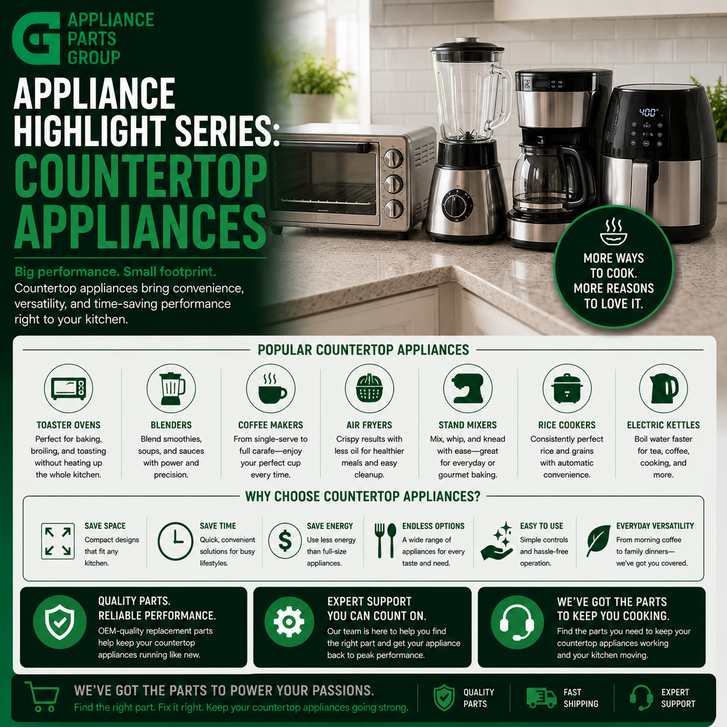
- Common examples include toaster ovens, air fryers, coffee makers, blenders, mixers, slow cookers, and countertop microwaves.
- Many performance issues come from worn seals, clogged filters, damaged heating elements, bad switches, or neglected cleaning.
- OEM replacement parts help restore fit, function, and reliability when a repair is possible.
- Regular cleaning, safe placement, and proper use can extend the life of countertop appliances.
Introduction
Countertop appliances have become essential tools in modern kitchens. They are compact, convenient, and often easier to use than full-size appliances for everyday tasks. Whether you are brewing coffee, reheating leftovers, blending smoothies, air frying vegetables, or making toast before work, countertop appliances help make cooking faster and more flexible.
Because these appliances are smaller, many homeowners assume they are disposable. In some cases, replacement may make sense. However, many countertop appliance problems are caused by simple wear items, clogged components, damaged cords, dirty sensors, loose knobs, cracked containers, or worn seals. When the appliance is well-built and replacement parts are available, repair can be a practical option.
This Appliance Highlight Series guide explains how countertop appliances work, what usually fails, which symptoms to watch for, and how OEM replacement parts can help keep your kitchen running smoothly.
What Are Countertop Appliances?
Countertop appliances are compact kitchen machines designed to sit on a counter, island, shelf, or cart rather than being permanently installed. They usually plug into a standard household outlet and serve a specific cooking, heating, mixing, or food preparation purpose.
Common countertop appliances include:
- Toasters and toaster ovens
- Countertop microwaves
- Air fryers
- Coffee makers and espresso machines
- Blenders and food processors
- Stand mixers and hand mixers
- Slow cookers and multi-cookers
- Electric kettles
- Rice cookers
- Countertop ice makers
Why Countertop Appliances Are So Popular
Countertop appliances offer convenience without requiring a remodel. They are especially useful in apartments, small homes, offices, dorms, break rooms, RVs, and secondary kitchens. Many homeowners also use them to reduce the workload on larger appliances. For example, a toaster oven may be more efficient for heating a small meal than using a full-size range oven.
Another advantage is flexibility. A countertop appliance can often be moved, stored, or replaced more easily than a built-in unit. For busy households, this flexibility makes it easier to prepare food quickly while keeping the main kitchen workflow open.
Common Countertop Appliance Problems
Even though countertop appliances are compact, they contain many of the same basic systems found in larger appliances. Heating elements, motors, thermostats, switches, sensors, seals, control boards, containers, lids, and power cords all experience wear over time.
Appliance Will Not Turn On
If a countertop appliance does not power on, the issue may involve the outlet, power cord, internal fuse, switch, safety interlock, control board, or thermal cutoff. Always unplug the appliance before inspecting it. If the plug, cord, or housing shows signs of burning or melting, stop using the appliance immediately.
Appliance Heats Poorly or Unevenly
Toasters, toaster ovens, air fryers, coffee makers, kettles, and countertop ovens rely on heating elements or heating plates. If the appliance heats unevenly, takes too long, or shuts off early, the cause may be a failing element, dirty sensor, bad thermostat, worn thermal fuse, or restricted airflow.
Motor Runs Slowly or Stops
Blenders, mixers, food processors, and ice makers depend on motors, couplers, gears, belts, blades, and drive assemblies. If the motor hums but does not turn, runs weakly, smells hot, or shuts off under load, the appliance may be overloaded or may have a worn drive component.
Leaks
Coffee makers, espresso machines, blenders, food processors, ice makers, and kettles may leak when gaskets, seals, reservoirs, lids, valves, or containers wear out. A small leak can worsen quickly, especially when heat or vibration is involved.
Buttons, Knobs, or Displays Stop Working
Controls on countertop appliances are exposed to steam, grease, flour, crumbs, water, and frequent handling. A sticky button, loose knob, cracked overlay, or dim display may point to a worn control panel, damaged switch, or control board issue.
Step-by-Step Troubleshooting
- Unplug the appliance. Never inspect, clean, or disassemble a countertop appliance while it is connected to power.
- Check the outlet. Plug in another small device to confirm the outlet is working.
- Inspect the power cord. Look for cuts, exposed wire, scorch marks, loose prongs, or melted insulation.
- Look for visible damage. Check lids, jars, trays, racks, baskets, seals, knobs, and housings.
- Clean removable parts. Crumbs, mineral deposits, grease, and food buildup can cause poor performance.
- Check airflow. Air fryers, toaster ovens, and countertop ovens need clear vents to prevent overheating.
- Reset the appliance if applicable. Some models have reset buttons, thermal protection, or digital controls that need a power cycle.
- Review the model number. Use the appliance model number when searching for compatible OEM parts.
- Replace worn parts when available. Common replaceable parts include jars, blades, lids, trays, baskets, knobs, seals, filters, switches, and heating components.
- Stop if electrical damage is present. Burning smells, sparks, repeated tripping, or melted parts require professional evaluation or replacement.
Common Parts That May Need Replacement
Countertop appliances vary by brand and model, but many use replaceable components. Choosing OEM replacement parts helps ensure the part is designed for the appliance’s specific fit and function.
Heating Elements
Heating elements are used in toaster ovens, air fryers, countertop ovens, electric kettles, and some coffee makers. A failing element may cause slow heating, uneven browning, or no heat at all.
Thermostats and Thermal Fuses
Thermostats regulate temperature, while thermal fuses help protect against overheating. If an appliance shuts off too soon or does not heat, these parts may be involved.
Carafes, Jars, Bowls, and Containers
Glass carafes, blender jars, food processor bowls, and mixer bowls can crack, chip, or lose their seals. Replacing the container is often simpler than replacing the entire appliance.
Blades, Couplers, and Gears
Blenders and food processors rely on sharp blades and secure drive connections. Worn couplers, stripped gears, or dull blades can reduce performance and strain the motor.
Filters and Water System Parts
Coffee makers, espresso machines, countertop ice makers, and some steam appliances may use filters, valves, pumps, tubes, and reservoirs. Mineral buildup can shorten the life of these components.
Knobs, Buttons, Trays, Racks, and Baskets
Exterior and removable parts often wear out first because they are handled daily. Replacing a cracked knob, missing tray, damaged basket, or broken rack can restore usability without replacing the appliance.
Preventative Maintenance Tips
Countertop appliances last longer when they are cleaned regularly and used according to the manufacturer’s instructions. Small habits can prevent overheating, leaks, odors, and premature part failure.
- Empty crumb trays frequently on toasters and toaster ovens.
- Descale coffee makers, kettles, and espresso machines as recommended.
- Keep air fryer baskets, trays, and vents free of grease buildup.
- Do not overload blenders, mixers, or food processors.
- Allow heated appliances to cool before cleaning or storing.
- Keep power cords away from hot surfaces and water.
- Replace cracked seals, lids, jars, and containers promptly.
- Use only parts that match the model number of the appliance.
When Repair Makes Sense
Repair may make sense when the appliance is higher quality, the problem is isolated, and the replacement part is available. For example, replacing a blender jar, coffee carafe, air fryer basket, toaster oven rack, mixer attachment, gasket, or knob may be cost-effective.
Repair may not be practical if the appliance has severe electrical damage, repeated overheating, a burned motor, unavailable parts, or a repair cost close to the cost of replacement. When in doubt, compare the appliance’s age, replacement cost, part availability, and safety condition.
Frequently Asked Questions
Are countertop appliances worth repairing?
Sometimes. Repair is often worthwhile when the issue involves a removable or replaceable part such as a jar, lid, tray, basket, seal, knob, filter, blade, or carafe.
What countertop appliance parts commonly wear out?
Common wear parts include seals, gaskets, blades, couplers, trays, racks, baskets, lids, knobs, filters, heating elements, and carafes.
Why did my countertop appliance stop turning on?
The cause may be the outlet, power cord, fuse, switch, safety interlock, control board, or internal wiring. Unplug the appliance before inspecting it.
Why does my air fryer smell like it is burning?
Grease buildup, food debris, restricted airflow, or a damaged heating element can cause burning smells. Stop using the appliance if you see smoke, sparks, or melted parts.
Can I replace a cracked blender jar?
Yes, many blender jars are replaceable. Match the jar to the exact model number to ensure proper fit with the blade assembly and base.
Why is my coffee maker leaking?
A coffee maker may leak because of a cracked reservoir, worn gasket, loose tube, damaged valve, misaligned carafe, or mineral buildup.
How often should I descale a coffee maker?
Frequency depends on water hardness and usage. Many households descale every one to three months, but the appliance manual should be the primary guide.
Why is my toaster oven heating unevenly?
Uneven heating may be caused by a failing heating element, dirty interior, blocked airflow, damaged rack position, or thermostat issue.
Can countertop microwave parts be replaced?
Some external and accessory parts can be replaced, such as trays, roller rings, bulbs, and filters. Internal microwave repairs should be handled carefully because high-voltage components can be dangerous.
Why is my mixer struggling with dough?
The mixer may be overloaded, using the wrong attachment, or experiencing wear in the gears, motor, or speed control system.
Should I buy OEM parts for countertop appliances?
OEM parts are designed for the specific appliance model, which helps support proper fit, performance, and reliability.
How do I find the right replacement part?
Locate the appliance model number, then search for parts that match that exact model. Model numbers are usually found on a label under, behind, or inside the appliance.
Entities and Terms
- Countertop microwave
- Toaster oven
- Air fryer
- Coffee maker
- Espresso machine
- Blender jar
- Food processor bowl
- Stand mixer
- Heating element
- Thermostat
- Thermal fuse
- Gasket
- Seal
- Blade assembly
- Drive coupler
- Control board
- Power cord
This article was written by an AI program as part of a beta test by Appliance Parts Group to explore how artificial intelligence can help inform and educate our customers.
Our goal is to use AI tools to provide clear, reliable information so you can make confident, well-informed purchasing decisions.