
Key Takeaways
- Compact appliances are ideal for apartments, condos, RVs, dorms, tiny homes, and secondary kitchens.
- Modern compact appliances can include many of the same features found in full-size models.
- Common compact appliances include refrigerators, dishwashers, washers, dryers, ranges, and microwaves.
- Regular cleaning, proper ventilation, and avoiding overloads help extend appliance life.
- OEM replacement parts help maintain proper fit, performance, and reliability.
Introduction
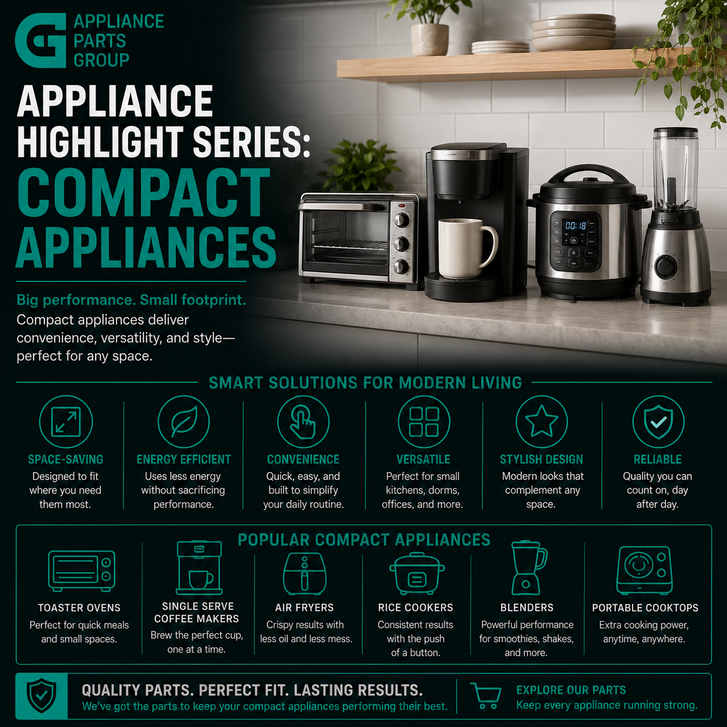
Compact appliances are becoming more popular as homeowners, renters, and property managers look for ways to save space without giving up everyday convenience. Whether used in an apartment kitchen, RV, basement bar, dorm room, office, accessory dwelling unit, or vacation rental, compact appliances provide practical performance in a smaller footprint.
Unlike older small appliances that were often limited in features, many modern compact appliances now include advanced controls, energy-saving designs, improved storage layouts, and more efficient operation. A compact refrigerator can keep food and beverages cold in tight spaces. A compact dishwasher can simplify cleanup in a small kitchen. A combination washer-dryer can bring laundry capability to homes without a traditional laundry room.
Because compact appliances are smaller, they are often placed in tighter areas where airflow, drainage, leveling, and routine maintenance become especially important. Understanding how these appliances work, what problems they commonly develop, and which replacement parts may be needed can help owners get better performance and longer service life from their equipment.
What Are Compact Appliances?
Compact appliances are smaller versions of standard household appliances. They are designed for spaces where a full-size refrigerator, dishwasher, washer, dryer, range, or freezer may not fit. These appliances may be narrower, shorter, shallower, portable, stackable, or built for countertop installation.
Common compact appliances include:
- Compact refrigerators
- Mini refrigerators
- Compact freezers
- Countertop dishwashers
- Portable dishwashers
- Apartment-size dishwashers
- Compact washers
- Compact dryers
- Washer-dryer combination units
- Apartment-size ranges
- Compact cooktops
- Countertop microwaves
- Beverage centers
- Portable air conditioners
Why Compact Appliances Are Popular
Compact appliances are useful because they solve a common problem: limited space. Many homes and rental properties do not have room for full-size appliances in every area. Compact models make it easier to add cooling, cooking, cleaning, or laundry capability without a major renovation.
Space Savings
The main advantage of compact appliances is their size. They can fit under counters, in closets, on countertops, in small kitchens, or in utility areas where standard appliances would be too large.
Flexible Installation
Some compact appliances are portable or freestanding, which makes them easier to move or relocate. This flexibility is useful for renters, RV owners, dorm residents, and homeowners who want a temporary or secondary appliance solution.
Lower Utility Use
Because compact appliances usually have smaller capacities, they may use less water or electricity than larger models during normal operation. Actual energy use depends on the appliance type, model, condition, and usage habits.
Modern Features
Many compact appliances now include digital controls, improved insulation, energy-saving cycles, sensor drying, adjustable shelves, stainless finishes, and smart diagnostic features.
Common Types of Compact Appliances
Compact Refrigerators
Compact refrigerators are often used in dorm rooms, offices, garages, entertainment rooms, RVs, and small apartments. Some are simple mini fridges, while others include freezer compartments, adjustable shelving, crisper drawers, and separate temperature controls.
Common issues with compact refrigerators include poor cooling, frost buildup, noisy operation, leaking water, and damaged door gaskets.
Compact Dishwashers
Compact dishwashers are available as countertop, portable, drawer-style, and narrow built-in models. They are helpful in small kitchens where a standard 24-inch dishwasher may not fit.
Common problems include poor draining, cloudy dishes, spray arm blockages, leaking door seals, and water inlet issues.
Compact Washers and Dryers
Compact laundry appliances are popular in apartments, condos, RVs, and homes without large laundry rooms. Some units are stackable, while others combine washing and drying in one appliance.
Common problems include slow draining, vibration, long drying times, failure to spin, and door latch errors.
Compact Cooking Appliances
Apartment-size ranges, compact ovens, cooktops, and microwaves provide cooking capability in smaller kitchens. These appliances may be electric, gas, or convection-based depending on the model.
Common issues include uneven heating, failed igniters, broken knobs, worn heating elements, and control board problems.
Common Problems With Compact Appliances
Poor Airflow
Compact appliances are often installed in tight spaces. When vents are blocked or there is not enough clearance around the unit, heat can build up. This can reduce performance and cause components to work harder.
Overloading
Compact washers, dryers, dishwashers, and refrigerators are designed for smaller loads. Overloading can cause poor cleaning, poor drying, motor strain, vibration, drainage problems, and premature part wear.
Drainage Problems
Compact dishwashers and washers may develop drainage problems when filters, pumps, hoses, or drain paths become clogged with debris.
Door Seal Failure
Door gaskets help keep cold air, hot air, water, or steam inside the appliance. A worn or torn gasket can cause leaks, poor cooling, longer run times, or reduced efficiency.
Electronic Control Issues
Many compact appliances use electronic controls. If a control board, sensor, touchpad, or user interface fails, the appliance may display error codes, stop mid-cycle, or fail to start.
Step-by-Step Troubleshooting
- Confirm the appliance is plugged in securely.
- Check the outlet, power cord, and circuit breaker.
- Review the owner’s manual for error codes or reset instructions.
- Make sure the appliance is level and stable.
- Inspect vents and clearances for blocked airflow.
- Clean filters, lint screens, spray arms, or condenser areas as applicable.
- Check water supply valves and inlet hoses on washers and dishwashers.
- Inspect drain hoses for clogs, kinks, or improper positioning.
- Look for damaged door gaskets, latches, or hinges.
- Listen for unusual humming, grinding, clicking, or rattling noises.
- Replace worn or failed OEM parts when a component is confirmed faulty.
- Contact a qualified technician if the issue involves sealed refrigeration systems, gas connections, or complex electrical diagnosis.
Common Parts That May Need Replacement
Compact Refrigerator Parts
- Door gaskets
- Thermostats
- Temperature sensors
- Evaporator fans
- Condenser fans
- Start relays
- Overload protectors
- Shelves and bins
Compact Dishwasher Parts
- Drain pumps
- Spray arms
- Door seals
- Float switches
- Water inlet valves
- Dish racks
- Filters
- Control boards
Compact Washer and Dryer Parts
- Drain pumps
- Drive belts
- Door locks
- Water inlet valves
- Heating elements
- Thermal fuses
- Drum rollers
- Lint screens
Compact Cooking Appliance Parts
- Surface elements
- Oven igniters
- Control knobs
- Temperature sensors
- Door hinges
- Thermostats
- Control boards
OEM replacement parts are designed to match the original equipment specifications for the appliance. Using the correct part number is important because compact appliances can have very specific dimensions, connectors, seals, and mounting designs.
Preventative Maintenance Tips
Keep Airflow Open
Allow proper clearance around refrigerators, dryers, portable air conditioners, and other appliances that release heat. Blocked airflow can reduce efficiency and shorten component life.
Clean Filters Regularly
Filters in dishwashers, washers, dryers, and air conditioners should be cleaned according to the manufacturer’s instructions. Dirty filters can cause poor performance and unnecessary strain.
Do Not Overload
Compact appliances have smaller capacities. Keeping loads within the recommended limit helps improve cleaning, cooling, drying, and washing performance.
Inspect Door Seals
Check gaskets and seals for cracks, gaps, or food buildup. A clean, flexible seal helps the appliance maintain temperature, prevent leaks, and operate efficiently.
Use the Correct Settings
Compact appliances often have specialized cycles. Choosing the correct cycle for the load size or food storage need can improve performance and reduce wear.
Check Hoses and Connections
Inspect washer and dishwasher hoses for cracks, leaks, or kinks. Replace damaged hoses before they cause water damage.
Frequently Asked Questions
What is considered a compact appliance?
A compact appliance is a smaller appliance designed for limited-space areas such as apartments, dorms, RVs, offices, and small kitchens.
Are compact appliances good for apartments?
Yes. Compact appliances are often ideal for apartments because they provide useful features while taking up less space than standard models.
Do compact appliances use less energy?
Many compact appliances use less energy because of their smaller size, but actual energy use depends on the model, condition, and usage habits.
Can compact appliances be repaired?
Yes. Many compact appliances can be repaired by replacing worn or failed parts such as pumps, gaskets, thermostats, belts, fans, and switches.
Why is my compact refrigerator not cooling?
Possible causes include blocked airflow, dirty condenser coils, a bad door gasket, thermostat failure, fan failure, or a start relay problem.
Why is my compact dishwasher not draining?
A compact dishwasher may not drain because of a clogged filter, blocked hose, failed drain pump, or debris inside the drain path.
Can a compact washer handle regular laundry?
A compact washer can handle routine laundry, but it is designed for smaller loads than a full-size washer.
Why does my compact dryer take so long to dry?
Long drying times may be caused by a clogged lint screen, restricted venting, overloading, a weak heating element, or poor airflow.
Are washer-dryer combo units worth it?
Washer-dryer combo units can be useful where space is limited because they wash and dry laundry in a single appliance.
How often should compact appliances be cleaned?
Cleaning frequency depends on the appliance and usage level, but filters, vents, seals, and surfaces should be checked regularly.
Are OEM parts important for compact appliances?
OEM parts are important because compact appliances often require exact fitment for seals, pumps, shelves, controls, and electrical components.
Where are compact appliances commonly used?
Compact appliances are commonly used in apartments, dorm rooms, tiny homes, RVs, offices, vacation rentals, garages, and secondary kitchens.
Entities and Terms
- Compact refrigerator
- Mini refrigerator
- Compact dishwasher
- Countertop dishwasher
- Portable dishwasher
- Compact washer
- Compact dryer
- Washer-dryer combo
- Apartment-size range
- Door gasket
- Drain pump
- Water inlet valve
- Thermostat
- Temperature sensor
- Control board
- Heating element
- Thermal fuse
- Spray arm
- Evaporator fan
- Start relay
This article was written by an AI program as part of a beta test by Appliance Parts Group to explore how artificial intelligence can help inform and educate our customers.
Our goal is to use AI tools to provide clear, reliable information so you can make confident, well-informed purchasing decisions.