
Key Takeaways
- Appliance float switches help control water levels in dishwashers, washing machines, and other water-using appliances.
- A faulty float switch can cause overfilling, underfilling, draining problems, or error codes.
- Many float switch problems are caused by debris, detergent residue, damaged wiring, or normal wear.
- Basic inspection and cleaning can sometimes restore proper operation before replacing the part.
- Using the correct OEM replacement float switch helps maintain proper fit, function, and appliance safety.
Introduction
Appliance float switches are small parts with an important job: they help tell an appliance when enough water has entered the tub, sump, reservoir, or pan. Although they are most commonly associated with dishwashers, float switches can also appear in washing machines, ice machines, humidifiers, condensate systems, and certain commercial appliances.
When a float switch works correctly, most homeowners never notice it. The appliance fills, washes, drains, and shuts off as expected. When the switch fails or becomes stuck, however, the symptoms can be frustrating. A dishwasher may refuse to fill, a washer may overfill, or an appliance may stop mid-cycle with standing water or an error code.
This guide explains what appliance float switches do, how they fail, how to troubleshoot them, and when replacement may be the best repair option.
What Is an Appliance Float Switch?
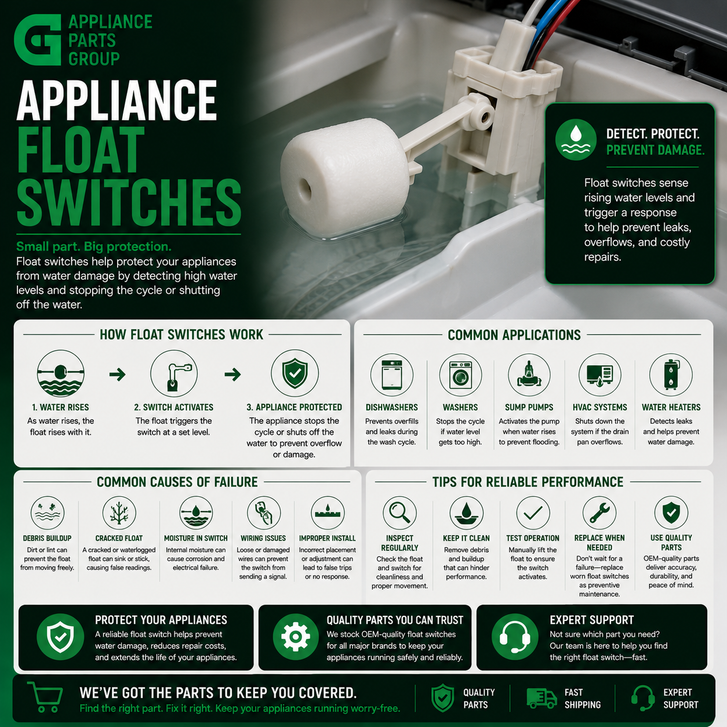
A float switch is a water-level control device. It usually works with a floating piece of plastic, foam, or another buoyant material that rises and falls with the water level. As the float moves, it activates a small electrical switch. That switch sends a signal to the appliance control system.
In many dishwashers, the float sits inside the tub near the front corner. As water enters the dishwasher, the float rises. When the water reaches the correct level, the float switch tells the water inlet valve to stop filling. This helps prevent leaks, overflow, and water damage.
In other appliances, the float switch may monitor a drain pan, condensate tray, reservoir, or sump area. The basic purpose is the same: detect water level and help the appliance respond properly.
Where Float Switches Are Commonly Used
Float switches are used in several appliance systems, including:
- Dishwashers: To prevent overfilling and control tub water level.
- Washing machines: In some designs, to help monitor water level or overflow conditions.
- Ice machines: To detect reservoir or bin water levels.
- Dehumidifiers: To shut the appliance off when the bucket is full.
- Condensate systems: To detect water in drain pans or pump reservoirs.
- Commercial appliances: To manage fill, drain, and safety shutoff functions.
Common Symptoms of a Bad Float Switch
A faulty or stuck float switch can create several appliance problems. The exact symptoms depend on the appliance type and how the switch is used.
Dishwasher Will Not Fill
If a dishwasher float is stuck in the raised position, the control system may think the dishwasher is already full of water. As a result, the water inlet valve may not open. The dishwasher may run dry, hum, or advance through the cycle without washing properly.
Dishwasher Overfills
If the float switch does not activate when the water level rises, the dishwasher may continue filling too long. This can lead to leaking around the door, water on the floor, or a cycle that shuts down unexpectedly.
Washer Overfilling
In appliances that use float or level switches for overflow protection, a failed switch can prevent the appliance from detecting excess water. This may cause the tub or pan to fill beyond its intended level.
Error Codes
Modern appliances may display error codes related to water level, overflow protection, filling time, or draining. The float switch may not always be the only possible cause, but it is often part of the diagnostic process.
Appliance Stops Mid-Cycle
If the control board receives an incorrect signal from the float switch, it may interrupt the cycle for safety. This can leave dishes dirty, clothes soaking wet, or water sitting in the appliance.
Why Float Switches Fail
Float switches can fail mechanically, electrically, or because something prevents the float from moving freely.
Food Debris and Detergent Buildup
In dishwashers, food particles, hard water minerals, soap residue, and grease can collect around the float assembly. If the float cannot move up and down freely, the switch may send the wrong signal.
Damaged or Loose Wiring
The switch depends on a good electrical connection. Loose terminals, damaged wires, corrosion, or a poor connection can make the appliance behave as if the switch has failed.
Normal Wear
Like any electrical component, the internal contacts inside a float switch can wear out over time. After years of use, the switch may no longer open or close reliably.
Water Leaks or Moisture Damage
Float switches are designed for water-level sensing, but nearby leaks, heavy moisture, or corrosion can damage terminals and connectors.
Incorrect Installation
If a replacement float, switch, bracket, or harness is not installed correctly, the float may not activate the switch at the right water level.
Step-by-Step Troubleshooting
- Disconnect power. Always unplug the appliance or turn off power at the breaker before inspecting internal components.
- Turn off the water supply. For dishwashers and washers, shut off the water supply before working around fill components.
- Locate the float assembly. In many dishwashers, the float is inside the tub near the front. The switch is usually below the tub, beneath the float stem.
- Check float movement. Lift the float gently. It should move freely up and down without sticking.
- Clean around the float. Remove debris, detergent residue, or mineral buildup that may block movement.
- Inspect the float for damage. Look for cracks, warping, missing pieces, or signs that the float no longer sits correctly.
- Inspect wiring and terminals. Look for loose connectors, corrosion, burnt marks, or broken wires.
- Listen for switch actuation. Some switches make a faint click when the float is raised and lowered.
- Test the switch if comfortable. A multimeter can be used to check continuity, but only after the appliance is disconnected from power.
- Compare with the appliance model number. Before ordering a part, use the appliance model number to confirm the correct OEM float switch.
- Replace the switch if needed. If the switch fails testing, has damaged terminals, or does not respond reliably, replacement is usually recommended.
Common Parts That May Need Replacement
When diagnosing a water-level issue, the float switch may not be the only part involved. Several related OEM parts may need inspection.
Float Switch
The float switch is the electrical component that responds to float movement. If the internal contacts fail, the appliance may not detect the correct water level.
Float Assembly
The float itself can become cracked, warped, jammed, or coated with residue. If the float does not rise and fall properly, the switch may not activate correctly.
Water Inlet Valve
If an appliance will not fill or overfills, the water inlet valve should also be considered. A stuck valve can allow too much water into the appliance even if the float switch is working.
Door Gasket or Tub Seal
In dishwashers, overfilling may cause leaks around the door. However, a worn gasket can also leak even when the water level is normal.
Control Board
The control board receives input from the float switch. Control board failure is less common than a stuck float or bad switch, but it can happen.
Wiring Harness
A damaged harness can interrupt the signal between the float switch and the control system.
Repair Options
Some float switch issues can be resolved with cleaning. If the float is stuck due to food debris, detergent residue, or mineral buildup, carefully cleaning the area may restore normal movement.
If the electrical switch has failed, replacement is usually the best repair. Float switches are generally small parts, but correct fit matters. An OEM replacement switch is designed to match the appliance model, mounting position, terminal style, and operating specifications.
Homeowners who are comfortable with basic appliance repair may be able to replace a dishwasher float switch with common hand tools. However, if there is visible wiring damage, repeated tripping, water damage, or uncertainty about the diagnosis, a qualified appliance technician may be the safer choice.
Preventative Maintenance Tips
- Scrape heavy food debris from dishes before loading the dishwasher.
- Use the correct detergent type and amount for the appliance.
- Clean the dishwasher filter regularly.
- Inspect the float area for debris if the dishwasher begins filling or draining oddly.
- Avoid forcing the float up or down.
- Address leaks quickly to prevent corrosion around electrical parts.
- Use the appliance model number when ordering replacement parts.
Frequently Asked Questions
What does an appliance float switch do?
A float switch helps detect water level. It tells the appliance control system when water has reached a certain height.
Where is the float switch in a dishwasher?
The float is usually inside the dishwasher tub near the front corner. The switch is commonly located below the tub, beneath the float stem.
Can a bad float switch stop a dishwasher from filling?
Yes. If the float switch signals that the dishwasher is already full, the appliance may not allow more water to enter.
Can a float switch cause a dishwasher to overflow?
Yes. If the switch does not activate properly, the dishwasher may continue filling too long.
Can I clean a float switch?
You can usually clean around the float and float housing. The electrical switch itself should not be soaked or cleaned aggressively.
How do I know if the float is stuck?
Lift the float gently. It should move freely and return to its normal position without binding.
Is a float switch the same as a water inlet valve?
No. The float switch senses water level. The water inlet valve controls water entering the appliance.
Should I replace the float and switch together?
It depends on the appliance design and the condition of the parts. If both are worn, damaged, or sold as an assembly, replacing both may be practical.
Can a float switch trigger an error code?
Yes. Some appliances monitor float switch signals and may display fill, overflow, or drain-related error codes.
Do washing machines use float switches?
Some washers and related systems may use float or water-level switches, although many washing machines use pressure sensors instead.
Why should I use my model number when buying a float switch?
Model numbers help identify the correct OEM part for fit, terminal style, mounting location, and appliance compatibility.
Can I keep using an appliance with a bad float switch?
It is not recommended. A faulty float switch can cause leaks, poor washing performance, or water-level problems.
Entities and Terms
- Float switch
- Float assembly
- Dishwasher float
- Water inlet valve
- Control board
- Wiring harness
- Door gasket
- Tub seal
- Overflow protection
- Continuity test
- Water level sensor
- Drain pan
This article was written by an AI program as part of a beta test by Appliance Parts Group to explore how artificial intelligence can help inform and educate our customers.
Our goal is to use AI tools to provide clear, reliable information so you can make confident, well-informed purchasing decisions.