
Key Takeaways
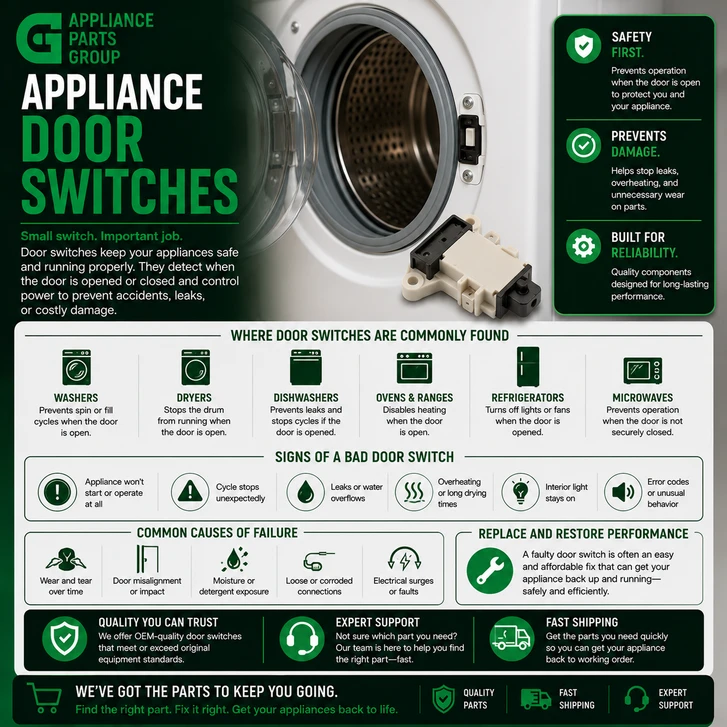
- Appliance door switches tell an appliance whether a door, lid, or access panel is safely closed before certain functions can operate.
- A failed door switch can cause symptoms such as an appliance that will not start, stops unexpectedly, leaves lights on, or displays a door-related error.
- Dryers, washers, dishwashers, refrigerators, microwaves, and other appliances may use different styles of door switches and interlock assemblies.
- Before replacing a switch, inspect the door alignment, latch, strike, wiring, and connectors because mechanical problems can imitate switch failure.
- When replacement is necessary, selecting the correct OEM appliance door switch by model number helps ensure proper fit, electrical specifications, and operation.
Introduction
An appliance door switch is a small component with an important job. Depending on the appliance, the switch may confirm that a dryer door is closed, prevent a washer from spinning with the lid open, activate refrigerator lighting, or form part of a microwave's safety interlock system.
Because door switches are activated every time an appliance is opened and closed, they can experience significant mechanical wear over the life of the appliance. A switch may eventually stop making reliable electrical contact, its actuator can become damaged, or the surrounding latch and door hardware can fall out of alignment.
The confusing part for homeowners is that a bad door switch does not always produce an obvious "door switch" symptom. A dryer may appear completely unresponsive when the Start button is pressed. A dishwasher may refuse to begin a wash cycle. A refrigerator light may remain on with the door closed. A washer may fill but refuse to spin. These problems can have several causes, but the door switch or door-locking system is often one of the components worth inspecting.
This guide explains what appliance door switches do, the symptoms associated with common failures, basic troubleshooting procedures, and how to determine when an OEM replacement switch may be appropriate.
What Is an Appliance Door Switch?
A door switch is an electrical switch activated by the position of an appliance door, lid, latch, or strike. When the door moves, a mechanical actuator on the switch changes the state of one or more electrical contacts.
Some switches are extremely simple. For example, a refrigerator door switch may turn the interior light on when the door opens and off when the door closes. Other appliances use door switches as part of a more complex control or safety circuit.
A clothes dryer typically needs confirmation that the door is closed before the motor can run. Dishwashers may use one or more latch switches to confirm that the door is secured before washing begins. Washing machines can use lid switches, lid locks, or door-lock assemblies to control agitation and high-speed spin functions.
Microwave ovens are particularly important because they commonly use multiple interlock switches rather than a single basic door switch. These switches are part of a safety system designed to ensure that the microwave operates only when the door is properly closed. Microwave high-voltage components can retain dangerous electrical energy even after the appliance is unplugged, so microwave diagnosis involving internal components should generally be left to a qualified technician.
Where Door Switches Are Commonly Used
Dryer Door Switches
Most dryers use a switch mounted near the door opening. When the door closes, a projection on the door presses the switch actuator. The dryer control system then recognizes that the door is closed.
A broken dryer door switch can prevent the dryer from starting even when the control panel appears to operate normally. On some models, opening the door while the dryer is running releases the switch and stops the drum.
Washer Lid and Door Switches
Top-load washers may use a traditional lid switch or an electronically monitored lid-lock assembly. Front-load washers normally use a door-lock assembly that combines mechanical locking components with electrical switches or sensors.
When these systems malfunction, the washer may fail to start, refuse to spin, remain locked, or display a lid or door error code.
Dishwasher Door Switches
Dishwashers commonly have switches associated with the door latch. Closing and latching the door allows the control system to confirm that the dishwasher is ready to operate.
A worn switch, damaged latch, or misaligned door can prevent a dishwasher from starting even if the electronic controls still illuminate.
Refrigerator Door Switches
Refrigerator switches are frequently associated with interior lights, but modern refrigerator designs may use door-position information for several functions. Depending on the model, the appliance may use the door status when controlling lighting, alarms, fans, displays, or dispenser functions.
A defective switch can cause the light to remain on, fail to illuminate, or produce other door-position-related symptoms.
Microwave Door Interlock Switches
Microwaves typically contain multiple switches operated by the door latch mechanism. Because the interlock system interacts with safety circuits and high-voltage components, microwave door switch service requires additional precautions beyond the troubleshooting used for many other household appliances.
Common Symptoms of a Bad Appliance Door Switch
Door switch symptoms vary by appliance design, but several warning signs occur frequently.
- The appliance will not start even though power is available.
- The appliance starts intermittently depending on how firmly the door is closed.
- A dryer stops running unexpectedly or will not respond to the Start button.
- A washer will not enter the spin cycle.
- A dishwasher control panel operates, but the wash cycle will not begin.
- An interior appliance light stays on when the door is closed.
- An interior light does not illuminate when the door is opened.
- The appliance displays a door, lid, latch, or lock error.
- The door must be pushed, lifted, or repositioned before the appliance works.
- Operation changes when pressure is applied near the latch or switch area.
These symptoms do not automatically prove that the switch itself has failed. Door hinges, latch assemblies, strikes, wiring connections, electronic controls, and other components can create very similar problems.
Why Appliance Door Switches Fail
Normal Mechanical Wear
A frequently used appliance may have its door opened and closed thousands of times. Each cycle operates the switch mechanism. Over time, internal contacts and spring-loaded mechanisms can wear.
Broken Switch Actuator
Many switches use a small plastic button, lever, or actuator. If this piece cracks or breaks, the door may no longer depress the switch far enough to change its electrical state.
Door or Latch Misalignment
A perfectly functional switch cannot operate correctly if the door no longer reaches it. Loose hinges, worn latch components, a bent strike, or improperly installed door hardware can prevent the actuator from being fully depressed.
Damaged Electrical Contacts
Electrical contacts inside a mechanical switch can wear, pit, or stop making consistent contact. This can create intermittent operation in which the appliance works sometimes but not others.
Loose or Damaged Wiring
Wiring connectors attached to the switch can loosen or become damaged. Before assuming the switch needs replacement, visually inspect accessible connections for loose terminals, damaged insulation, or signs of overheating.
Moisture and Contamination
Door switch locations can sometimes be exposed to moisture, detergent residue, lint, food debris, or other contamination. The degree of exposure depends on the type of appliance and switch location.
Step-by-Step Troubleshooting
- Disconnect power. Unplug the appliance or disconnect power at the appropriate electrical supply before removing panels or accessing internal components.
- Check the door mechanically. Open and close the door several times. Look for sagging, looseness, resistance, or an unusual gap near the latch.
- Inspect the latch and strike. A broken or misaligned latch may prevent a good switch from activating.
- Locate the switch actuator. On appliances where it is readily accessible, identify where the door contacts the switch. Check for a broken button, lever, or mounting bracket.
- Inspect the switch mounting. A loose switch can move backward when the door closes instead of being fully depressed.
- Inspect wiring and connectors. Look for disconnected terminals, damaged wiring, corrosion, or heat discoloration. Do not pull connectors by their wires.
- Check the appliance's documentation. Model-specific service information may provide expected switch states, diagnostic procedures, or error-code definitions.
- Test the switch when appropriate. A mechanical switch can often be checked for continuity with a multimeter after power has been disconnected and the switch has been isolated from the circuit. The correct terminal configuration varies by switch.
- Confirm the exact model number. If replacement is required, use the appliance's full model number to identify the correct replacement component.
- Reassemble and test safely. Reinstall covers, guards, connectors, and hardware before restoring power and checking appliance operation.
Never bypass a door switch as a permanent repair. Door switches frequently perform safety-related functions, and defeating the switch can allow the appliance to operate under conditions it was not designed to support.
How a Door Switch Can Be Tested
Many traditional appliance door switches can be evaluated with a multimeter, but the procedure depends on the switch design. A switch may have normally open contacts, normally closed contacts, or several terminals serving different circuits.
After electrical power has been disconnected and the switch isolated as required by the service procedure, a technician may measure continuity while operating the switch actuator. The reading should change according to the designed contact configuration.
A continuity test is only one part of diagnosis. A switch can test correctly on the workbench but fail to activate when installed because the door, hinge, latch, or strike does not move the actuator far enough.
Electronic door locks and sensor-based systems may require different diagnostic methods. Always follow procedures appropriate for the specific appliance model rather than assuming that every door-related component is a simple mechanical switch.
Common Parts That May Need Replacement
Door Switch
The switch itself may require replacement if its housing, actuator, or internal electrical contacts have failed. OEM replacement switches are manufactured for specific appliance applications, making proper model-number identification important.
Door Latch
A damaged latch can prevent the door from remaining in the correct position. Some appliances use a separate latch and switch, while others combine several components into one assembly.
Door Strike
The strike is the component that engages the latch when the door closes. Cracked, bent, or worn strikes can cause intermittent door-switch activation.
Washer Lid Lock or Door Lock Assembly
Modern washing machines may use an integrated locking assembly rather than a basic switch. These assemblies can contain switches, locking mechanisms, sensors, and electrical connections in one component.
Microwave Interlock Switches and Latch Components
Microwaves may use primary, secondary, and monitoring switches associated with the door latch system. Because improper servicing can create serious electrical and operational hazards, internal microwave repairs are best performed by an appropriately qualified technician.
Wiring Harness or Connector
A replacement switch will not correct a poor electrical connection elsewhere in the circuit. Damaged terminals, connectors, or harness sections may need separate repair or replacement.
When searching for a replacement part, locate the appliance model number from its identification label. Two appliances that look nearly identical from the outside can use different electrical switches, connectors, mounting locations, or revisions.
Appliance Parts Group can help homeowners and service professionals locate OEM appliance replacement parts using the equipment model and part information.
Why Model Number Matters When Ordering a Door Switch
It can be tempting to order a switch based only on appearance. Many appliance switches look similar, particularly small snap-action switches used in door and latch assemblies. Appearance alone, however, does not establish compatibility.
The correct switch may differ in terminal arrangement, current rating, actuator length, mounting configuration, connector style, contact behavior, or manufacturer revision. A part that physically resembles the original may not be designed for the same appliance circuit.
For that reason, begin your parts search with the complete appliance model number. The model label can commonly be found around a door opening, behind a drawer, inside a cabinet, beneath a lid, or on the rear of the appliance depending on the product category.
Repair or Replace the Appliance?
A failed door switch by itself does not normally mean the entire appliance needs to be replaced. Door switches, latch assemblies, and lid locks are service components on many appliances.
The larger repair decision depends on the condition of the appliance, the availability of the correct replacement component, labor requirements, and whether additional problems are present. If an otherwise functional appliance has a confirmed switch failure and the appropriate replacement part is available, replacing the failed component may restore normal operation.
For complicated safety circuits, inaccessible switches, high-voltage equipment, or situations where the diagnosis is uncertain, professional appliance service may be appropriate.
Preventative Maintenance Tips
- Close doors normally. Avoid slamming appliance doors or lids because repeated impacts can place unnecessary stress on latches, hinges, strikes, and switches.
- Keep latch areas clean. Remove lint, detergent buildup, crumbs, and other debris that can interfere with normal door movement.
- Watch for door sagging. A door that begins to drop or rub may need hinge attention before the misalignment damages other components.
- Do not force a locked washer door. If a front-load washer remains locked, follow the manufacturer's procedure rather than pulling aggressively on the handle.
- Address intermittent symptoms early. If an appliance begins operating only when the door is pushed or repositioned, inspect the door system before the condition becomes worse.
- Use the correct replacement part. Match parts using the appliance model number and the appropriate OEM part information.
Frequently Asked Questions
What does an appliance door switch do?
A door switch detects whether an appliance door or lid is open or closed. Depending on the appliance, that information may control starting, stopping, lighting, locking, spinning, alarms, fans, or safety functions.
Can a bad door switch prevent an appliance from starting?
Yes. Dryers, dishwashers, washers, and other appliances may be designed not to operate unless the control system receives the correct door-closed signal.
How do I know if my dryer door switch is bad?
Possible signs include a dryer that will not start, stops unexpectedly, or reacts differently when pressure is applied to the door. The latch, wiring, and control circuit should also be considered during diagnosis.
Can a dishwasher door switch cause the dishwasher not to start?
Yes. If the dishwasher cannot confirm that its door is properly latched, it may prevent the wash cycle from starting. A latch alignment problem can cause similar symptoms.
What happens when a washer lid switch fails?
Symptoms depend on the washer design. A washer may refuse to start, fail to spin, display a lid-related error, or stop at a particular stage of the cycle.
Why does my refrigerator light stay on when the door is closed?
A sticking or failed door switch is one possibility. Door alignment, switch positioning, wiring, and model-specific electronic controls can also affect interior lighting.
Can I bypass an appliance door switch?
A door switch should not be bypassed as a permanent repair. Many switches perform important operating or safety functions. The underlying failure should be diagnosed and the appropriate component repaired or replaced.
Can I test a door switch with a multimeter?
Many mechanical door switches can be tested for continuity after the appliance is disconnected from power and the switch is properly isolated. Terminal functions vary, so model-specific information should be used whenever available.
Are all appliance door switches the same?
No. Switches can vary in electrical ratings, contact arrangements, terminals, actuators, mounting styles, connectors, and physical dimensions. Always confirm compatibility using the appliance model number.
What is the difference between a door switch and a door lock?
A basic door switch primarily detects position. A door-lock assembly may physically lock the door while also containing switches or sensors that report its status to the appliance control system.
Should I replace the latch when replacing the door switch?
Not necessarily. The latch should be inspected for damage, wear, and alignment. Replace additional components only when diagnosis indicates that they are defective or necessary for proper operation.
How do I find the correct OEM appliance door switch?
Start with the complete model number from the appliance identification label. Use that number to locate the switch or door-lock assembly specified for the particular appliance model and revision.
Entities and Terms
- Appliance door switch
- Dryer door switch
- Washer lid switch
- Washer lid lock
- Front-load washer door lock
- Dishwasher door latch switch
- Refrigerator door switch
- Microwave interlock switch
- Door latch
- Door strike
- Switch actuator
- Wiring harness
- Electrical connector
- Continuity test
- OEM appliance replacement parts
This article was written by an AI program as part of a beta test by Appliance Parts Group to explore how artificial intelligence can help inform and educate our customers.
Our goal is to use AI tools to provide clear, reliable information so you can make confident, well-informed purchasing decisions.