
Key Takeaways
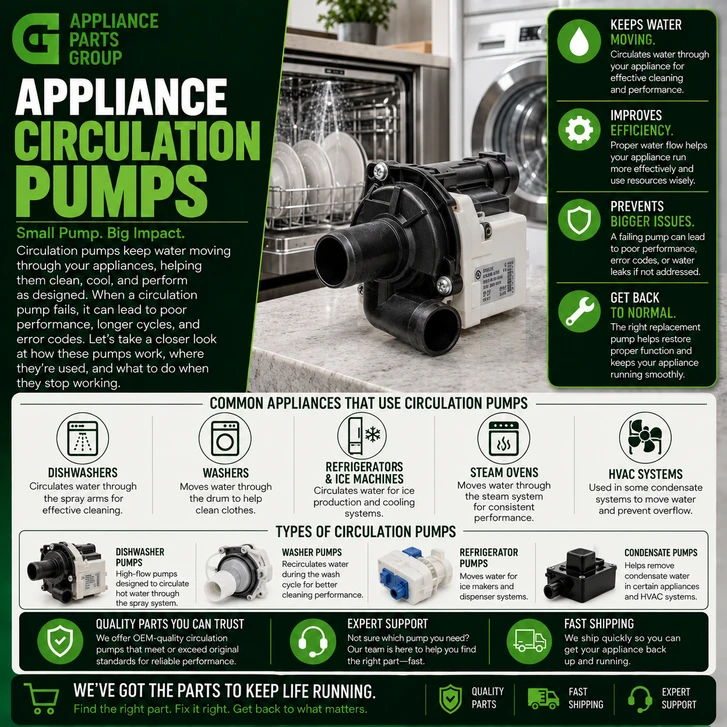
- Appliance circulation pumps move water through systems such as dishwasher spray arms, ice machine evaporator systems, and other water-circulation assemblies.
- Common signs of circulation pump trouble include poor cleaning, weak water movement, unusual humming or grinding noises, leaks, and cycles that run without producing the expected results.
- A circulation pump and a drain pump perform different jobs: the circulation pump generally recirculates water during operation, while the drain pump removes wastewater from the appliance.
- Before replacing a pump, check filters, spray arms, hoses, wiring, connectors, and the pump impeller for restrictions or damage.
- When replacement is necessary, use the appliance model number to identify the correct OEM circulation pump, pump-and-motor assembly, seals, hoses, and related components.
Introduction
When an appliance uses water, getting that water into the machine is only part of the process. In many appliances, water must continue moving after it enters. That is where the circulation pump becomes important.
A circulation pump is an electrically driven pump designed to move water through an appliance during operation. Dishwashers are one of the most familiar examples. After a dishwasher fills, its circulation pump pushes wash water through the spray system so the spray arms can clean the dishes. Some ice machines and specialized appliances also rely on circulation pumps to continuously move water through specific parts of their systems.
Because the pump usually operates out of sight, homeowners may not immediately recognize circulation pump failure. They may simply notice that dishes remain dirty, water does not appear to be moving normally, the appliance makes an unusual sound, or performance has gradually declined.
Understanding what a circulation pump does can make troubleshooting much easier and help determine whether the pump itself or another component is responsible.
What Is an Appliance Circulation Pump?
An appliance circulation pump is a motor-driven component that creates water flow within an appliance. Depending on the equipment design, the motor may rotate an impeller that draws water into the pump and forces it through hoses, channels, spray arms, or other parts of the water system.
The exact construction varies considerably between manufacturers and appliance types. Some circulation pumps are available as individual replacement components. Others are incorporated into larger pump-and-motor assemblies. Certain designs may also combine the circulation system with additional components, including heaters, housings, seals, or sump assemblies.
That is why identifying a replacement pump by appearance alone is unreliable. Two pumps may look similar while having different electrical ratings, mounting arrangements, connectors, impellers, housings, or water connections.
Where Are Circulation Pumps Used?
Circulation pumps appear in several types of residential and commercial equipment. The purpose is similar—move water where it needs to go—but the application can be very different.
Dishwasher Circulation Pumps
Dishwashers are probably the appliance most commonly associated with circulation pumps. During the wash portion of a cycle, the dishwasher fills with a controlled amount of water. The circulation pump draws water from the sump area and sends it through the dishwasher's wash system.
Depending on the dishwasher design, this water may be directed to lower, middle, or upper spray arms. The process repeats continuously during portions of the wash cycle.
If circulation becomes weak or stops entirely, the dishwasher may still fill and drain. However, the dishes can remain dirty because water is not being delivered through the spray arms with the intended flow.
Ice Machine Circulation Pumps
Some ice-making equipment also uses a circulation pump. In these systems, the pump may move water from a reservoir across an evaporator surface during ice production.
The exact process depends on the ice machine design. For example, some systems circulate water over an evaporator plate as ice forms. Proper pump operation is therefore important to consistent water distribution and ice production.
Commercial and Specialized Appliances
Circulation pumps are also found in certain commercial dishwashers, beverage equipment, specialty cleaning equipment, and other appliances that repeatedly move water through a controlled system.
For technicians and equipment owners, this makes "circulation pump" a broad component category rather than a single universal part.
Circulation Pump vs. Drain Pump: What Is the Difference?
One of the most common points of confusion when troubleshooting an appliance is the difference between a circulation pump and a drain pump.
A circulation pump generally moves water around inside the appliance while it is operating. In a dishwasher, for example, the pump sends wash water through the spray system.
A drain pump moves wastewater out of the appliance and into the household drain system.
This distinction matters because a dishwasher can have a perfectly functional drain pump while suffering from a failed circulation pump. The machine may fill, sit relatively quiet during the wash portion of the cycle, and then successfully drain the water at the end. A homeowner may initially assume that because the dishwasher drains, "the pump" must be working. In reality, the appliance may use separate pumps for circulation and draining.
Common Signs of a Failing Circulation Pump
Circulation pump symptoms vary by appliance, but several warning signs are especially common.
1. Poor Dishwasher Cleaning Performance
Dirty dishes are one of the most noticeable symptoms of inadequate dishwasher circulation. Food may remain on plates, detergent may not dissolve as expected, and items in certain racks may clean worse than others.
However, poor cleaning does not automatically prove the circulation pump has failed. Blocked spray arms, a clogged filter, incorrect loading, insufficient water, detergent issues, or other water-system problems can create similar symptoms.
2. Spray Arms Are Not Moving Normally
Dishwasher spray arms depend on water flow. If circulation is insufficient, the spray arms may not rotate correctly or may receive very little water.
Before condemning the pump, inspect the spray-arm openings for food particles, mineral buildup, labels, or other debris that can restrict water flow.
3. Humming or Buzzing
A pump motor may hum when it receives power but cannot rotate normally. A jammed impeller, internal mechanical failure, or motor problem may be responsible.
Electrical troubleshooting should only be performed by someone familiar with appliance electrical systems and appropriate safety procedures.
4. Grinding or Unusual Mechanical Noise
Debris can occasionally enter a pump or impeller area. Worn bearings or damaged internal pump components can also create unusual mechanical sounds.
Stop using the appliance if the noise is severe or accompanied by leaking, overheating, or an electrical odor.
5. Water Leaking Around the Pump
The motor itself is not always responsible for a circulation-system leak. Water can escape from a pump housing, hose, clamp, gasket, O-ring, seal, or connection near the pump.
Carefully identify the actual source before ordering replacement parts.
6. The Appliance Fills but Does Not Circulate Water
A dishwasher that fills normally but produces little or no washing action may have a circulation-system problem. If the appliance later drains correctly, the symptoms may further suggest that the problem is related to circulation rather than drainage.
Possible causes include the circulation pump, wiring, electronic controls, an obstruction, insufficient water level, or another component affecting pump operation.
Why Do Appliance Circulation Pumps Fail?
Circulation pumps work in demanding conditions. They may operate around hot water, detergent, food particles, mineral deposits, repeated temperature changes, and moisture. Over years of operation, mechanical and electrical components can wear.
Normal Motor Wear
The circulation pump motor may accumulate significant operating time over the life of an appliance. Bearings, bushings, windings, seals, and other components can eventually deteriorate.
Debris and Foreign Objects
Broken glass, food particles, labels, seeds, small pieces of plastic, and other debris can sometimes reach portions of a dishwasher's water system. Depending on the design, debris may restrict an impeller or damage pump components.
Mineral Buildup
Hard-water minerals can accumulate throughout an appliance's water system. Deposits may affect spray-arm openings, filters, hoses, and other water passages, reducing overall circulation performance.
Seal or Gasket Deterioration
Pumps often depend on seals, gaskets, and O-rings to keep water contained. A deterioration in one of these components may cause a leak even when the pump motor continues to operate.
Electrical Problems
A circulation pump requires the correct electrical supply and control signals. Damaged wiring, loose connectors, control problems, or motor winding failure can prevent operation.
Because live-voltage testing presents a shock hazard, electrical diagnosis should be left to a qualified service professional unless you have the appropriate training and equipment.
Step-by-Step Troubleshooting
- Disconnect power. Unplug the appliance when possible or switch off the appropriate circuit breaker before accessing internal components. Shut off the water supply if the repair procedure requires disconnecting water lines.
- Confirm the actual symptom. Determine whether the appliance is failing to fill, circulate, or drain. These are different functions and may involve different components.
- Inspect filters and accessible screens. Remove accumulated food, debris, or buildup according to the appliance manufacturer's cleaning instructions.
- Check dishwasher spray arms. Make sure spray-arm holes are not obstructed and that the arms can move as intended.
- Check for adequate water. A circulation pump cannot produce normal washing action if the appliance does not receive the correct amount of water. Fill problems can sometimes resemble pump problems.
- Listen during operation. A silent wash period, humming motor, intermittent operation, or grinding noise can provide useful diagnostic clues. Do not disassemble or reach into a running appliance.
- Inspect hoses and connections. With power disconnected, inspect accessible circulation hoses, pump connections, clamps, and seals for restrictions, leaks, deterioration, or loose fittings.
- Inspect the pump area. If accessible under the manufacturer's service procedure, check for evidence of leaking, debris, overheating, or physical damage.
- Inspect wiring and connectors. With power disconnected, look for loose plugs, corrosion, damaged insulation, overheated terminals, or broken wiring.
- Confirm the replacement part by model number. If diagnosis points to pump failure, use the complete appliance model number and manufacturer information to identify the correct OEM replacement component.
Some circulation pumps require substantial appliance disassembly to replace. Dishwashers may need to be disconnected and removed from the cabinet, while certain pump assemblies require removal of hoses, wiring, mounting hardware, or sump components. If the procedure exceeds your repair experience, professional service is appropriate.
Common Parts That May Need Replacement
A circulation problem does not necessarily mean that only the pump needs attention. Several related components can affect water movement.
Circulation Pump
The circulation pump is the primary component responsible for moving water through the circulation system. Depending on the appliance, the pump may be available separately or only as part of a larger assembly.
Pump and Motor Assembly
Some manufacturers supply the pump and motor as a complete assembly. This can include the motor, impeller, pump housing, and other application-specific components.
Circulation Pump Hose
Hoses carry water between the pump, sump, spray system, reservoir, or other components. A restricted, cracked, loose, or leaking hose can interfere with circulation.
Pump Seals and Gaskets
Seals and gaskets help prevent water from escaping where pump components connect. Replace seals according to the manufacturer's repair procedure whenever required during pump service.
Spray Arms
Damaged or obstructed dishwasher spray arms can mimic circulation pump symptoms by reducing water distribution.
Filter and Sump Components
Filters help keep debris from recirculating through the wash system. A severely restricted filter or sump passage can reduce flow to the circulation pump.
Electronic Controls and Wiring
The pump cannot operate correctly without proper electrical power and control. Wiring, connectors, relays, and electronic control components should be considered when appropriate during diagnosis.
Appliance Parts Group carries genuine OEM circulation-related components from multiple appliance manufacturers. Examples include dishwasher circulation pumps and pump-and-motor assemblies from Whirlpool, Bosch/Thermador/Gaggenau, Asko, Viking, Electrolux/Frigidaire, GE Appliances, and other manufacturers.
Always verify compatibility using the appliance model number before ordering. A part number found on an old pump can be useful, but appliance model information helps account for part substitutions, production changes, and model-specific configurations.
Should You Replace a Circulation Pump Yourself?
Whether circulation pump replacement is a reasonable DIY repair depends heavily on the appliance.
Some pump replacements require basic hand tools and straightforward disassembly. Others require pulling a dishwasher from the cabinet, turning or positioning the appliance for access, disconnecting electrical connectors and multiple hoses, replacing seals, and carefully reassembling the water system.
A mistake involving a seal, hose, clamp, or gasket can create a water leak. Incorrect electrical connections can create additional problems.
Before starting the repair, review the manufacturer's service information when available and consider the difficulty of accessing the pump. If diagnosis requires live electrical testing or extensive disassembly, consider using a qualified appliance technician.
How to Find the Correct OEM Circulation Pump
The most important information when shopping for a replacement circulation pump is usually the appliance's complete model number.
The model and serial tag may be located around the dishwasher door opening, on the frame, inside the appliance cabinet, or in another manufacturer-specific location.
Once you have the model number, you can determine whether your appliance requires a circulation pump, circulation pump and motor assembly, sump-and-pump assembly, integrated pump-and-heater assembly, or another configuration.
OEM parts are manufactured for specific equipment applications and provide the intended mounting points, electrical connections, dimensions, and operating characteristics for the models they support.
Do not assume that two visually similar pumps are interchangeable. Always verify the correct part for the specific appliance model.
Preventative Maintenance Tips
Circulation pumps are wear components, so no maintenance routine can guarantee that a pump will never fail. However, good appliance maintenance can reduce avoidable restrictions and help the water system operate normally.
- Clean dishwasher filters regularly. Follow the manufacturer's recommendations for removing and cleaning accessible filters.
- Inspect spray arms. Check spray openings for food debris and mineral deposits.
- Remove foreign objects. Broken glass, labels, and hard food debris should be removed from the dishwasher rather than allowed to remain near the sump.
- Use the appropriate detergent. Follow the appliance manufacturer's detergent recommendations and avoid products not intended for the appliance.
- Address leaks quickly. A small leak around a pump, hose, or seal should not be ignored.
- Investigate new noises. Grinding, buzzing, squealing, or other sudden changes in operating sound can indicate a developing mechanical problem.
- Maintain water-system components. Filters, hoses, spray arms, reservoirs, and other circulation-related components should be kept clean and inspected when performance changes.
- Use the appliance as designed. Proper loading and routine cleaning help the circulation system perform as intended.
Frequently Asked Questions
What does a circulation pump do in an appliance?
A circulation pump moves water through an appliance during operation. In a dishwasher, it typically sends wash water through the spray system. In other appliances, it may circulate water through a reservoir, evaporator, or other water circuit.
How do I know if my dishwasher circulation pump is bad?
Possible symptoms include poor cleaning, little or no spray-arm action, humming or grinding noises, and a dishwasher that fills and drains but does not wash effectively. These symptoms can have other causes, so troubleshooting should be performed before replacing the pump.
Is a circulation pump the same as a drain pump?
No. A circulation pump generally recirculates water within the appliance, while a drain pump removes wastewater from the appliance.
Can a dishwasher drain normally with a bad circulation pump?
Yes. Many dishwashers use separate circulation and drain pumps. A dishwasher may therefore drain normally even if the circulation pump is not operating.
Can a clogged filter make it seem like the circulation pump has failed?
Yes. Restricted filters, spray arms, sump passages, or hoses can reduce water flow and produce symptoms that resemble circulation pump failure.
Why is my circulation pump making a grinding noise?
Grinding can be caused by debris near the impeller, worn mechanical components, or internal pump damage. Disconnect power before inspecting accessible pump components.
Can a circulation pump leak?
Yes. Leaks may develop at the pump housing, seal, gasket, hose, clamp, or another connection around the pump assembly. Identify the exact source before ordering replacement parts.
Should I replace the circulation pump if my dishwasher is not cleaning?
Not automatically. First check filters, spray arms, water supply, loading, detergent use, hoses, and other likely causes. Pump replacement should follow proper diagnosis.
Can I replace an appliance circulation pump myself?
It depends on the appliance and your repair experience. Some replacements are relatively accessible, while others require significant disassembly, plumbing connections, electrical connections, and careful sealing.
How do I find the correct circulation pump for my appliance?
Locate the appliance's complete model number and use it to verify the correct OEM pump or pump assembly. Do not rely only on the appearance of the existing pump.
Do circulation pumps come with the motor?
Some do. Depending on the manufacturer and model, the replacement may be sold as an individual pump, pump-and-motor assembly, or a larger assembly containing additional components.
What other parts should I inspect when replacing a circulation pump?
Inspect related hoses, clamps, seals, gaskets, wiring connectors, filters, sump components, and spray arms. The exact components depend on the appliance design.
Entities and Terms
- Circulation pump
- Dishwasher circulation pump
- Pump and motor assembly
- Drain pump
- Pump impeller
- Pump housing
- Sump
- Circulation hose
- Spray arm
- Filter
- Pump seal
- Gasket
- O-ring
- Wiring harness
- Electronic control
- Ice machine circulation pump
- OEM appliance parts
This article was written by an AI program as part of a beta test by Appliance Parts Group to explore how artificial intelligence can help inform and educate our customers.
Our goal is to use AI tools to provide clear, reliable information so you can make confident, well-informed purchasing decisions.