
Key Takeaways
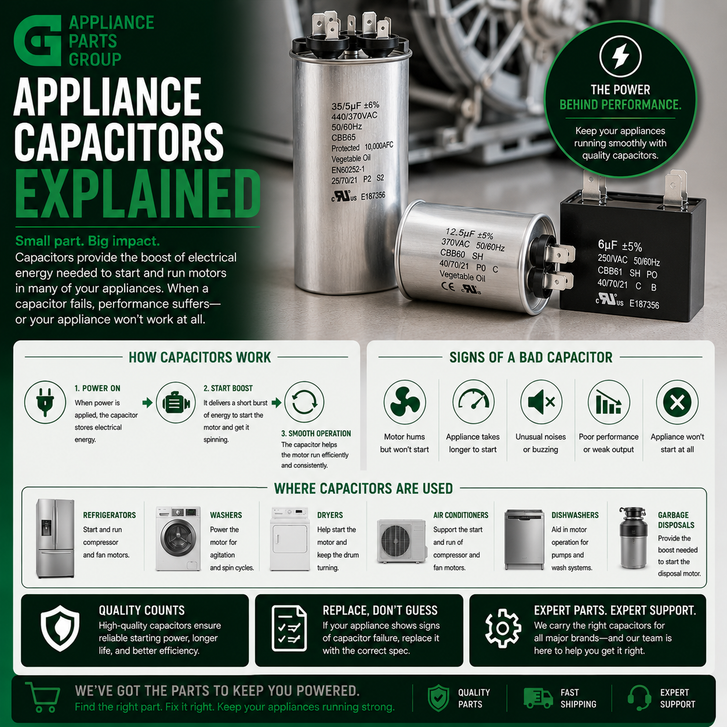
- Appliance capacitors store and release electrical energy to help motors start or run efficiently.
- Start capacitors provide a short boost, while run capacitors help motors operate smoothly.
- Common symptoms of a bad capacitor include humming, slow starting, overheating, and motors that will not run.
- Capacitors can hold an electrical charge even after an appliance is unplugged, so safety is extremely important.
- Using the correct OEM replacement capacitor helps protect the motor, control board, and other appliance components.
Introduction
Many household appliances rely on electric motors. Refrigerators use motors to run compressors and fans. Washers use motors to spin and agitate. Dryers use motors to turn the drum and move air. Dishwashers use motors to circulate and drain water. In many of these appliances, a small electrical component called a capacitor helps the motor start, run, or maintain steady operation.
Capacitors are often overlooked because they are small and usually hidden inside the appliance cabinet. However, when one fails, the appliance may stop working correctly. A refrigerator may hum but not cool. A washer may struggle to spin. A dryer motor may buzz without turning. A dishwasher pump may fail to start. Understanding what capacitors do can help homeowners recognize possible symptoms and know when an OEM replacement part may be needed.
What Is an Appliance Capacitor?
An appliance capacitor is an electrical component that stores energy and releases it when needed. In appliances, capacitors are commonly used with motors. They help create the electrical conditions needed for a motor to start or continue running efficiently.
Most appliance capacitors are cylindrical or oval-shaped components with two or more terminals. They may be mounted near a motor, compressor, blower assembly, or control area. Some are enclosed in plastic cases, while others have metal housings. The capacitor rating is usually printed on the side of the part and may include microfarads, voltage, tolerance, and temperature information.
Start Capacitors vs. Run Capacitors
There are two main capacitor types commonly found in appliances: start capacitors and run capacitors.
A start capacitor provides a short burst of electrical energy to help a motor begin turning. Once the motor reaches speed, the start capacitor is usually taken out of the circuit by a relay, switch, or electronic control. Start capacitors are common in applications where a motor needs extra torque at startup.
A run capacitor stays in the circuit while the motor operates. It helps improve motor efficiency, reduce electrical stress, and maintain smoother operation. Run capacitors are commonly used with fans, compressors, blower motors, and other continuous-duty motor applications.
Some appliances may use one capacitor, while others may use multiple capacitors or a dual capacitor. A dual capacitor combines two capacitor functions in one housing, often used where two motors or motor windings need capacitor support.
Appliances That May Use Capacitors
Capacitors may be found in several appliance categories. Refrigerators and freezers may use capacitors with compressors, condenser fans, or evaporator fans. Washers may use capacitors with drive motors. Dryers may use capacitors with motor circuits depending on the design. Dishwashers may use capacitors with circulation pumps or drain pumps. Air conditioners and HVAC-related appliances often rely heavily on start and run capacitors.
Not every appliance uses the same capacitor design. Some newer appliances use electronically controlled motors that may not use a traditional external capacitor. Others still depend on capacitors as part of a motor start or run circuit.
Common Symptoms of a Bad Appliance Capacitor
A failing capacitor can cause symptoms that look similar to a bad motor, compressor, relay, or control board. Common warning signs include a motor that hums but does not start, a motor that starts slowly, intermittent operation, overheating, clicking sounds, or a burning electrical smell.
In a refrigerator, a bad capacitor may cause the compressor to hum, click, or fail to start. In a washer, the tub may not spin properly or the motor may struggle under load. In a dishwasher, the pump may not circulate or drain water correctly. In a dryer, the motor may buzz when the start button is pressed but fail to turn the drum.
Visual signs can also help. A swollen capacitor, leaking fluid, cracked case, burned terminal, or melted wire connector may indicate failure. However, a capacitor can fail internally without visible damage.
Why Appliance Capacitors Fail
Capacitors can fail for several reasons. Heat is one of the most common causes. Appliances that operate in warm areas, have poor ventilation, or experience heavy use can place extra stress on capacitors. Electrical surges, voltage fluctuations, worn motors, and loose wiring can also shorten capacitor life.
Age is another factor. Over time, the internal materials inside a capacitor can degrade. When capacitance drops below the proper range, the motor may no longer receive the support it needs. A weak capacitor may still allow the appliance to run occasionally, but performance often becomes unreliable.
Sometimes the capacitor is not the root cause. A failing motor, restricted blower wheel, stuck pump, dirty condenser coil, or mechanical obstruction can overload the circuit and damage the capacitor. That is why it is important to inspect related parts before replacing the capacitor.
Step-by-Step Troubleshooting
- Unplug the appliance. Always disconnect power before inspecting internal components.
- Review the appliance symptoms. Note whether the motor hums, clicks, starts slowly, overheats, or fails completely.
- Locate the capacitor. Depending on the appliance, it may be near the motor, compressor, pump, or control area.
- Inspect the capacitor visually. Look for swelling, cracks, leaks, burned terminals, corrosion, or loose connectors.
- Check nearby components. Inspect wiring, relays, motor shafts, belts, pumps, fans, and other moving parts.
- Discharge the capacitor safely. Capacitors can store energy after power is removed. Use proper safety procedures or contact a technician.
- Test with a meter if qualified. A multimeter with capacitance testing can help compare the part to its rated microfarad value.
- Match the replacement carefully. Use the correct capacitance rating, voltage rating, terminal style, and appliance model compatibility.
- Install securely. Reconnect wires exactly as they were originally positioned and ensure the capacitor is mounted firmly.
- Test operation. Restore power and confirm that the appliance starts, runs, and cycles normally.
Common Parts That May Need Replacement
When a capacitor fails, the capacitor itself may be the only part that needs replacement. However, related components should also be considered. These may include the start relay, overload protector, motor, compressor, wiring harness, terminal connector, blower motor, circulation pump, drain pump, or fan motor.
For refrigerators, the start capacitor often works with the start relay and overload device. If the compressor clicks repeatedly or hums without starting, these parts should be inspected together. For washers, a motor capacitor may be part of the drive system. If the washer will not spin or agitate, the drive belt, lid switch, motor, and control board may also need attention.
For dishwashers, a pump capacitor may help the circulation or drain motor operate. If water remains in the tub or dishes are not being cleaned properly, the pump, impeller, filter, drain hose, and float switch should be checked. For dryers, symptoms that seem like capacitor failure may also involve the door switch, thermal fuse, drive motor, belt switch, or start switch.
Choosing an OEM replacement capacitor helps ensure the part matches the appliance design. Capacitor ratings matter. Installing the wrong microfarad rating or voltage rating can cause poor motor performance, overheating, or additional component damage.
Preventative Maintenance Tips
Good maintenance can reduce stress on appliance capacitors and motors. Keep refrigerator condenser coils clean so the compressor does not work harder than necessary. Make sure dryer vents are clear to prevent overheating. Avoid overloading washers, because heavy loads can strain the drive motor. Clean dishwasher filters regularly so pumps do not struggle against debris or restricted water flow.
Appliances should also have proper ventilation. Heat buildup around motors, compressors, and control areas can shorten component life. If an appliance repeatedly trips breakers, hums, smells hot, or starts inconsistently, stop using it until the issue is diagnosed.
Frequently Asked Questions
What does a capacitor do in an appliance?
A capacitor stores and releases electrical energy to help a motor start or run efficiently.
What is the difference between a start capacitor and a run capacitor?
A start capacitor gives a motor a short boost at startup. A run capacitor remains active while the motor operates.
Can a bad capacitor stop an appliance from working?
Yes. A failed capacitor can prevent a motor, compressor, fan, or pump from starting or running correctly.
What are common signs of a bad capacitor?
Common signs include humming, clicking, slow starting, overheating, intermittent operation, or a motor that will not run.
Can I replace an appliance capacitor myself?
Some experienced homeowners can replace capacitors, but capacitors can hold electrical charge. If you are unsure, contact a qualified technician.
How do I know which capacitor to buy?
Match the capacitor by appliance model number, part number, microfarad rating, voltage rating, and terminal style.
Can I use a capacitor with a different rating?
You should use the correct specified rating. The wrong capacitor can damage the motor or cause poor performance.
Why does my refrigerator click but not start?
A clicking refrigerator may have an issue with the start capacitor, start relay, overload protector, compressor, or wiring.
Can a capacitor look normal and still be bad?
Yes. Some failed capacitors show no visible damage and must be tested with the proper meter.
Do all appliances use capacitors?
No. Some appliances use traditional capacitors, while others use electronically controlled motor systems.
Should I replace related parts at the same time?
It depends on the appliance and symptoms. Relays, overloads, wiring connectors, motors, and pumps should be inspected during diagnosis.
Entities and Terms
- Start capacitor
- Run capacitor
- Dual capacitor
- Compressor
- Motor winding
- Start relay
- Overload protector
- Drive motor
- Blower motor
- Circulation pump
- Drain pump
- Condenser fan
- Evaporator fan
- Microfarad rating
- Voltage rating
This article was written by an AI program as part of a beta test by Appliance Parts Group to explore how artificial intelligence can help inform and educate our customers.
Our goal is to use AI tools to provide clear, reliable information so you can make confident, well-informed purchasing decisions.