
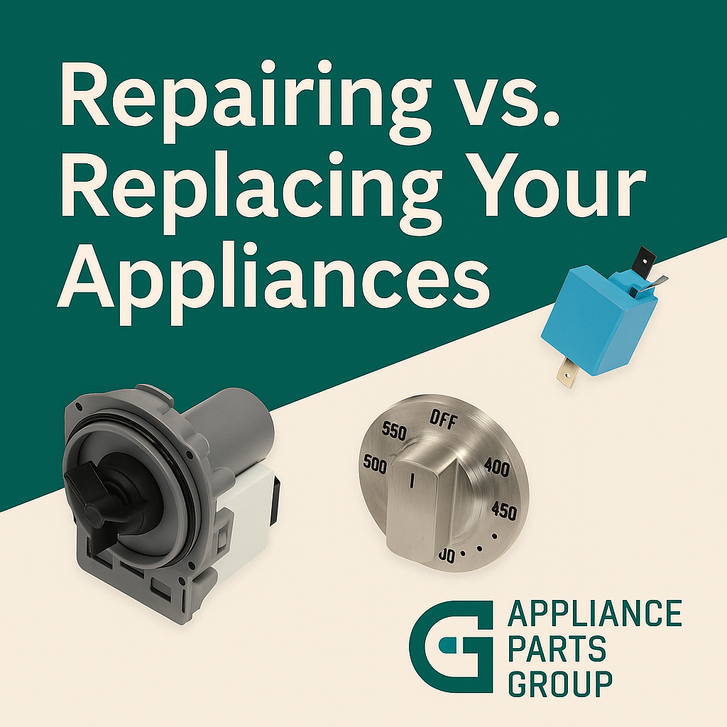
With costs rising and supply chains still uneven, replacing a major household appliance can be expensive, inconvenient, and unnecessary. In many cases, a targeted repair using genuine OEM parts restores like-new performance for a fraction of the price of a new unit. Below, we break down the financial, environmental, and practical reasons to choose repair first—plus what to look for, which parts commonly fail, and how to decide when replacement finally makes sense.
1) Repairing Usually Costs Far Less Than Replacing
Most common failures—like a worn oven igniter, a refrigerator door gasket, or a washer drain pump—can be fixed for a small percentage of the cost of a new appliance. You also avoid hidden expenses like delivery fees, haul-away charges, cabinetry adjustments, and time spent waiting for installs.
- Refrigerator: Door gaskets, thermistors, fans, and water valves are relatively low-cost fixes that restore cooling performance.
- Oven/Range: Igniters and bake/broil elements are straightforward swaps that correct slow preheats and uneven cooking.
- Washer/Dryer: Belts, pumps, rollers, and thermal fuses are common wear items that prevent bigger failures when replaced early.
Tip: If a repair quote is roughly under 50% of the replacement cost, repair is typically the better value—especially for mid/high-quality models.
2) OEM Parts Protect Performance, Fit, and Safety
OEM (Original Equipment Manufacturer) parts are engineered to your exact model specifications. That means correct fit, tested materials, and the performance standards your appliance was designed for. Using OEM helps maintain warranties and avoids the risks of mismatched tolerances like leaks, overheating, or premature wear.
3) Repairs Are Faster and More Convenient
During busy seasons, new appliance lead times can stretch from days to weeks. A repair can often be completed the same day—especially if you have local access to parts. With minimal downtime and no reconfiguration of cabinetry or utilities, the repair path keeps your home routine moving.
4) Repairing Is the Sustainable Choice
Extending the useful life of a working appliance reduces landfill waste and the environmental footprint from manufacturing new units. Small part swaps—like coils, belts, pumps, and sensors—can add years of service while improving energy efficiency when components are restored to spec.
5) Common Symptoms and the Likely Fix
- Fridge not cooling evenly: Check condenser coils, evaporator fan motor, door gaskets, or thermistor.
- Oven slow to preheat/uneven baking: Inspect igniter, bake/broil element, and temperature sensor.
- Dishwasher leaves residue: Clean filter and spray arms; inspect inlet valve and circulation pump.
- Washer won’t drain/spins poorly: Look at the drain pump, belt, or lid/door switch.
- Dryer takes too long: Clean the venting, then check the belt, rollers, and thermal fuse.
6) When a Replacement Makes Sense
There are times when replacement is the smarter call:
- Multiple major components have failed at once (e.g., control board + compressor).
- The unit is well past its expected lifespan and inefficient by today’s standards.
- You’re remodeling and need new dimensions, features, or finishes.
Even then, you can often make a low-cost repair to keep the appliance running until the new unit arrives, avoiding an emergency purchase.
7) The Repair-First Playbook (Step-by-Step)
- Document the symptom: Odd noises, error codes, longer cycles, or temperature swings.
- Check simple maintenance: Clean filters, vents, and coils; verify power and water supply.
- Look up your model number: Found on the door frame, inside the cabinet, or behind a kick plate. This ensures you order the correct OEM part.
- Replace wear items first: Belts, gaskets, valves, and sensors are fast wins that often resolve the problem.
- Escalate wisely: If symptoms persist, inspect motors, boards, and sealed systems—or contact a technician.
8) Property Managers & Landlords: Why Repair Pays
For multifamily or rental portfolios, planned repairs reduce emergency calls, improve resident satisfaction, and make budgeting predictable. Stocking a small kit of common OEM parts—gaskets, igniters, belts, rollers, valves—keeps units online and turnovers smooth.
9) Total Cost of Ownership Favors Repair
Beyond the sticker price, consider delivery, installation, haul-away, and the impact on cabinetry or vents. A properly executed repair avoids most of those costs. It also offsets the hidden cost of learning curves (new controls, new clearances) and potential feature trade-offs if you rush into a replacement that isn’t ideal for your space.
10) How to Buy OEM Parts with Confidence
- Use your full model number (and serial when available) to filter compatible parts.
- Verify part photos and specs (connectors, lengths, gaskets) before ordering.
- Choose an authorized distributor for authenticity, fast fulfillment, and support.
Quick Links to Popular OEM Categories
- Oven Igniters & Elements
- Refrigerator Gaskets & Seals
- Dishwasher Pumps & Valves
- Dryer Belts, Rollers & Fuses
- OEM Refrigerator Water Filters
This article was written by an AI program as part of a beta test by Appliance Parts Group to explore how artificial intelligence can help inform and educate our customers. Our goal is to use AI tools to provide clear, reliable information so you can make confident, well-informed purchasing decisions.