
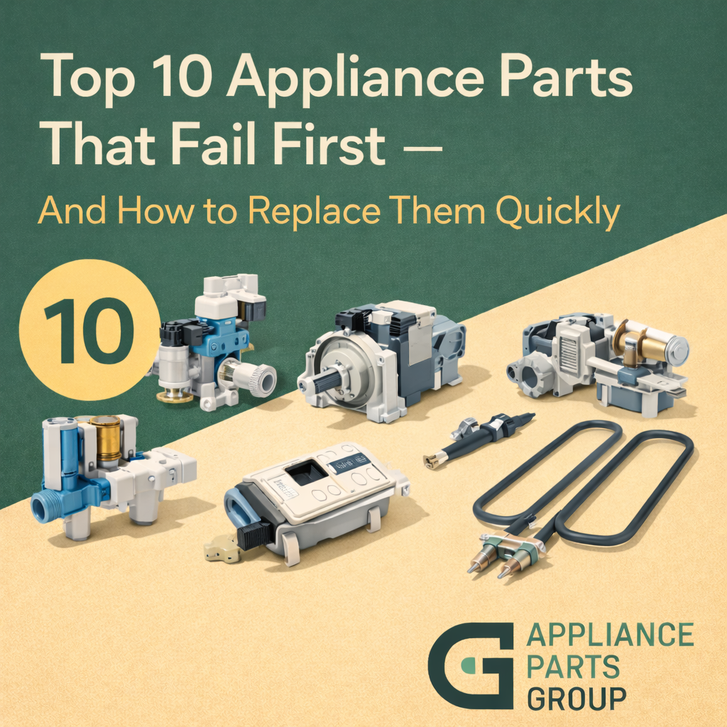
Most appliance breakdowns aren’t “mysteries.” In many cases, the same handful of wear components fail first across washers, dryers, refrigerators, dishwashers, and ovens. The good news: many of these parts are designed to be replaceable, and swapping the right genuine OEM part can restore performance fast—often without replacing the entire appliance.
Quick safety note: Always disconnect power (and shut off water or gas if applicable) before attempting any repair. If you’re unsure about any step, it’s always okay to call a qualified technician.
Below are 10 common appliance parts that often fail first—plus quick, practical tips to replace them efficiently.
1) Dryer Thermal Fuse
Common symptom: Dryer won’t start or stops mid-cycle.
Quick replacement tip: Locate the fuse on the blower housing or heater assembly. Take a photo of wire placement before removal and replace with the correct OEM fuse for your model.
2) Dryer Belt
Common symptom: Motor runs but drum doesn’t turn (or loud thumping).
Quick replacement tip: Remove the front or top panel, release belt tension at the idler pulley, and route the new belt in the same path. OEM belts help ensure correct length and tension.
3) Washer Drain Pump
Common symptom: Washer won’t drain, or water remains in the tub.
Quick replacement tip: Prepare towels and a shallow pan. Access the pump (often from the front or bottom), disconnect hoses, and install the OEM pump with clamps fully seated.
4) Washer Door Lock / Lid Switch
Common symptom: Washer won’t start or stops when trying to spin.
Quick replacement tip: These are usually fast swaps with a few screws and a wiring connector. Match the OEM lock/switch to your exact model to avoid fit and compatibility issues.
5) Refrigerator Door Gasket
Common symptom: Frost buildup, warm temps, or condensation around the door.
Quick replacement tip: Warm the new gasket (room temp or warm water) to help it seat flat. Install evenly and check for gaps using the “paper test” around the perimeter.
6) Refrigerator Evaporator Fan Motor
Common symptom: Warm refrigerator section, noisy fan, or uneven cooling.
Quick replacement tip: Unplug the unit, remove the freezer back panel, and replace the fan motor with the correct OEM version to match airflow and connector type.
7) Dishwasher Door Seal
Common symptom: Water leaks from the door area during cycles.
Quick replacement tip: Clean the channel where the seal seats. Press the new OEM seal firmly into place and verify corners are fully set.
8) Dishwasher Inlet Valve
Common symptom: Dishwasher won’t fill, fills slowly, or leaks underneath.
Quick replacement tip: Turn off water, disconnect the supply line, and replace the valve. OEM valves help ensure correct flow rate and fit.
9) Oven Bake Element
Common symptom: Oven won’t heat or heats unevenly.
Quick replacement tip: Turn off power at the breaker. Remove mounting screws, gently pull the element forward, swap wires to the new OEM element, and reinstall.
10) Gas Oven Igniter
Common symptom: Oven won’t ignite, takes a long time to light, or clicks without heating.
Quick replacement tip: Shut off gas and power. Replace the igniter carefully (avoid touching the element surface with bare fingers if applicable) and use the correct OEM igniter for your model.
How to Replace Parts Faster (Without Guessing)
If you want the quickest, smoothest repair process, focus on three things:
- Find the model number first: This ensures you’re shopping parts designed for your exact appliance version.
- Use exploded diagrams when available: They help you confirm location and part identity.
- Choose genuine OEM parts: OEM parts are engineered for fit and compatibility, which reduces the risk of returns and repeat repairs.
Get the Right OEM Part the First Time
Whether you’re tackling a quick DIY fix or working with a technician, selecting the correct replacement part is the key to getting your appliance running again quickly. When you start with the model number and choose genuine OEM parts, you can repair with confidence and keep reliable appliances in service longer.
This article was written by an AI program as part of a beta test by Appliance Parts Group to explore how artificial intelligence can help inform and educate our customers. Our goal is to use AI tools to provide clear, reliable information so you can make confident, well-informed purchasing decisions.