
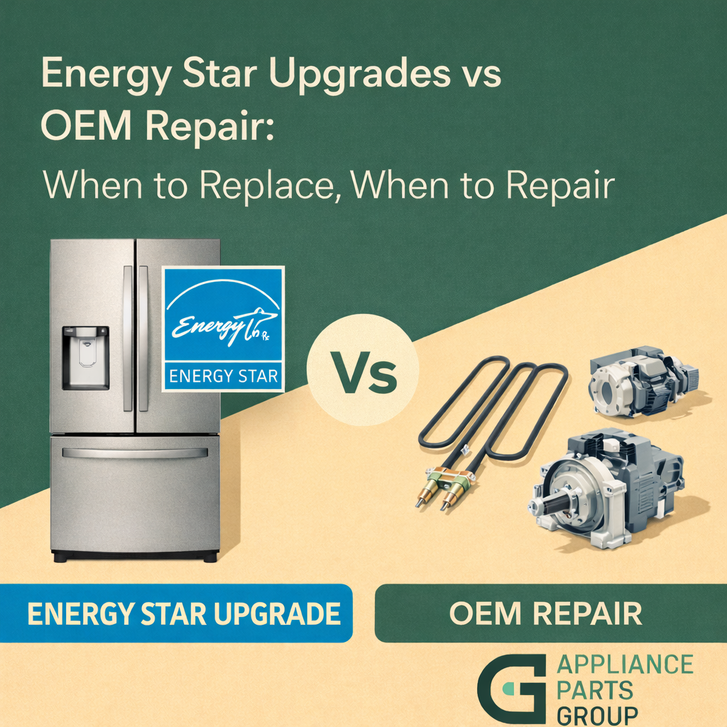
When an appliance starts acting up, homeowners often face a tough decision: should you repair what you have, or replace it with a new Energy Star® appliance that promises better efficiency? The right answer depends on more than just the age of the unit. You’ll get the best result by looking at total cost, reliability, efficiency gains, and how quickly you need the appliance back in service.
This guide breaks down a practical way to decide between an Energy Star upgrade and a repair using genuine OEM replacement parts—so you can make the choice that makes the most sense for your home and budget.
The Big Picture: What You’re Really Comparing
At a high level, the decision usually comes down to:
- Cost today (repair bill vs replacement cost)
- Cost over time (energy and water use, maintenance)
- Reliability (how likely another failure is soon)
- Time (downtime, delivery, installation)
- Performance (how well the appliance does the job)
Good rule: If the appliance is otherwise in good shape and the repair is targeted (one or two common wear components), an OEM repair is often the fastest way to restore performance with confidence.
When OEM Repair Makes the Most Sense
Repairing with OEM parts is often the best option when the appliance is structurally sound and the issue is isolated to a replaceable component. Many common breakdowns are caused by parts that are designed to wear over time.
Examples of repairs that are often worth it
- Electric ranges/ovens: bake elements, broil elements, temperature sensors, igniters (gas)
- Dryers: thermal fuses, belts, drum rollers, heating elements, igniters
- Washers: drain pumps, inlet valves, door locks, lid switches
- Dishwashers: inlet valves, door seals, drain pumps, spray arms
- Refrigerators: door gaskets, fans, defrost components, ice maker valves
OEM parts help ensure the replacement component matches the original specifications for fit, performance, and compatibility—especially important when you want the repair to last and avoid repeat issues.
When an Energy Star Upgrade Can Be the Smarter Move
Energy Star appliances are designed to meet stricter efficiency standards, which can reduce energy and water usage. Replacement is often the better choice when the appliance has multiple issues, the core system is failing, or the expected efficiency gain is meaningful for your household.
Replacement tends to make sense when:
- The appliance has recurring failures within a short timeframe
- There are multiple expensive components failing at once
- The appliance has known damage (rust, heavy corrosion, leaking tubs, cracked liners)
- You’re facing a major sealed-system repair (some refrigerator cooling system issues)
- You are intentionally upgrading for capacity, features, or efficiency
A Practical Decision Guide
Use this table as a quick way to decide which direction to lean:
| Factor | Repair with OEM Parts | Replace with Energy Star Appliance |
|---|---|---|
| Problem scope | Single part failure, clear diagnosis | Multiple issues, uncertain root cause |
| Appliance condition | Cabinet, tub, and core structure in good shape | Rust, cracks, leaks, heavy wear, or major damage |
| Time pressure | Need it running fast; parts can ship quickly | Delivery/installation timeline is acceptable |
| Budget | Lower upfront cost, targeted fix | Higher upfront cost, potential long-term savings |
| Efficiency goals | Efficiency is already acceptable | High usage household where savings add up |
Don’t Forget the “Hidden” Replacement Costs
When comparing repair vs replace, people often look only at the sticker price. But replacement can include additional costs such as:
- Delivery and haul-away fees
- Installation kits (hoses, cords, vents, fittings)
- Required adapters or electrical upgrades
- Time off work or schedule coordination
- Potential delays for out-of-stock models
In many households, a reliable OEM repair restores performance quickly and avoids disruption—especially if the appliance otherwise meets your needs.
How OEM Repair Supports Long-Term Value
If you decide to repair, using OEM parts helps protect long-term value. OEM components are designed for your specific appliance model and are intended to match the original fit and performance. That means fewer “guesswork” problems, fewer compatibility issues, and more confidence in the outcome of the repair.
Need Help Choosing the Right Path?
If you’re unsure whether repair or replacement is the best move, start by identifying your appliance’s model number and the exact symptom you’re seeing. In many cases, a single OEM part can restore performance and keep an otherwise solid appliance running for years.
This article was written by an AI program as part of a beta test by Appliance Parts Group to explore how artificial intelligence can help inform and educate our customers. Our goal is to use AI tools to provide clear, reliable information so you can make confident, well-informed purchasing decisions.